

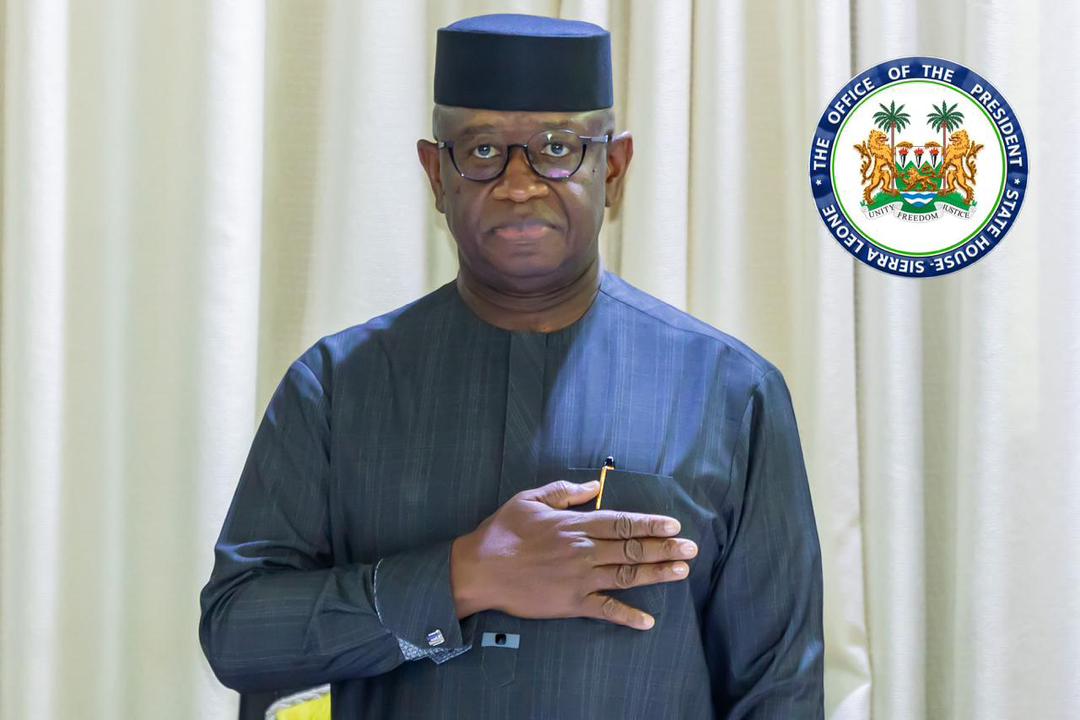
In a high-level meeting at State House in Freetown on Thursday, 12 March 2026, His Excellency President Dr. Julius Maada Bio formally received a comprehensive progress report from the Presidential Council for Delivering Feed Salone. The President used the occasion to reaffirm that the initiative remains the government’s flagship response to Sierra Leone’s historical food security challenges, positioning it as a cornerstone of national sovereignty. Since its inauguration in October 2023, the council has been charged with moving the needle on agricultural productivity, and the President was firm in his stance that the program must deliver tangible, life-changing results for every Sierra Leonean.

Addressing the council, which is comprised of specialized experts, President Bio noted that the mission is to shift the country away from the limitations of subsistence farming and toward a robust, productive sector capable of generating mass employment and driving sustainable economic growth. He highlighted visible improvements in rural livelihoods and a steady decline in malnutrition rates, attributing these successes to a culture of innovation and idea-sharing. The President maintained a confident tone regarding the nation’s natural assets, emphasizing that Sierra Leone possesses the inherent potential to produce enough food to feed its entire population without relying on external markets.
The urgency of the initiative was framed against a backdrop of global instability, with President Bio pointing out that international conflicts and geopolitical tensions continue to wreak havoc on global supply chains. He described “Feed Salone” as a critical national resilience strategy, noting that the country’s reliance on food imports has already begun to diminish due to the consistent progress made over the last three years. This shift is bolstered by a significant rise in cocoa exports, which has strengthened foreign exchange earnings. Furthermore, the President celebrated the fact that farmers now enjoy unprecedented access to high-quality seeds, thanks to the establishment of the seed laboratory at Mile 91 and the rigorous scientific contributions of the Sierra Leone Agricultural Research Institute.
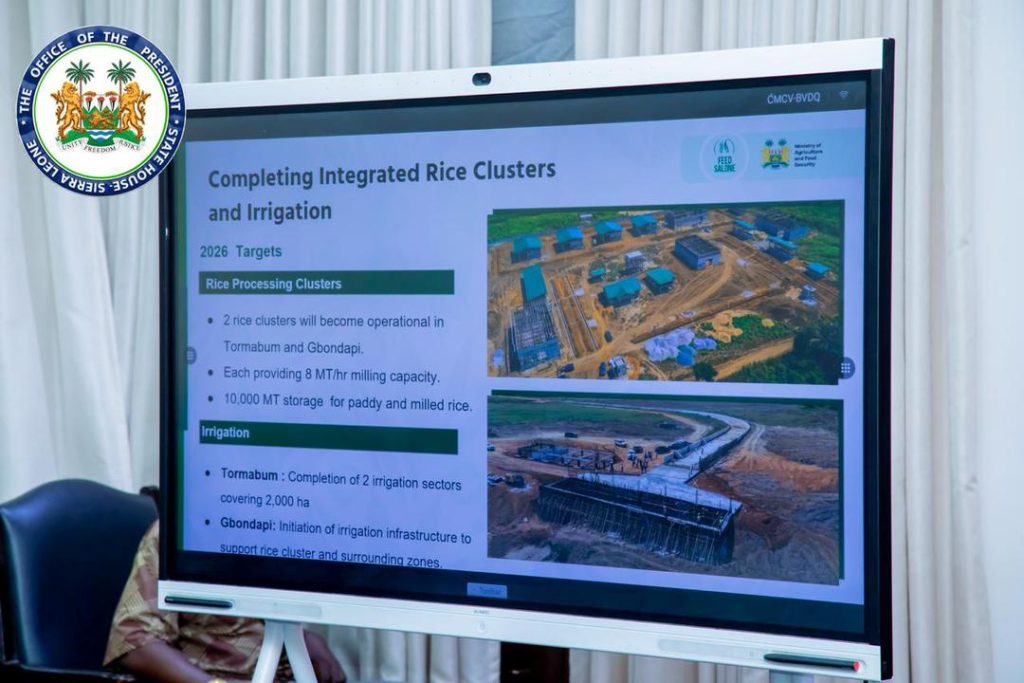
Looking toward the immediate future, President Bio declared that 2026 must be “a year of action,” calling for intensified private sector involvement, particularly in the poultry sub-sector. He urged the council to maintain a rigorous tracking system for progress, while simultaneously expanding irrigated farmlands and mobilizing fresh investment. The President shared optimistic updates on infrastructure, noting that irrigation works in Tormabum and Gbondapi are nearing completion. He expressed a firm belief that continued investment will eventually eliminate the need to import staples such as rice, onions, and fresh eggs, provided there is a continued focus on building essential infrastructure like storage facilities, feeder roads, and milling plants.
The President’s vision for the next phase of the initiative includes a heavy emphasis on value addition through the local processing of agricultural goods, powered by data-driven technology. “This Feed Salone initiative must be treated as a national priority. We are building a Sierra Leone where we can feed ourselves and improve lives,” the President stated. This sentiment was backed by hard data from the Minister of Agriculture and Food Security, Henry Musa Kpaka, who reported a dramatic drop in severe food insecurity from 28% in 2023 to just 13% in 2025. Minister Kpaka further revealed that the country has successfully avoided seed imports for three consecutive years by strengthening domestic systems.
The scale of the intervention is evidenced by the cultivation of 17,100 hectares of rice, 3,000 hectares of cocoa, and hundreds of hectares dedicated to onions and maize. As the government looks ahead to the remainder of 2026, the strategy involves the creation of two specialized rice production clusters, a dedicated Cocoa Board, and the long-awaited Agricultural Development Bank and Insurance Scheme. With the arrival of 40 new tractors to bolster mechanized farming, the administration is signaling that the transition from policy to large-scale implementation is now in full swing.
