

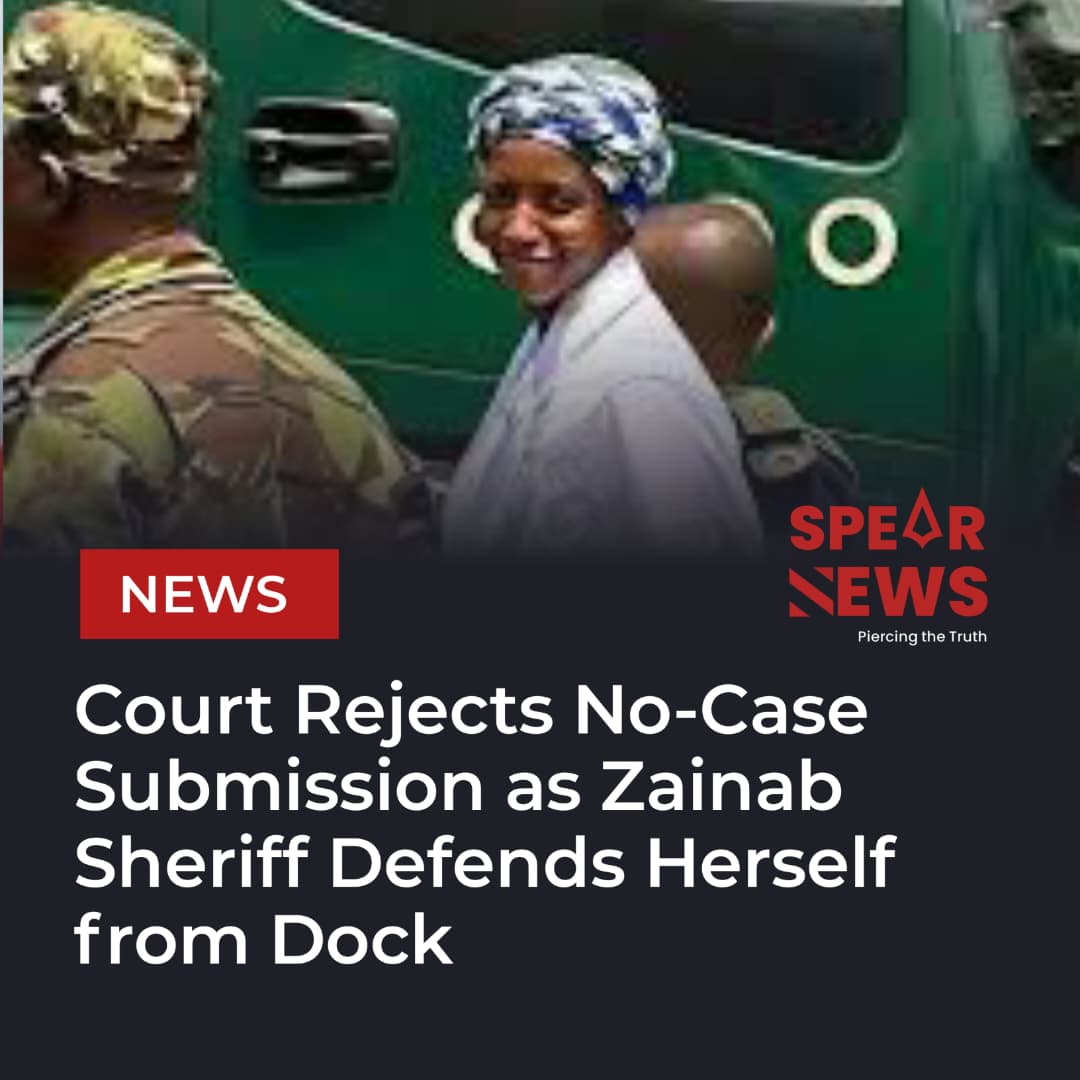
The trial of Zainab Sheriff took a decisive turn on March 31, 2026, after a Magistrate Court sitting at Pademba Road in Freetown dismissed a no-case submission filed by her defence, ruling that the prosecution had established a prima facie case and requiring her to open her defence in a matter that has rapidly evolved from a criminal proceeding into a politically charged national debate.
Delivering the ruling, Magistrate Mustapha Brima Jah held that, based on the evidence presented by the state, the defendant had a case to answer, rejecting arguments that the charges were defective in law or unsupported by credible facts. The decision marks a critical stage in proceedings that have not only drawn legal scrutiny but also triggered widespread political reactions across Sierra Leone’s sharply divided landscape.
Sheriff, a popular entertainer and a visible political voice within the opposition All People’s Congress, is facing two criminal counts relating to incitement and the use of threatening language under the Public Order Act of 1965. The charges stem from remarks she allegedly made during a major APC rally held on January 31, 2026, at the Brima Attouga Mini Stadium in Freetown, an event that formed part of a broader wave of opposition mobilisation following months of political tension in the country.
The rally itself took place against a backdrop of lingering distrust from the disputed 2023 general elections, which had already strained relations between the ruling government and opposition forces. Since then, Sierra Leone’s political environment has remained fragile, with repeated accusations of suppression, contested governance decisions, and growing agitation among opposition supporters. It was within this volatile climate that Sheriff’s comments were made—comments that the prosecution now argues crossed the line from political speech into criminal incitement.
According to the state, her words during the rally were capable of provoking public disorder, particularly a statement suggesting that those who rig elections should face severe consequences. Prosecutors contend that such language, delivered before a politically charged crowd, posed a threat to public peace and stability. Sheriff, however, has consistently denied the allegations, maintaining that her remarks were figurative and aimed at condemning electoral malpractice rather than encouraging violence.
Since her arraignment on February 23, 2026, Sheriff has remained in detention at the Female Correctional Facility in Freetown after multiple bail applications were denied. Her continued remand—now stretching over several weeks—has intensified public scrutiny, especially given that another opposition figure, Lansana Dumbuya, who faced similar charges arising from the same rally, was granted bail. The disparity has fueled allegations of selective justice and deepened political mistrust.

At the close of the prosecution’s case, which relied on testimonies from two witnesses alongside digital and forensic evidence including video footage, transcripts, and device analysis, Sheriff’s legal team, led by R.S.V. Wright, mounted a vigorous no-case submission seeking to terminate the proceedings before the defence stage.
The defence challenged the legal foundation of the charges, arguing that the count of incitement was fundamentally flawed because it failed to specify the exact offence allegedly incited. Counsel contended that for a charge of incitement to stand, it must clearly identify both the act being encouraged and the persons targeted. Similarly, the charge of threatening language was attacked for not naming any identifiable victim, which the defence argued rendered it defective.
Beyond procedural objections, the defence also sought to dismantle the prosecution’s case on its own evidence. Under cross-examination, one of the prosecution’s key witnesses—an investigating officer—admitted that after reviewing the video in question, he did not personally feel incited. Another witness acknowledged that no individual had come forward to report being threatened or influenced by Sheriff’s remarks. The defence emphasised that the case was initiated by law enforcement authorities rather than in response to any public complaint, raising questions about its origin and intent.
Counsel further argued that Sheriff’s statement, when viewed in context, amounted to political expression rather than a direct call to violence. They maintained that the remarks did not identify any individual or group and were better understood as rhetorical condemnation of electoral fraud, likening such conduct to a betrayal of democratic values rather than advocating unlawful action.
In response, State Counsel Y.I. Sesay urged the court to dismiss the no-case submission, arguing that the charges were properly framed under Sierra Leonean law and that any perceived defects were not sufficient to invalidate the case. He maintained that incitement could be directed at the public at large and did not require a specific individual to be named. The prosecution further argued that the evidence presented, including the video recordings, was sufficient to meet the legal threshold requiring the defendant to enter a defence.
In his ruling, Magistrate Jah sided with the prosecution, holding that the charges complied with statutory requirements and that the court was bound by domestic legal principles rather than foreign authorities cited by the defence. He ruled that even if there were minor defects in the charges, they were not fatal, provided the substance of the offence was clear and the defendant was not misled.
On the evidence, the Magistrate concluded that the prosecution had established a prima facie case, meaning that the material presented, if left unchallenged, could support a conviction. He therefore dismissed the no-case submission and called on Sheriff to respond.
Faced with this development, Sheriff elected to make an unsworn statement from the dock, a procedural choice that allows her to present her account without being subjected to cross-examination.
In a composed but firm statement, she described herself as a patriotic citizen committed to the democratic process, insisting that her comments at the rally were intended to discourage electoral malpractice rather than incite violence. She pointed out that no complainant had emerged to claim harm or intimidation and argued that the case rested solely on the interpretation of her words by authorities.
She reiterated that she does not support violence and maintained that her remarks were taken out of context, framing the prosecution as an overreach that risks criminalising political expression in a tense democratic environment.
Her arrest in February followed her being declared wanted by the Sierra Leone Police, after which she was apprehended in Freetown. Since then, her detention and the repeated denial of bail—reportedly on at least six occasions—have continued to attract attention from political observers, legal analysts, and civil society actors, many of whom see the case as a test of the balance between state authority and freedom of expression.
The broader implications of the trial extend beyond Sheriff’s personal circumstances, touching on fundamental questions about the limits of political speech, the application of public order laws, and the independence of the judiciary in politically sensitive cases. In a country still navigating post-election tensions and calls for reform, the outcome of the case is likely to resonate far beyond the courtroom.
The matter has been adjourned to April 7, 2026, for continuation of the defence, with Sheriff remaining in custody as proceedings continue.