

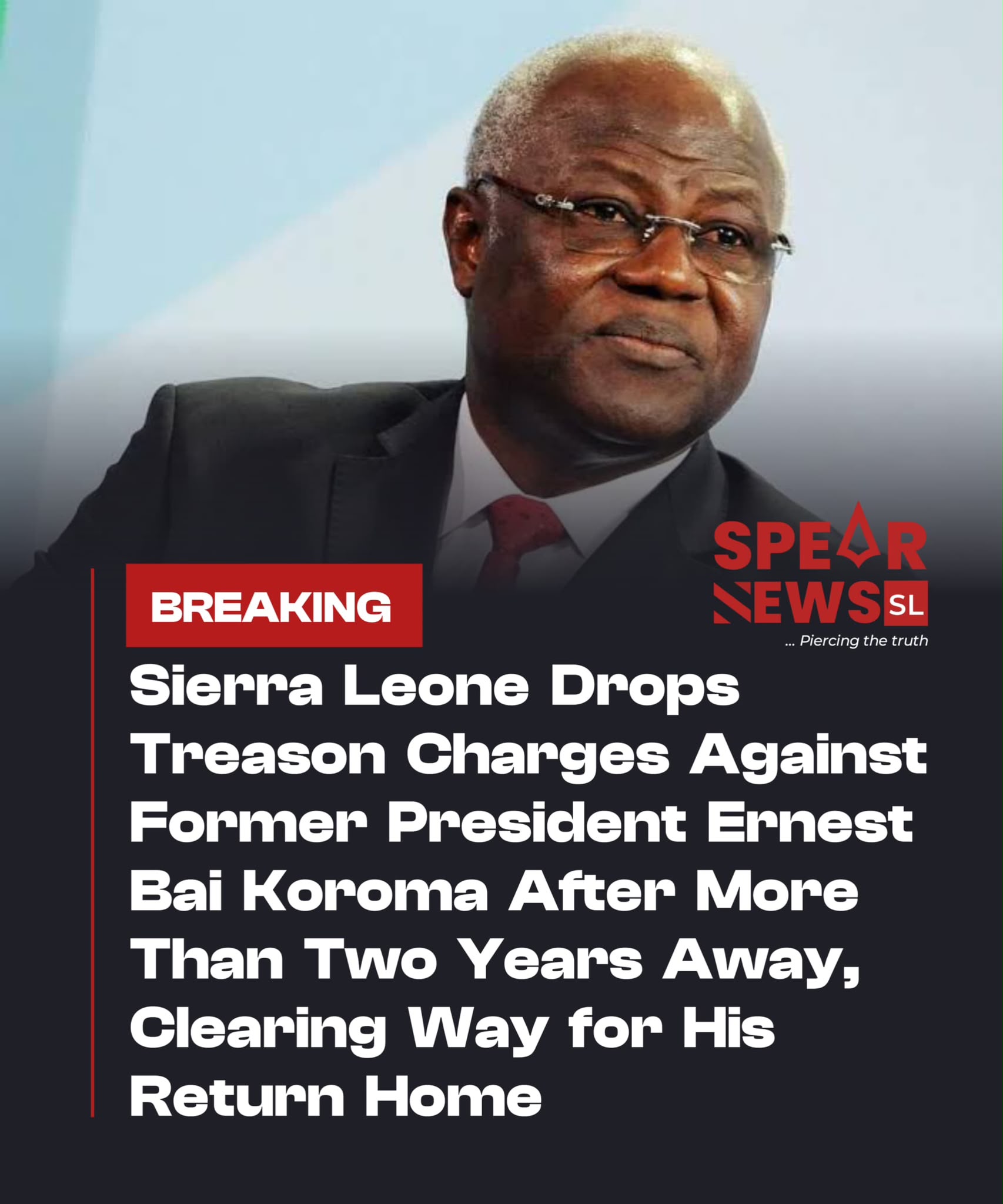
In one of the most significant political and legal developments in Sierra Leone’s recent democratic history, the Government of Sierra Leone has formally discontinued all criminal proceedings against former President Dr. Ernest Bai Koroma, bringing to an end a case that has dominated the country’s political landscape since the aftermath of the failed November 26, 2023 security crisis.
The announcement was made on Tuesday through an official public notice issued by the Office of the Attorney-General and Minister of Justice, confirming that the Attorney-General has exercised the powers vested in the office under Section 45 of the Criminal Procedure Act, 2024, to discontinue the prosecution against the former Head of State with immediate effect.
The notice stated that the criminal proceedings against Koroma are no longer before the courts, effectively terminating the case and automatically bringing to an end the bail conditions that had previously governed his movements. The government further confirmed that the former President is now free to return to Sierra Leone upon the completion of his medical treatment or at any time of his choosing.
The decision closes one of the most politically sensitive legal battles in Sierra Leone since the end of the country’s civil war and marks a significant turning point in national reconciliation efforts following years of heightened political tension between the ruling Sierra Leone People’s Party (SLPP) government of President Julius Maada Bio and the opposition All People’s Congress (APC).
Koroma, who served as Sierra Leone’s fourth President from September 2007 until April 2018 after defeating the SLPP in the 2007 presidential election and securing a second term in 2012, had consistently denied any involvement in the events surrounding the failed attacks of November 26, 2023. During that incident, heavily armed men launched coordinated assaults on military barracks, correctional facilities, prisons and other strategic installations across Freetown. More than 2,000 inmates were freed from prison during the attacks, while members of the security forces and civilians lost their lives. The government subsequently described the violence as an attempted coup aimed at overthrowing President Bio’s administration.

In the weeks that followed, investigations led security agencies to question several serving and former military officers, police personnel and individuals believed to have connections with the attacks. On January 3, 2024, the former President was formally charged with treason, misprision of treason and two counts of harbouring persons accused of participating in the attempted overthrow of the government. Prosecutors alleged that some members of his former presidential security detail had played key roles in the attacks and argued that evidence connected him to the conspiracy. Koroma firmly rejected the allegations, insisting that he neither planned nor supported any attempt to destabilize Sierra Leone’s constitutional order.
The filing of treason charges against a former democratically elected President was unprecedented in Sierra Leone’s post-war democratic history and immediately attracted international attention. Political observers warned that the prosecution had the potential to deepen divisions in a country still healing from the scars of civil conflict and recovering from months of political disagreement following the disputed June 2023 general elections. Regional leaders, ECOWAS, the African Union, the United Nations and other international partners closely monitored developments as calls intensified for dialogue, restraint and national reconciliation.
Initially placed under strict bail conditions that effectively confined him to his residence in Freetown, Koroma later sought permission from the High Court to travel abroad for medical treatment. In January 2024, the court granted his request, allowing him to leave Sierra Leone for Nigeria on medical grounds while remaining subject to the ongoing proceedings. What was expected to be a temporary medical trip gradually turned into a prolonged stay outside the country as the legal process continued and the former President remained abroad.
By the time Tuesday’s announcement was made, Koroma had spent more than two years outside Sierra Leone, making it the longest continuous period he has remained away from the country since assuming public office decades ago. Throughout that period, his possible return remained one of Sierra Leone’s biggest political talking points, with supporters insisting that the charges were politically motivated and critics maintaining that the judicial process should be allowed to run its course.
Tuesday’s decision effectively brings that chapter to a close.
According to the Attorney-General’s notice, the discontinuance of the proceedings means there is no longer an active criminal case before the courts. Consequently, the bail conditions imposed on the former President immediately lapse, restoring his freedom to travel and return home without judicial restrictions.
For supporters of the APC, the announcement is expected to be welcomed as a major political victory and a vindication of their long-held position that the charges should never have been brought. For the government, the decision is likely to be viewed as part of broader efforts aimed at promoting national unity, reducing political tensions and strengthening reconciliation at a time when Sierra Leone continues to confront significant economic and governance challenges.
Ernest Bai Koroma remains one of the most influential political figures in Sierra Leone’s modern history. Before entering politics, he built a successful career in the insurance industry, eventually becoming Managing Director of Reliance Insurance Trust Corporation. He emerged as leader of the APC in 2002, rebuilt the party after years in opposition and led it to victory in the landmark 2007 elections before securing another nationwide mandate in 2012.
His presidency was marked by major investments in road infrastructure, electricity generation, education and post-war reconstruction. His administration also led the country through one of the darkest periods in its history during the 2014–2016 Ebola epidemic, an unprecedented public health crisis that claimed thousands of lives and severely impacted Sierra Leone’s economy. While many praised his administration for infrastructure development and international engagement, it also faced criticism over allegations of corruption, governance challenges and economic management.
Even after leaving office in 2018, Koroma remained the APC’s most influential political figure, with his endorsement continuing to shape the direction of the party. His prosecution therefore carried implications far beyond the courtroom, becoming one of the defining political issues of the Bio administration and a symbol of the deep divisions that have characterised Sierra Leone’s political landscape in recent years.
With the charges now officially withdrawn, attention shifts to whether the former President will immediately return to Sierra Leone or complete his medical treatment before making the journey home. His eventual return is expected to attract nationwide attention and could become one of the defining political moments of 2026.
The discontinuance of the case represents more than the end of a criminal prosecution. It closes one of the most contentious legal and political episodes in Sierra Leone’s democratic history and opens what many hope will be a new chapter of political dialogue, reconciliation and national unity in a country that continues to strive for lasting peace and democratic stability.