

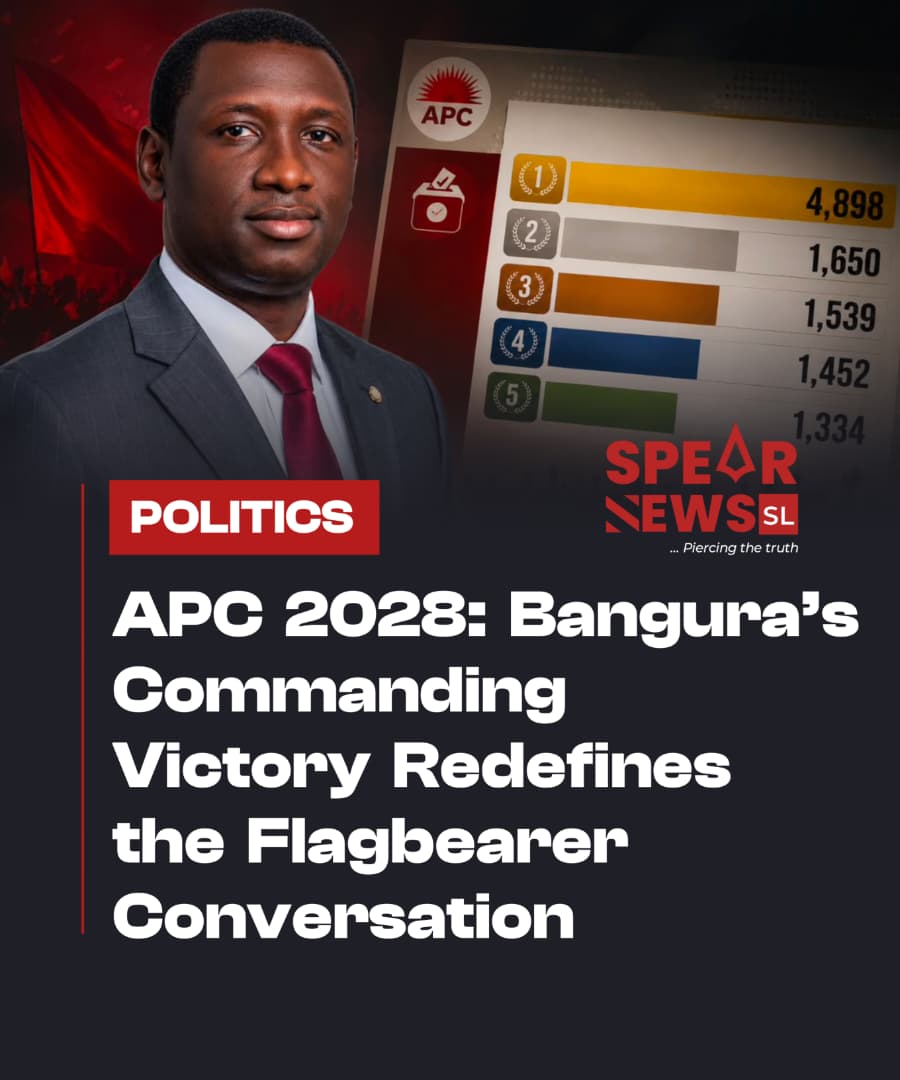

Dr. Ibrahim Bangura has emerged as the dominant figure in an independent opinion poll conducted to gauge sentiment around the All People’s Congress (APC) flagbearer race ahead of the 2028 general elections, securing 4,898 votes out of 12,276 cast and finishing with a commanding 3,248-vote advantage over his nearest challenger.
The final results, released after the poll closed, place Bangura at the top of a field of 11 aspirants, with 39.9 per cent of the total votes recorded.
The result marks the strongest showing by any candidate throughout the two-week exercise and gives Bangura a significant numerical lead over the rest of the field, placing his candidacy at the centre of an increasingly consequential conversation about who could lead the APC into the 2028 presidential contest.
Ady Macauley Esq. finished second with 1,650 votes, representing 13.4 per cent of the total. Chief Alhaji Samuel Sam-Sumana followed in third position with 1,539 votes, or 12.5 per cent, while Sheikh Alhaji Mohamed O. Kamara secured fourth place with 1,452 votes, representing 11.8 per cent.
Bai Mahmoud Bangura completed the top five with 1,334 votes, or 10.9 per cent.

Together, the five leading candidates accounted for 10,873 votes, representing 88.6 per cent of the total votes cast.
But the headline figure remains Bangura’s performance.
With 4,898 votes, he accumulated more votes than any other candidate and established a margin of 3,248 votes over Macauley, the candidate who finished second.
The final result represents a remarkable separation at the top of a contest that, during its early stages, appeared considerably less predictable.
The poll began with the organisers presenting it as an independent exercise intended to gauge sentiment among APC members, supporters and the wider public. Participants were invited to vote anonymously on the question of who they believed could give the APC the best chance of winning the 2028 general elections.
From the outset, however, the organisers made clear that the exercise was not an official APC poll and would not determine the party’s eventual flagbearer.
What followed was a two-week digital contest in which the leaderboard repeatedly shifted.
In the early days, Kambia emerged as a notable force in the voting pattern. After more than 1,000 votes had been recorded, the organisers reported that the race was beginning to take shape, while warning that the standings remained fluid.
The following day, the contest became even more volatile.
With more than 2,600 votes recorded, the organisers said the leaderboard had changed hands twice within 10 hours, with the leading candidates separated by fewer than a dozen votes at that stage. Kambia continued to attract attention, but the message from the early figures was clear: no candidate could afford to assume that an early advantage would survive the full voting period.
By August 4, the dynamics had begun to change.
One candidate had crossed the 2,000-vote threshold, while the top two had collectively attracted nearly 3,500 votes. At the same time, the third-placed candidate was closing in on 1,000 votes, prompting the organisers to ask whether the contest could become a three-horse race.
A day later, the gap between first and second had widened to more than 1,000 votes.
Even then, however, the contest was far from settled. The organisers continued to highlight the possibility of further movement, particularly among the candidates fighting for positions further down the leaderboard.
Then came Kono.
An overnight surge pushed Kono’s candidate into fourth position, producing one of the most significant reshuffles of the poll to that point. The development reinforced the impression that geographical mobilisation could have a major impact on the online standings.
By August 7, the organisers were pointing to Kambia, Kono and Kenema as three locations whose movements had become increasingly difficult to ignore.
Kambia had set the early pace. Kono had produced a dramatic late surge. Kenema, meanwhile, was beginning to attract attention because of the support appearing to emerge from a district widely associated with the governing side.
The organisers described the developments as a potentially significant political signal, although the poll itself could not establish whether those online voting patterns would translate into support within the APC’s formal structures.
Port Loko later provided another twist.
On August 11, the organisers announced that Port Loko had surged into second place as total participation crossed 11,000 votes. For the first time, every candidate in the top five had passed the 1,000-vote mark.
The final figures have now brought that rapidly changing contest to a close.
And while the battle for the positions immediately behind the leader remained extremely tight, Bangura had created a level of separation that no other candidate was able to match.
His 4,898 votes represent almost 40 per cent of the entire vote.
Macauley’s 1,650 votes, by comparison, account for 13.4 per cent.
Sam-Sumana’s 1,539 votes represent 12.5 per cent, Mohamed O. Kamara’s 1,452 account for 11.8 per cent, while Bai Mahmoud Bangura’s 1,334 represent 10.9 per cent.
The final table therefore presents a striking contrast: one candidate substantially ahead, followed by a cluster of four candidates separated by relatively narrow margins.
For Bangura, the significance of the result lies not only in finishing first but in the scale of the advantage.
The 3,248-vote margin between him and the runner-up is almost twice the number of votes obtained by Macauley himself.
It also means that Bangura individually attracted approximately 45 per cent of all votes received by the five leading candidates combined.
The concentration of support around the top five is another notable feature of the final result.
With 10,873 votes between them, the five leading candidates captured 88.6 per cent of the entire vote, leaving the remaining six aspirants collectively sharing the balance.
That figure illustrates the extent to which the poll became concentrated around a small group of candidates as voting progressed.
Yet the political meaning of the result requires an important qualification.
This was not an official APC selection exercise.
The organisers repeatedly described it as an independent WhatsApp opinion poll intended to gauge sentiment and stimulate conversation. The final results graphic likewise states that the exercise was not an official APC poll and should not be interpreted as a predictor of the party’s eventual flagbearer or the outcome of an election.
That distinction does not erase the significance of the participation, but it defines what can responsibly be inferred from the figures.
The poll provides a snapshot of online sentiment among those who participated. It demonstrates the ability of candidates and their supporters to mobilise votes within a digital environment, and it offers an indication of which names are generating substantial attention among participants.
It does not, however, replace the APC’s formal process for selecting its presidential candidate.
The eventual flagbearer will have to emerge through the party’s established mechanisms.
Still, the political conversation has changed.
Before the poll began, the field was characterised by uncertainty and a long list of aspirants. During the voting period, the leaderboard moved repeatedly, with different candidates and geographical constituencies generating bursts of momentum.
By the time the poll closed, however, Bangura had transformed that uncertainty into a commanding numerical advantage.
His 39.9 per cent share of the vote is the clearest indication from the exercise that his candidacy has generated significant online support among participants.
The result also places his name firmly in the wider conversation about the APC’s strategy for 2028.
The question before the party is ultimately much larger than who can win an online poll.
The APC will have to consider which candidate can unite its various constituencies, build a broad national coalition and present the strongest possible challenge at the general election.
The final poll cannot answer those questions on its own.
But it does provide a political snapshot at a moment when the 2028 conversation is beginning to gather momentum.
And that snapshot is unmistakable.
Dr. Ibrahim Bangura finished the exercise at the summit, with 4,898 votes, 39.9 per cent of the total and a 3,248-vote margin over his closest challenger.
The poll has now closed.
The formal APC flagbearer contest has not.
But after two weeks of shifting fortunes, geographical mobilisation and intense online participation, Bangura leaves this particular contest with the strongest numerical statement of the field.
For a candidate seeking to position himself at the centre of the APC’s 2028 presidential conversation, that is a result that will be difficult to overlook.