

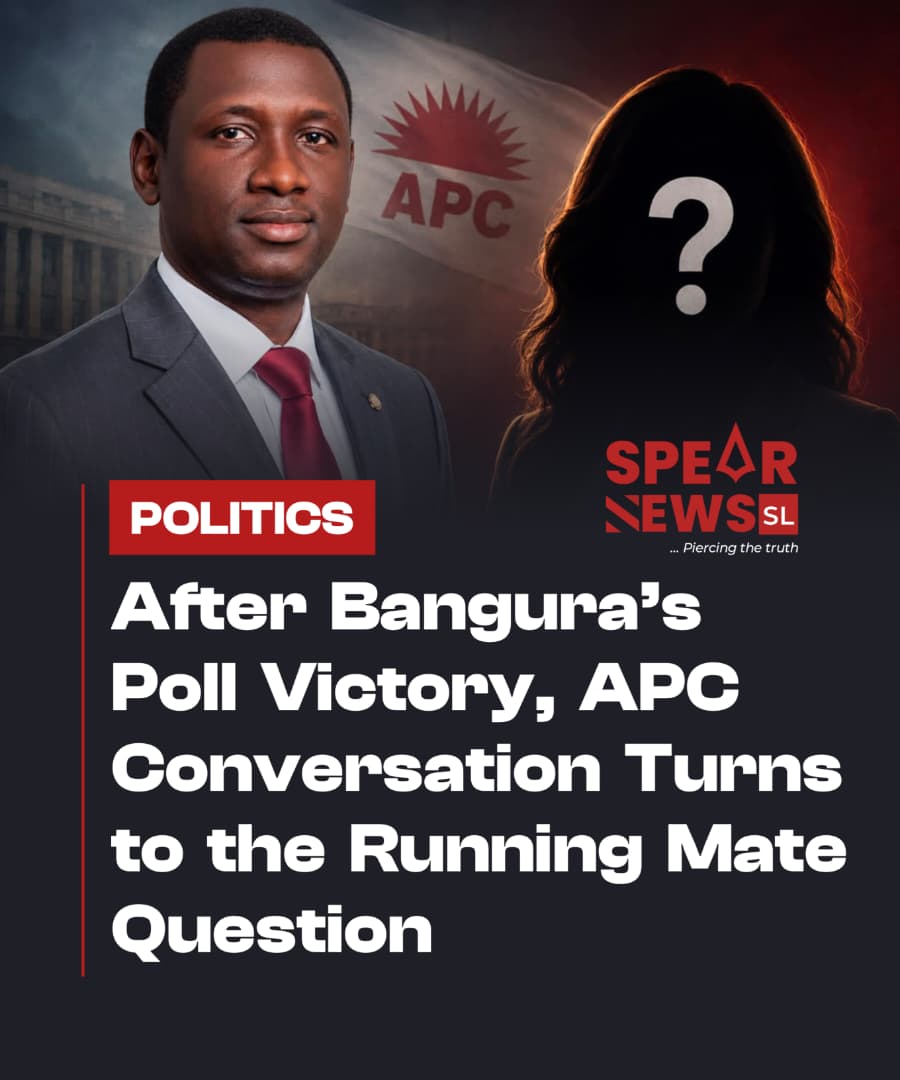
Barely after Dr. Ibrahim Bangura emerged at the top of an independent opinion poll tracking the All People’s Congress (APC) flagbearer race, a new question is beginning to shape the political conversation: who should stand beside him if his candidacy ultimately advances to the 2028 presidential contest?
That question has now surfaced directly on the APC Repositioning Collective’s WhatsApp channel, where a new poll asks participants what should matter most when the party eventually chooses its running mate.
The choices presented are striking.
Participants are being asked to choose between gender, religion, region, experience and electability, effectively opening a broader discussion about what kind of political balance the APC may need on a presidential ticket heading into 2028.
The timing is particularly notable.

It comes immediately after the channel’s independent APC flagbearer opinion poll closed with Bangura recording a commanding 4,898 votes, representing 39.9 per cent of the 12,276 votes cast.
Bangura finished 3,248 votes ahead of the second-placed candidate, Ady Macauley Esq., whose 1,650 votes represented 13.4 per cent of the total.
The poll was not an official APC selection exercise and does not determine the party’s eventual flagbearer. The organisers themselves repeatedly stated that it was an independent WhatsApp opinion poll designed to gauge sentiment and stimulate conversation.
But the result has nevertheless created a new context for the conversation now unfolding around the running mate.
The new poll begins with a premise that goes beyond simply choosing a deputy.
It states that a Vice President must be ready to assume the presidency at short notice, while a running mate must also contribute to winning the election.
From there, participants are asked what should matter most in selecting the APC’s running mate.
The five options are gender, religion, region, experience and electability.
As of the screenshot reviewed by Spear News, the gender option had been selected, while the other four options had recorded no votes at the time the image was captured.
That early snapshot should not be treated as a final result. But the question itself is politically significant because it introduces the possibility that the APC’s eventual ticket could be judged not only by the strength of its presidential candidate, but also by how effectively the running mate complements that candidate.
And that is where the discussion becomes particularly interesting.
If Bangura’s performance in the recently concluded opinion poll is viewed as an indication of the strength of his online support, the next question naturally becomes one of ticket construction.
What kind of running mate could broaden the appeal of a Bangura-led ticket?
Would the party prioritise gender?
Would it consider religious balance?
Would regional considerations take precedence?
Would political and governance experience be the decisive factor?
Or would the party ultimately favour the person considered most capable of expanding the ticket’s electoral reach?
The new poll places all five questions on the table.
A Woman at Number Two?
Perhaps the most consequential question is the one concerning gender.
Sierra Leone has never had a woman serve as Vice President.
Since the vice-presidency was established, the office has been occupied by men, including APC figures such as Samuel Sam-Sumana and Victor Bockarie Foh, as well as the current Vice President, Mohamed Juldeh Jalloh of the Sierra Leone People’s Party. (Wikipedia)
Women, however, have previously sought the position as running mates.
In 2012, Kadi Sesay became the running mate to then opposition presidential candidate Julius Maada Bio and sought to become Sierra Leone’s first female Vice President. (Voice of America)
In 2018, Isata Dora Bangura also became a vice-presidential candidate, running alongside Charles Margai of the People’s Movement for Democratic Change. She was described as the second woman to run for the vice-presidency in Sierra Leone’s history. (Wikipedia)
The distinction is important.
Sierra Leone has had women contesting for the vice-presidency.
It has never had a woman actually occupy the office.
That historical reality gives the gender question a significance beyond political arithmetic.
If the APC eventually fields a male presidential candidate, the decision to select a woman as running mate could be presented as more than a balancing exercise. It could become a statement about representation, political inclusion and the country’s willingness to break another barrier in its executive history.
But that would still be a political decision for the APC, not something determined by the current WhatsApp poll.
Beyond Gender
Religion presents another possible consideration.
The new poll explicitly asks whether the APC should continue the practice of a Muslim/Christian ticket.
That question is particularly relevant in Sierra Leone, where religious coexistence has historically formed an important part of the country’s social fabric.
However, religious balance alone would not necessarily determine electoral success.
A running mate must also be capable of strengthening the ticket politically, communicating effectively with voters, contributing to governance and helping build the broad coalition required to compete nationally.
That is why the poll’s other options, region, experience and electability, are equally important.
A running mate from a different geographical base could potentially expand the ticket’s footprint.
A candidate with substantial governance experience could provide institutional depth.
And a politically popular running mate could strengthen the ticket’s ability to mobilise voters.
The central question is therefore not simply who balances Bangura?
It is who complements Bangura most effectively?
That distinction could become increasingly important as the APC’s 2028 conversation develops.
From Flagbearer to Ticket
The significance of the new poll ultimately lies in the sequence.
First came the question of who should lead the APC into 2028.
The independent poll produced a clear answer among its participants: Bangura finished first with 4,898 votes.
Now the conversation has moved one step further.
If a candidate has emerged strongly from an opinion exercise, what kind of running mate would give that candidate the strongest possible national ticket?
The answer will depend on far more than a WhatsApp poll.
The APC’s eventual presidential ticket will have to navigate party structures, internal alliances, regional considerations, religious sensitivities, gender representation, electoral mathematics and the broader national political environment.
But the new poll has nevertheless opened a conversation that could become increasingly important.
It asks whether the APC should approach the running-mate question primarily as a matter of balance or as a matter of electoral strategy.
And perhaps the most intriguing possibility is that the two may not be mutually exclusive.
A woman could bring gender representation.
A Christian could provide religious balance.
A candidate from another region could expand geographical reach.
An experienced politician could strengthen the governance credentials of the ticket.
And an individually popular figure could contribute directly to electoral mobilisation.
The challenge would be finding a candidate capable of bringing several of those qualities together.
For now, the poll is only asking the question.
But after Bangura’s commanding performance in the flagbearer opinion poll, the conversation has clearly moved beyond who leads.
It is beginning to ask what the ticket should look like.
And with Sierra Leone yet to see a woman occupy the Vice Presidency, the gender question carries a historical dimension that could make the eventual choice particularly consequential.
The APC has not selected its 2028 flagbearer.
It has not selected a running mate.
And the WhatsApp polls do not determine either decision.
But the questions now being put before the party’s supporters offer an early glimpse into the political calculations that could shape one of the country’s most closely watched presidential contests.
For a party looking towards 2028, the next chapter may not simply be about choosing a leader.
It may be about building a ticket that can convince Sierra Leoneans that the future can look different from the past.