

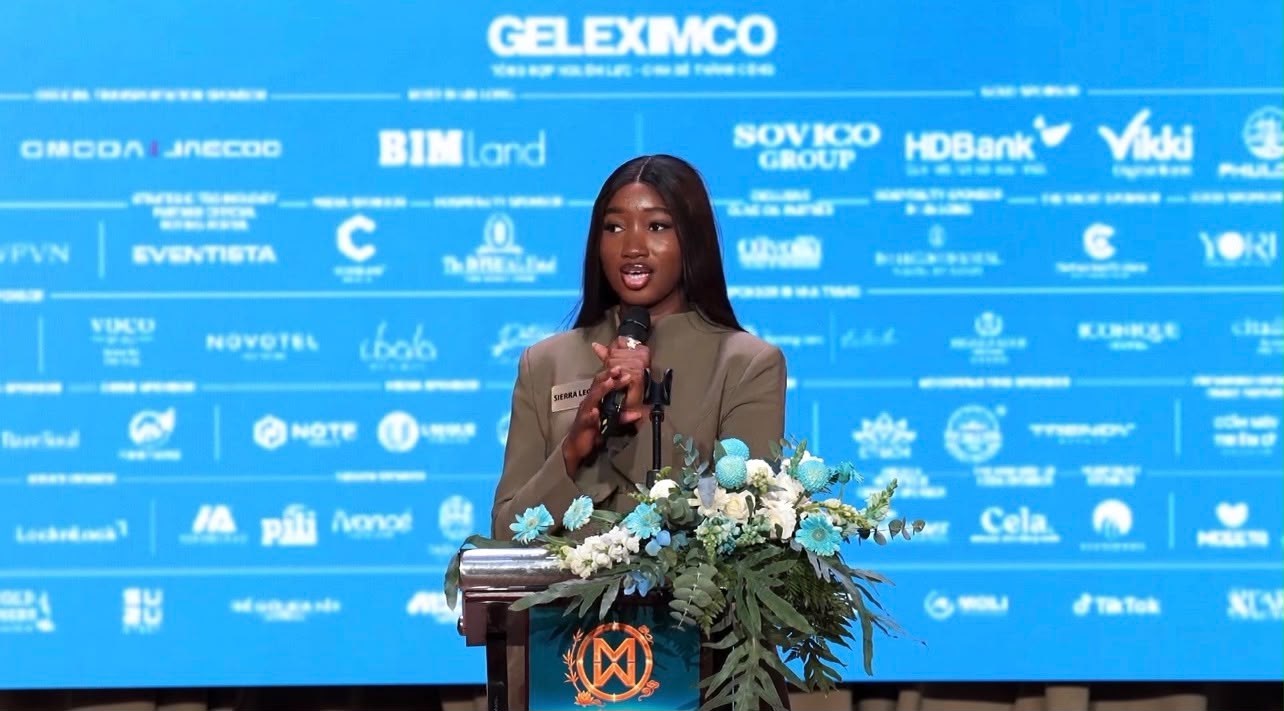
Miss World Sierra Leone 2026, Mariyam Lorba Konneh, has delivered what many Sierra Leoneans may consider one of the most emotional and consequential speeches ever made by a Sierra Leonean contestant on the international stage, using her platform at the Miss World Head-to-Head Challenge to draw global attention to the devastating impact of kush on women and vulnerable communities across the country.
Standing before Miss World officials, fellow contestants and an international audience, the 22-year-old beauty queen abandoned the traditional pageantry script and instead chose to speak from personal experience, recounting a painful story that has become the driving force behind her Beauty With A Purpose mission.
Introducing herself as a soon-to-be finance graduate, entrepreneur and founder of Sierra Leone’s first 24-hour beauty salon operated entirely by women, Mariyam said there was much more to her than pageantry.
“I am a 22-year-old soon-to-be finance graduate. At the same time, I own Sierra Leone’s first ever 24-hour beauty salon that is interestingly run by just women,” she said.
She further explained that she runs a charity foundation dedicated to empowering young people through what she described as the “Healthy Body, Healthy Mind and Healthy Community Initiative.”

However, she made it clear that her presentation was not about achievements or accolades.
“Today, I’m not really here to talk about a project, so I’m going to be talking from my heart. I want to talk on behalf of women whose voices are too often unheard,” she declared.
The atmosphere in the room reportedly shifted when Mariyam began narrating a deeply personal encounter that exposed her to the realities of drug addiction.
“Two years ago, while visiting one of the poorest communities in my country’s capital, I saw a young girl touching through heaps of garbages, looking for something to eat or maybe something she can sell just to survive,” she said.
“As I walked closer, she looked up. It was my childhood best friend. She had lost herself completely to addiction. This is someone I went to school with, someone I laughed with, someone I hope to have a bright future together with, or someone that is even supposed to be in this room with us today.”
Using the heartbreaking story as a gateway into a wider national crisis, Mariyam turned the world’s attention to kush, the highly dangerous narcotic that has become one of Sierra Leone’s biggest public health emergencies.
“Across Sierra Leone and increasingly across many other African countries, we have a drug that is posing as a threat to our generation. It’s commonly known as Kosh or the zombie drug, and that is because of the zombie-like effect it actually has on its users,” she said.
She explained that the drug’s destructive reputation has drawn comparisons to the opioid epidemic that has ravaged communities in Europe and North America.
“But this drug is said to contain similar synthetic opioids that is being found in Fentolin, which most of us in the Europe and America were very aware of because it had devastated lot of communities there,” she stated.
In one of the most shocking moments of her presentation, Mariyam spoke about widespread reports surrounding the composition of the drug.
“But apart from fentanyl, this drug is also said to compose of dead people’ bones. They practically dig up graves of our loved ones, take out the remains and constitutes this drug, which is making it so deadly and so potent,” she said.
Describing the impact of kush on the human body, Mariyam painted a grim picture of the suffering endured by users.
“This drug starts with affecting the brain; it shuts the brain down completely, and then moves to swelling of the limbs, the feet. Slowly and surely, the respiratory system shuts down completely. It’s actually that bad,” she said.
She further noted that substances reportedly associated with the production of the drug were originally intended for medical purposes.
“Pentaline, which is also used to make this drug, is actually a drug issued out to cancer patients just to relieve pain. But when it’s used illegally or when it’s abused, it can cause serious harm to the human body,” she said.
While acknowledging that substance abuse is a global problem affecting millions, Mariyam stressed that women are paying a particularly devastating price.
“Overall, 300 million people are said to be on drugs as we speak in this room, but sadly, just one out of five of them do get the help that they need,” she said.
“For women, especially, which is my greatest concern, the consequences are so heartbreaking.”
She then delivered what may become one of the most quoted passages from Sierra Leone’s participation at Miss World this year.
“This drug in question has exposed a lot of women to prostitution, exploitation, drug trafficking, theft, violence, just to survive,” she said.
“It will shock you to know that some of these women don’t even get to see their monthly menstrual cycle because the drug has taken over their bodies completely.”
Mariyam also highlighted the dangers faced by unborn children when addiction and pregnancy collide.
“And sadly, when this drug finally meets with pregnancy, it affects both the mother and the baby. It has resulted to babies being born underweight, unhealthy, autistic, or having the Down syndrome, or even requiring urgent medical help since birth.”
“No baby deserves to born in that type of situation,” she added.
The emotional high point of her presentation came when she revealed that her childhood friend eventually died as a result of addiction.
“The death of my best friend was not the end of her journey. We actually lost her to the drug, but that was not the end of her journey,” she said.
According to Mariyam, that tragedy became the inspiration behind the establishment of the Mariyam’s Ways Foundation, an initiative focused on helping women affected by addiction rebuild their lives.
“It somehow inspired me to establish the Mariyam’s Ways Foundation, which is the best thing that has ever happened to me,” she said.
“Luckily for me, with the help of individuals, NGOs, and CSOs in my country, we have successfully been able to put together a rehabilitation center for these women.”
She revealed that the project has already recorded significant impact.
“We have saved over 280 women from slums and vulnerable communities, guide their recovery and see how we can connect them with tools that can just help them to regain their independence,” she said.
But beyond Sierra Leone, Mariyam said her dream is to build a global movement that gives hope to people battling addiction regardless of nationality or background.
“These are things I’ve been able to do as Mariyam or as Miss World Sierra Leone, but I also stand here today as a Miss World contender,” she said.
“I don’t wish for this initiative to just stop in Sierra Leone. I want to see every single person battling drug addiction, be it in England, Kenya, Sierra Leone, South Africa, Portugal, to know that there is a safe space for them to relive their dreams.”
“There is a safe space for them to start.”
As she concluded her presentation, Mariyam transformed her crown into a symbol of advocacy rather than beauty.
“So this is the bubbles that I wear. This is the crown on my head. And if you’re in this room today and you do believe that every single human being deserves a second chance at relieving their dreams, kindly raise a hand up with me.”
The room responded.
For many Sierra Leoneans watching from home, however, the message may have resonated far beyond the applause. At a time when kush continues to destroy families, claim lives and push countless young women into cycles of exploitation and despair, Mariyam Lorba Konneh used one of the world’s biggest stages not to talk about herself, but to force the world to confront a crisis that has become one of Sierra Leone’s deepest national wounds.
And in doing so, she may have delivered Sierra Leone’s most powerful voice yet in the global fight against drug addiction.