

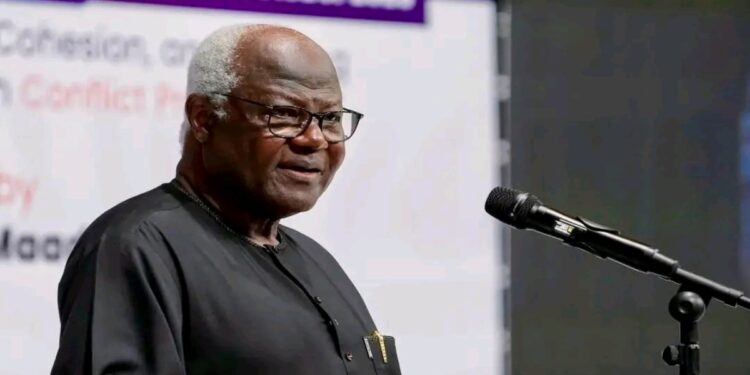
Former President Ernest Bai Koroma has called on Sierra Leone’s political leaders and citizens to put national interest above party loyalty, rebuild trust and work together to protect the country’s hard-won peace, as the two-day National Unity and Social Cohesion Conference ended with the adoption of the Freetown Declaration.
In a statement issued today by the Office of the Former President of Sierra Leone, Koroma delivered a personal reflection on Sierra Leone’s journey from civil war to peace.
He praised President Julius Maada Bio for establishing the Independent Commission for Peace and National Cohesion (ICPNC) and for convening the gathering under the theme “From Commitment to Action: Rebuilding Trust, Strengthening National Unity and Advancing Social Cohesion.”
“The responsibility of a president is not only to govern, but also to hold the country together. That is no small responsibility,” Koroma told the audience of national leaders, traditional and religious authorities, civil society, women, youth and international partners.
The conference, organised by the ICPNC to mark its fifth anniversary, focused on implementing the Agreement for National Unity signed in October 2023 between the Government and the All People’s Congress (APC), particularly Resolution 6 on dialogue and conflict prevention. It came three years after the disputed 2023 elections and amid efforts to ease political tensions ahead of the 2028 polls.

Recalling the 2007 transition
Koroma drew on his own experience of the 2007 democratic transition. He recalled visiting outgoing President Ahmad Tejan Kabbah to thank him for his service and assure him that his counsel would remain valued. He also described visiting former Vice President Solomon Berewa after the election results and discovering that his security detail had been withdrawn. Koroma immediately instructed the Inspector General of Police to restore the protection.
The anecdotes, he said, underlined a core principle: the transfer of power must never mean the withdrawal of dignity, respect or protection from those who have served the nation. “Belonging to a political party is a democratic choice, while being Sierra Leonean is a shared inheritance,” he stressed. No citizen should be disadvantaged because of political conviction, region or place of birth.
In a lighter but pointed moment that drew laughter and applause, Koroma asked why he should not visit President Bio in Tihun, or why Bio should not visit him in Makeni.
“Let’s sit down and talk. Let’s dialogue, dialogue, dialogue. We must find a solution,” he urged.
“I am just a telephone call away”
In one of the most warmly received moments, Koroma offered his continued support to the sitting President. “Moving forward, I am just a telephone call away,” he said, prompting sustained applause. The assurance signalled his readiness to place his experience at the service of national reconciliation beyond any single presidency.
He warned that prolonged political tensions and institutional mistrust were discouraging investment, slowing development and denying young people opportunities.
“The world won’t wait for us. West Africa won’t wait for us,” he cautioned, urging Sierra Leoneans not to let another decade pass without addressing the differences holding the country back.
Koroma emphasised shared responsibility: those in government must exercise humility and accommodate differing views; the opposition must operate within the law; and civil society, journalists, traditional and religious leaders, and ordinary citizens all have roles in strengthening institutions and rebuilding public trust.
Bio’s keynote and broader context
In his keynote address, President Bio apologised on behalf of the State to victims and survivors of the civil war, directed a review of the reparations programme recommended by the Truth and Reconciliation Commission, and proposed a National Peace and Cohesion Action Framework, a Peace Basket Fund (with an initial Le25 million allocation earmarked for the 2027 budget), a strengthened Inter-Party Dialogue Committee, a Code of Conduct for Peaceful Elections, school-based peace and civic education, a National Peace Week, and work towards a National Peace Memorial.
He also reaffirmed that he will complete his constitutional mandate in 2028 and will not be a candidate in the next presidential election, committing to a peaceful transfer of power.
United Nations Special Representative of the Secretary-General for West Africa and the Sahel, Leonardo Santos Simão, welcomed the renewed engagement between the two leaders and the conference’s focus on turning commitments into action. The ICPNC, under Executive Secretary Hawa Sally Samai, had earlier visited Koroma in Makeni to secure his participation, describing the event as a platform for honest reflection rather than another document.
The conference closed on 27 October with the adoption of the Freetown Declaration on National Unity and Social Cohesion 2026. The declaration outlines priority actions, including an Elders’ Forum of current and former leaders, stronger inter-party dialogue, conflict-prevention mechanisms, and clear timelines for follow-up. The ICPNC has said it will publish the conference report, Declaration and a Commitment Register within 30 days.
For many Sierra Leoneans watching the two leaders share the stage, the gathering represented a rare moment of visible political maturity. Whether the goodwill translates into sustained dialogue, practical reforms and reduced tension before 2028 will depend on the willingness of all sides to move from words to consistent action. As Koroma put it, Sierra Leone belongs to all its people – and its peace, unity and future are a responsibility they must share.