

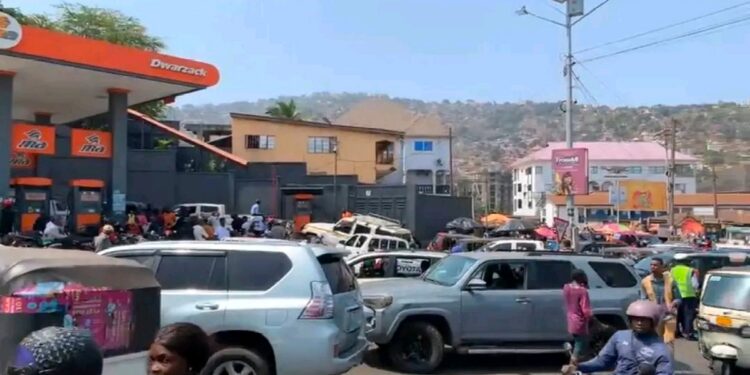
For many Sierra Leoneans, the country’s recurring fuel crisis is not simply an economic headline. It is the queue that forms at dawn, the commercial motorbike rider unable to earn a living, the market trader paying more to transport goods and the household struggling to keep its generator running.
Sierra Leone is once again confronting a familiar but increasingly difficult challenge: rising petroleum prices, tightening fuel supplies and recurring shortages that threaten to deepen the cost-of-living crisis.
With the festive season approaching, concerns are growing over whether the country can maintain a stable supply of petroleum products during a period traditionally associated with increased travel, commercial activity and household spending.
Rising Prices And Mounting Pressure
Official pump prices, set on September 8, 2026, stand at NLe 40 per litre for petrol and NLe 45 for diesel.

The adjustment represents a significant increase for consumers. Compared with the NLe 27.30 recorded a year earlier, petrol prices have risen by approximately 46.5 per cent. They have also increased from NLe 35 just three months before the latest adjustment.
In broader terms, petrol prices have climbed from NLe 25 to NLe 40 per litre in 2026, representing a 60 per cent increase.
The consequences extend well beyond filling stations. Higher fuel costs feed into public transportation, commercial deliveries, food distribution and the operating expenses of businesses that depend on generators.
In October, Sierra Leone ranked third in Africa among countries with the highest petrol prices, behind Malawi and Zimbabwe, according to GlobalPetrolPrices data cited by Business Insider Africa. The reported price of $2.033 per litre also placed the country 36th globally.
GlobalPetrolPrices further estimated that filling a 40-litre tank in Sierra Leone costs the equivalent of 174.41 per cent of the average monthly income.
Why Fuel Prices Continue To Rise
Sierra Leone imports all its petroleum products, leaving the domestic market particularly vulnerable to fluctuations in international oil prices and movements in the exchange rate.
The government attributed the September price adjustment to continued increases in global petroleum prices, partly linked to geopolitical tensions involving Iran and their effects on international oil markets.
Under the pricing framework administered by the National Petroleum Regulatory Authority (NPRA), the full pass-through price in September would have been NLe 41.04 per litre for petrol and NLe 46.76 for diesel.
The government said it would absorb the difference through subsidies to limit the immediate impact on consumers.
By September 24, the government was subsidising NLe 1.80 per litre on petrol and NLe 2.89 on diesel to maintain the official pump prices at NLe 40 and NLe 45 respectively.
During the three months preceding September, approximately US$8.3 million had reportedly been spent to keep domestic fuel prices below their full market levels.
However, NPRA data effective October 28 suggested a shift in the subsidy position. Petrol selling at NLe 40 was reportedly 2.23 leones above its cost under the official pricing formula, while diesel at NLe 45 continued to receive a subsidy of NLe 1.01 per litre.
The changing figures highlight the delicate balance between protecting consumers from international market volatility and ensuring petroleum importers can sustain their operations.
Recurring Scarcity Raises Supply Concerns
While rising prices remain a major concern, the availability of fuel has become an equally pressing issue.
In early September, several filling stations across Freetown and other parts of the country reportedly suspended sales amid days of artificial scarcity. Long queues formed as motorists struggled to obtain petroleum products.
The disruption coincided with tensions between oil marketing companies and the authorities over adjustments to pump prices to reflect increasing import costs.
A similar situation has returned in November.
Several filling stations in Freetown have reportedly stopped selling petroleum products, leaving motorists, commercial drivers and other fuel-dependent businesses struggling to access supplies. Malador was reportedly among the few stations selling fuel, with restrictions on the quantities customers could purchase.
The latest disruption occurred as Sierra Leone hosted the West Africa Integration and Investment Summit 2026, bringing regional and international visitors into the country.
The timing has renewed concerns about the reliability of the country’s petroleum distribution system, particularly during periods of heightened demand.
In Bo, reports of tightening supplies have also fuelled fears that petrol prices could reach NLe 50 per litre. Although no official approval for such an increase has been established, the possibility has generated anxiety among commercial motorbike riders, traders and transport operators.
There have also been allegations that some filling stations may be withholding petroleum products. However, no independently verified evidence has established deliberate hoarding by individual stations.
How Much Fuel Does Sierra Leone Have?
The country’s petroleum stock position offers further insight into the challenges facing the market.
NPRA data for the week of November 4 indicated that Sierra Leone held approximately 11.2 million litres of petrol, sufficient for an estimated 2.1 weeks of consumption.
The regulator projected that existing petrol stocks could be depleted by November 19 if no new shipment arrived.
Diesel supplies stood at approximately 28.3 million litres, representing an estimated 5.2 weeks of consumption.
The NPRA classified petrol and jet fuel supplies as tight, indicating that delays in incoming shipments could quickly translate into shortages at filling stations.
These figures underscore the importance of timely petroleum imports, particularly as the country approaches a period when demand is expected to increase.
Government Moves To Stabilise Supply
The government says it is intensifying engagements with oil marketing companies to guarantee uninterrupted petroleum supplies ahead of the festive season.
At a biweekly industry meeting held in Tokeh this month, Minister of Trade and Industry Ibrahim Alpha Sesay reaffirmed the government’s commitment to settling outstanding subsidy payments owed to petroleum operators.
NPRA Director General Brima Baluwa Koroma also indicated that international petrol and diesel prices had recorded marginal declines following political developments in the United States and Israel. However, the reduction had yet to translate into lower domestic pump prices because of existing subsidy arrangements.
Finance Minister Karefa A. F. Kargbo urged petroleum companies to submit detailed cost information covering premium and freight charges.
He also disclosed that the Bank of Sierra Leone had engaged commercial banks to facilitate timely foreign currency payments by oil marketers.
Beyond immediate interventions, the government is accelerating plans to become a more active participant in petroleum importation, storage and wholesale supply.
The proposed approach, according to the government, is not intended to displace private operators but to strengthen national supply security and reduce the country’s exposure to external market shocks and disruptions within the private distribution chain.
The Burden On Ordinary Sierra Leoneans
For ordinary citizens, the consequences of fuel shortages are immediate and increasingly expensive.
The government has indicated that fares for Waka Fine bus commuters will remain unchanged, with additional subsidies intended to absorb increased fuel costs.
However, commercial motorbike and tricycle riders, market traders and small businesses that depend on generators have no equivalent protection.
When filling stations suspend sales, some consumers turn to informal vendors, where petrol is sold in bottles at considerably higher prices.
The practice, commonly associated with the local black market known as jamba or jabu, creates another layer of financial pressure for people already struggling with rising transportation and living costs.
For commercial riders, higher fuel expenses often translate into increased fares. For traders, transportation costs can push up the prices of food and other essential commodities. For small businesses, unreliable fuel supplies can mean reduced operating hours and lost revenue.
The result is an economic chain reaction in which a disruption at the filling station eventually reaches households, markets and businesses across the country.
A Festive Season Test For Government
As the festive season approaches, the challenge facing Sierra Leone is no longer simply how to manage pump prices. It is whether the country can guarantee a reliable and predictable supply of petroleum products.
The government’s assurances, subsidy commitments and proposed greater involvement in fuel importation may provide part of the solution. However, the immediate test will be whether those measures translate into consistently available fuel at filling stations.
The NPRA has not announced when the next pump price review will take place.
For now, Sierra Leoneans remain caught between high prices and uncertain availability, with the prospect of further disruptions threatening an already difficult economic environment.
In Sierra Leone’s fuel market, the official pump price determines what consumers should pay. But when supplies disappear, scarcity determines what they actually pay.
And it is ordinary Sierra Leoneans who continue to bear the cost.