

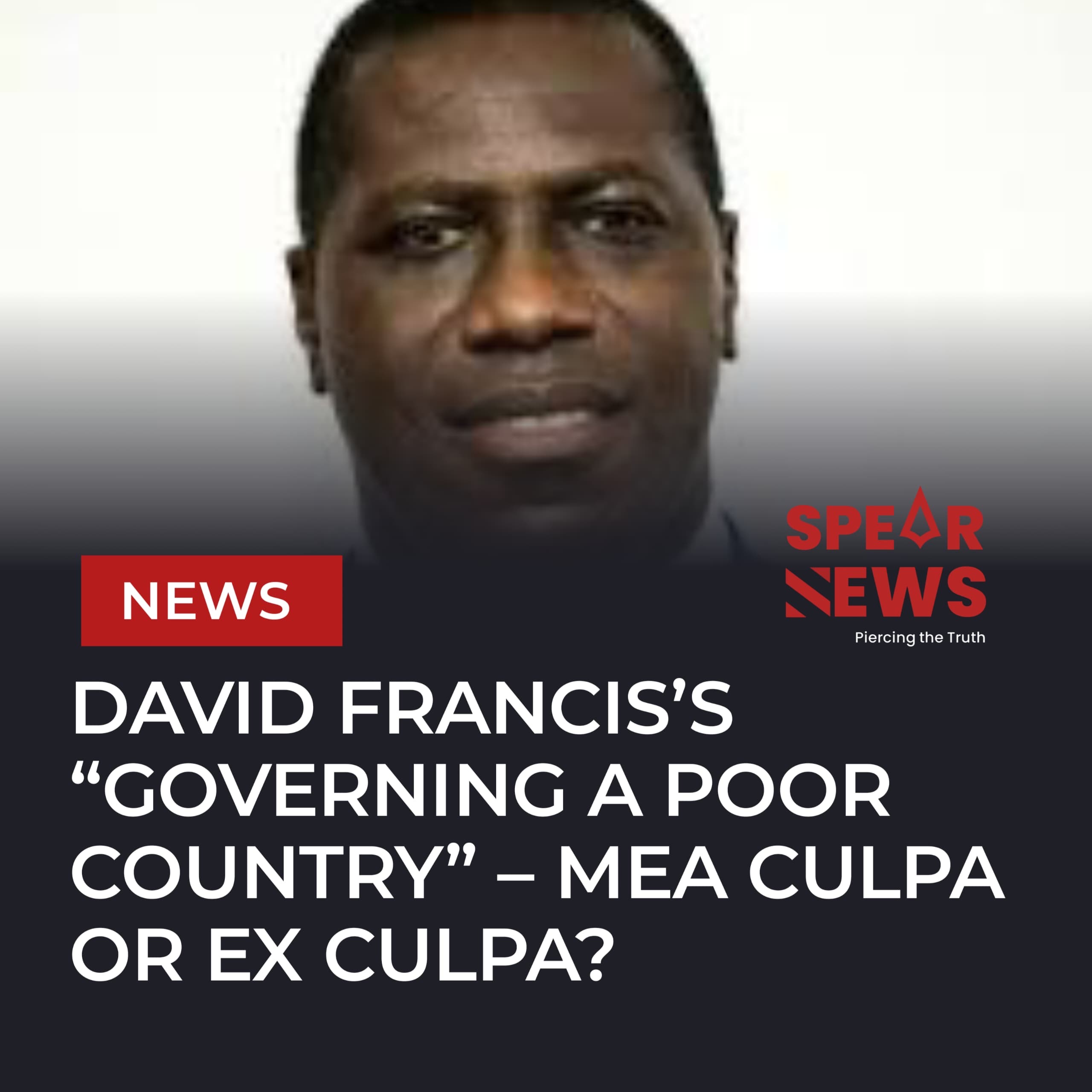
By Andrew Keili | Ponder My Thoughts

A book authored by the first Chief Minister in Sierra Leone’s post-colonial era on the complexities of governance should be essential reading for political observers and governance experts. Professor David Francis, in his book Governing a Poor Country: Perspectives from a Former Chief Minister of Sierra Leone, does not disappoint in sharing his experiences and perspectives. Yet, when a man whose tenure was marked by controversies presents his narrative, one cannot help but “ponder” beyond the confines of the text.
Let me go straight to the heart of the matter. What exactly is the mandate of the Chief Minister, as envisioned when the office was revived, and how did Francis contribute to the governance landscape? We learn that one primary aim of the Chief Minister’s office was to free President Julius Maada Bio from the constraints of close allies who had effectively become gatekeepers. The Chief Minister’s role was designed to be professional, technocratic, and central to coordinating governance across ministries. Constitutionally, the Chief Minister ranks fourth in ministerial precedence and third in executive order, serving not as a politician but as an enforcer—a messenger between the President, Vice President, and the governance machinery. Francis oversaw 28 ministries, 14 legislative agencies under the Office of the President, and specialized agencies like the DSTI, while also serving as Principal Adviser to the President.
Francis details his achievements: he coordinated inter-ministerial operations, reinstated Performance Management Contracts for ministers, made committees functional, organised Cabinet retreats, and established key institutions such as the National Disaster Management Agency (NDMA) and the Independent Commission of Peace and National Cohesion (ICPNC). He highlights his role in the formulation of President Bio’s first Executive orders, signalling a shift toward technocratic governance.
He is also candid about failures. He did not secure APC participation in the Bintumani III conference, failed to obtain Cabinet approval for a National Reforestation and Timber Governance Agency, could not fully address plastic pollution challenges, and struggled to implement recommendations from the Governance Transition Team (GTT) report. Unsurprisingly, the blame for these failures is apportioned externally: the APC is primarily faulted, alongside a “small but misguided faction” of his SLPP colleagues, whom he accuses of misleading party grassroots to view him as an outsider despite his long-standing contributions to the party.
Francis openly reflects on tensions within his political environment. He notes, “My concerted efforts not to ‘outshine the Principal/Master,’ i.e., President Bio, in hindsight, my assertive, competitive, disciplined, and determinedly professional service delivery activities and interventions might have inadvertently created what Robert Greene warned against: ‘do not go too far in displaying your talents or you accomplish the opposite—inspire fear and insecurity.’” He recalls disapproval from colleagues, critiques from legal luminaries like Dr. Abdulai Conteh, and tensions over the distribution of power, including the relocation of the MCC programme to the Vice President’s office. Yet, he praises Vice President Dr. Mohamed Juldeh Jalloh for loyalty, competence, and effective leadership, stating, “What the majority of the country do not seem to appreciate and understand is the simple fact that Vice President Dr. Mohamed Juldeh Jalloh is the most powerful Vice President ever in the history of modern Sierra Leone.”

Francis is equally candid in acknowledging the role of international partners. He notes the British government’s initial skepticism regarding the Free Quality Education Programme, which required three years of persistence before the promised £24 million support was released. He credits former Education Minister Alpha Timbo for steadfast dedication in achieving this milestone. Francis also recounts his personal experience during a visit to the European Commission with President Bio, where President Jean-Claude Juncker unexpectedly recognised him by name, eliciting both amusement and embarrassment. This anecdote, he notes, is a practical illustration of Robert Greene’s warning about the perils of outshining the master.
Yet, modesty is perhaps not Francis’s strongest suit. He highlights his academic pedigree and influence at Bradford University, claiming his stature “rubbed off” on then-PhD student and future President Bio. He frames his tenure as bringing gravitas, decorum, and disciplined professionalism to governance, positioning it as a corrective to the prior era of nepotism, informal networks, and patronage-based governance.
Despite the accomplishments he outlines, Francis expresses some regrets—particularly over his confrontational language toward the APC and the limited success in implementing GTT recommendations. He attributes systemic challenges in governance to the entrenched neo-patrimonial structures of Sierra Leonean politics, yet maintains that the Chief Minister’s office remains essential. He argues, “Complexities of our domestic landscape demand a central coordinating node, making the existence of the office not an option but a functional imperative.” He cites recognition from SLPP Chairman Prince Harding, who, during a visit to Kenema, remarked, “Only Chief Minister Professor Francis can bring cats and dogs to sit at the same high table for Kenema deliberations.”
While Francis’s book provides detailed accounts of both successes and challenges, some critical questions remain unaddressed. Why was he ultimately removed as Chief Minister? How does he view the handling of the office by his successors, J.J. Saffa and Dr. David Sengeh? Why is he so effusive in his praise of Vice President Juldeh Jalloh? Does Francis now intend to pursue a more active political role, or will he remain in the academic and advisory space? These omissions leave the reader pondering whether this is a true mea culpa or an ex culpa—an account that explains failures largely by attributing blame elsewhere.
In conclusion, Francis’s Governing a Poor Country is an enlightening read. It provides rare insight into the workings of the Chief Minister’s office, the constraints of technocratic governance, and the political and structural hurdles inherent in Sierra Leone’s system. Yet, it also raises questions about accountability, legacy, and personal ambition. Readers are left to decide for themselves whether the book represents an honest self-reflection or a careful positioning of the author amidst the complex political landscape. In either case, the book is an important contribution to the discourse on governance, development, and leadership in Sierra Leone.
Ponder my thoughts.