

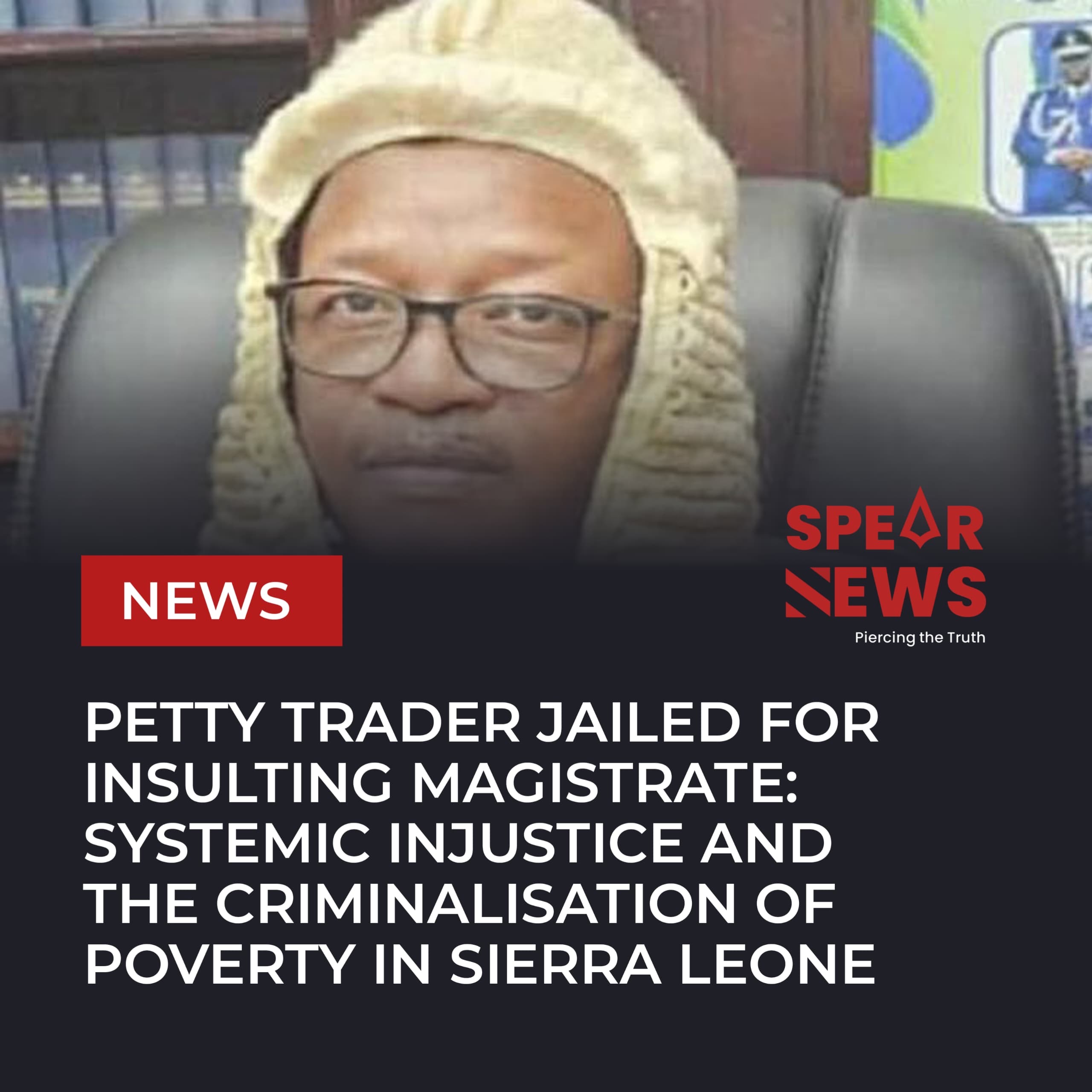
Sierra Leone is confronting a profound crisis of justice following the imprisonment of Fatmata Kamara, a petty fry-fry seller from New Jersey Junction, Goderich, sentenced to two months in prison after allegedly insulting a magistrate. The case, which began in mid-March 2026, has provoked widespread condemnation from citizens, human rights organisations, and legal experts, highlighting systemic failures, abuse of judicial power, and the stark inequalities embedded within the nation’s justice system.

On 18 March 2026, Kamara was convicted under Sections 2 and 3 of the Public Order Act, 1965, which criminalise “public insult and provocation” and “insulting conduct.” According to available information, the incident arose from a verbal exchange with a customer who turned out to be Magistrate Aaron Bangura. The magistrate was off duty, wearing plain clothes, and waiting at Kamara’s stall for his food when a disagreement occurred over the pace of service. What might have remained an ordinary dispute escalated into criminal proceedings when Bangura initiated a private prosecution, bypassing the police and customary investigative procedures.
The sentencing magistrate, Solomon Christian Kekurah, reportedly justified the two-month consecutive prison sentence on the grounds that Kamara’s words were directed at “a high-level citizen of this country in the capacity of a magistrate.” Legal analysts and human rights advocates have strongly criticised this reasoning, noting that the Public Order Act contains no provision for enhanced penalties based on the social status of the alleged victim. The use of consecutive sentences, generally reserved for distinct offences, further underscores the disproportionate nature of the punishment.
Public outrage has been swift and vocal. On social media, citizens expressed alarm at the apparent abuse of judicial power. Sheka Forna (@tonkolili) tweeted:
“A start, but as long as Magistrates Aaron Bangura and Solomon Christian Kekurah (a disgrace to the profound wisdom of his namesake, and his own implied faith) remain on the bench, justice has not been served.”
@sierraeyesalon similarly condemned the decision:

“A Fry-Fry Seller, a Magistrate, and the Laws That Criminalise Poverty. The case of Fatmata Kamara is not an isolated injustice; it is the system working exactly as petty offence laws were designed to work. Fatmata Kamara is in prison today because she was rude to a man she did not know was a magistrate. She will serve two months, not because she threatened anyone, not because she breached anyone’s peace, but because she lacked the status and the power to defend herself against laws that were designed, sixty years ago, to keep people like her in their place.”
These reactions reflect widespread concern over the misuse of the law and the systemic inequities faced by low-income citizens, particularly informal workers such as market women, street vendors, and unemployed individuals. Reports indicate that the Freetown Male Correctional Centre operates at over 800% capacity, largely due to minor offence convictions, a phenomenon repeatedly documented by organisations such as AdvocAid and the Centre for Accountability and the Rule of Law (CARL). According to their research, petty offence laws disproportionately affect the poor, reinforcing social hierarchies rather than maintaining public order.
The Public Order Act of 1965, under which Kamara was prosecuted, was drafted in an era when the state sought to control public behaviour through broadly defined offences. Sections 2 and 3 criminalise public insult, provocation, and conduct deemed likely to “provoke a breach of the peace.” Yet these provisions are vague, subjective, and easily manipulated, creating opportunities for judicial overreach and the selective targeting of marginalized groups. Advocates argue that the law has been weaponised to enforce deference to authority, rather than protect public order or safety.
The procedural irregularities in Kamara’s case are striking. No police investigation was conducted, no caution was issued, and no public-interest assessment preceded the prosecution. The private prosecution effectively placed a single magistrate in the dual role of complainant and enforcer, a circumstance that human rights observers warn violates fundamental principles of impartiality, fairness, and due process. The sentencing magistrate’s remarks reveal a troubling misuse of authority: the punishment was imposed not to address harm, but to enforce social hierarchy and deference to judicial status.
The wider implications of Kamara’s case are reinforced by precedent from the ECOWAS Community Court of Justice, which in November 2024 ruled that certain provisions of Sierra Leone’s Public Order Act, including loitering offences, were unlawful, discriminatory, and violated international human rights standards. The reasoning of that judgment, advocates argue, applies equally to the provisions used to convict Kamara. Criminalising minor verbal interactions, particularly against informal workers, represents a direct violation of rights to equality, non-discrimination, and freedom of expression.
The Chief Justice of Sierra Leone, Komba Kamanda, intervened on 24 March 2026, ordering Kamara’s immediate release and instructing lower courts to comply. While this action secured her freedom, it did not address the systemic issues underlying her unjust imprisonment. Civil society groups and legal experts have emphasised that true justice requires more than temporary relief; it demands structural reform, legislative overhaul, and mechanisms to prevent judicial abuse.
Legal advocates have outlined several urgent reforms. They argue that Sections 2 and 3 of the Public Order Act should be repealed or amended, non-custodial alternatives for minor disputes should replace imprisonment, and private prosecutions must include mandatory public-interest reviews and police oversight. Judicial accountability and training are essential to prevent similar abuses in the future.
Fatmata Kamara’s case is emblematic of the intersection of poverty, informal economic activity, and legal vulnerability in Sierra Leone. It demonstrates how outdated laws, when combined with concentrated judicial authority, can disproportionately punish the poor and reinforce systemic inequalities. The fact that a magistrate’s displeasure over service at a fry-fry stall could result in imprisonment underscores the urgent need for reforms that protect the rights of all citizens, not just those with status or influence.
The criminalisation of ordinary verbal disputes and the exploitation of petty offence laws are not isolated phenomena. Research by AdvocAid, CARL, and other organisations shows that low-income Sierra Leoneans frequently face imprisonment for minor offences while the wealthy and powerful enjoy immunity. Overcrowding in prisons, procedural irregularities, and the discretionary misuse of legal provisions create a system in which equality before the law is largely aspirational, rather than actual.
While Kamara’s release offers immediate relief to one woman and her family, the broader conversation on justice, rights, and judicial accountability continues. Sierra Leone faces a critical moment: either it reforms outdated laws and strengthens procedural safeguards, or it risks perpetuating cycles of injustice in which the poor are criminalised for routine interactions while those in power remain untouchable. Fatmata Kamara’s experience should serve as a warning and a call to action, illustrating that freedom is fragile, the law can be misapplied, and justice must be actively protected, not assumed.
Her ordeal has reignited national debate, with citizens, civil society organisations, and human rights advocates insisting that lasting reform is essential. True justice, they argue, is not simply the absence of imprisonment, but equality before the law, dignity for all citizens, and the dismantling of structures that allow power and status to dictate outcomes. Until these reforms are enacted, the criminalisation of poverty will persist, ordinary citizens will remain vulnerable, and the promise of equal justice in Sierra Leone will remain unfulfilled.