

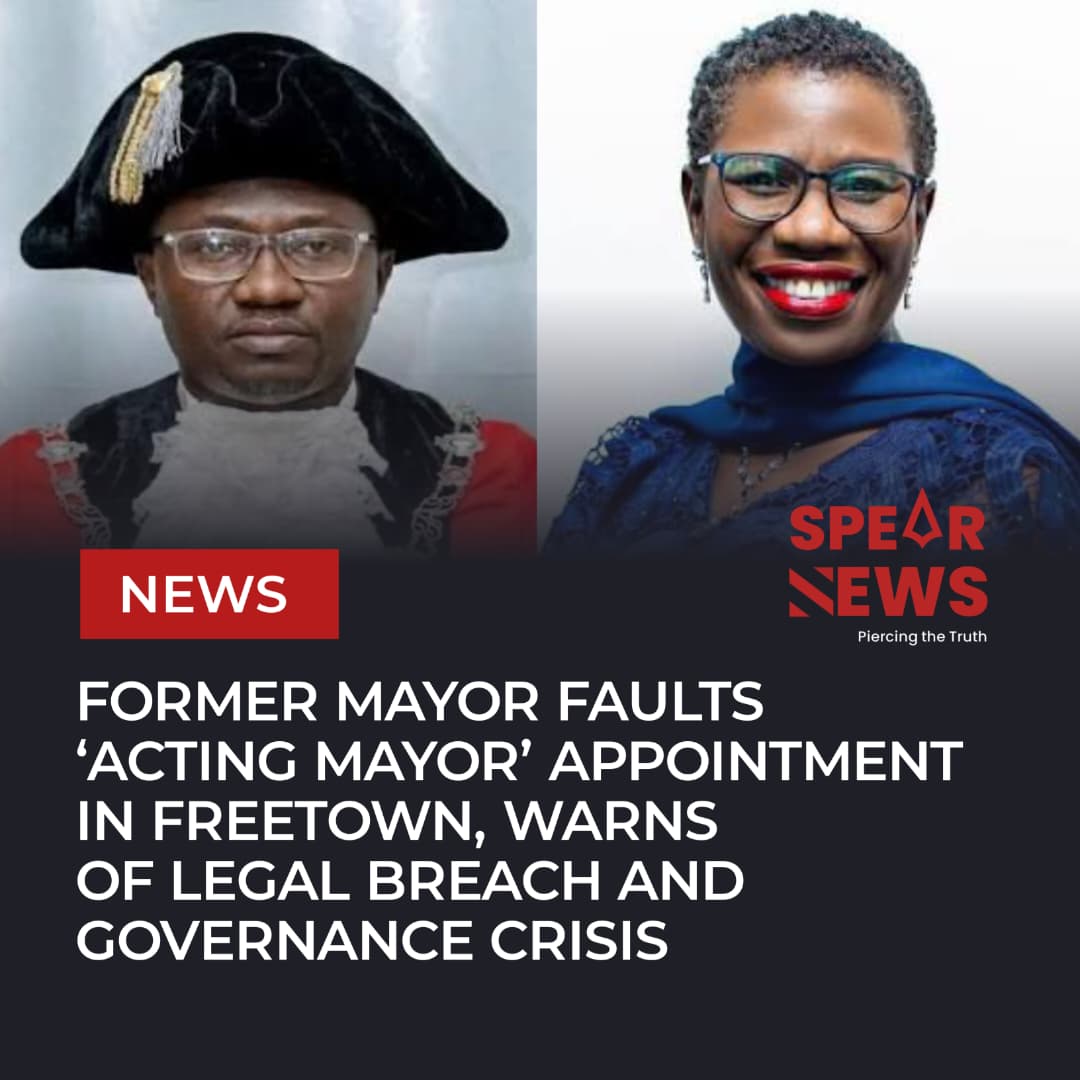
A former two-term Mayor of Freetown, Layemin Joe Sandi, has raised strong legal objections to the recent appointment of an “acting mayor” for the Freetown City Council, warning that the move not only lacks constitutional and statutory backing but also sets a dangerous precedent for local governance in Sierra Leone at a time of heightened political tension and institutional strain.
Sandi, who also served as the National Public Relations Officer of the Sierra Leone People’s Party (SLPP), expressed deep concern over the decision by SLPP councillors to nominate Councillor Ibrahim Gbla as acting mayor, a move made amid the ongoing boycott of council activities by opposition All People’s Congress (APC) officials. The boycott, which began in late February 2026, followed disagreements over the implementation of recommendations by the Cross-Party Tripartite Committee, including the appointment of a new Electoral Commission chairman and proposals to adopt a Proportional Representation electoral system.
According to Sandi, the Local Government Act 2022 does not recognise or provide for any office known as “Acting Mayor,” making the recent appointment legally questionable. He argued that the law is explicit in outlining succession and procedural arrangements within local councils, stating that in the absence of a sitting mayor, the deputy mayor is empowered to perform the functions of the office, thereby preserving the democratic mandate conferred through elections. He further clarified that where both the mayor and deputy mayor are unavailable, councillors are only permitted to select one among themselves to preside over a specific meeting, a temporary and procedural responsibility that does not confer executive authority or the status of a mayor.
His position aligns with that of Mayor Yvonne Aki-Sawyerr, who has publicly dismissed the appointment as lacking any legal foundation under the Local Government Act 2022. Aki-Sawyerr has specifically referenced Section 16(3) of the Act, which limits the role of councillors in such circumstances to presiding over meetings without assuming the powers of the mayoral office. The interpretation of this provision has become central to the ongoing dispute, as critics argue that the designation of an acting mayor effectively creates a position that is not recognised by law.
Sandi also raised concerns about the legality of council proceedings under the current circumstances, noting that valid council decisions require the presence of at least half of all councillors to form a quorum. With the APC boycott significantly reducing participation, questions have emerged over whether recent deliberations and decisions meet the legal threshold required for legitimacy. He emphasised that while the Ministry of Local Government has supervisory authority over councils, it does not possess the legal power to appoint or endorse an acting mayor, reinforcing his view that the current arrangement falls outside the established legal framework.
He further pointed out that where a local council becomes unable to function effectively, the law provides a clear, albeit stringent, pathway for intervention. Such action, he explained, can only be undertaken by the President and must be backed by a two-thirds majority approval in Parliament, a safeguard designed to prevent arbitrary interference in local governance structures. By contrast, he warned that the current approach risks bypassing these legal safeguards and undermining institutional integrity.

The controversy has heightened concerns over governance in Sierra Leone’s capital, particularly regarding the delivery of essential services such as waste management, sanitation, and urban administration. Analysts warn that prolonged political deadlock and institutional uncertainty could have immediate consequences for residents, who rely on the city council for basic services and infrastructure management. Recent public opinion data indicates that 76 percent of Sierra Leoneans view the APC boycott negatively, while 68 percent believe it is undermining democratic governance, reflecting widespread concern over the impact of political disputes on everyday life.
Despite his criticism of the acting mayor appointment, Sandi acknowledged the broader issues that have contributed to the current impasse, including concerns over governance, the ongoing drugs crisis, and the rising cost of living. However, he stressed that responses to these challenges must remain firmly within the bounds of the law. “None of this takes away from the underlying issues that have led to the current boycott,” he said. “However, the method of response must not undermine the legal framework that holds our local governance system together.”
He called for a return to dialogue, urging political actors across party lines to engage constructively and prioritise the interests of citizens over partisan considerations. Emphasising the critical role of local councils as the closest tier of government to the people, Sandi warned that any weakening of these institutions would disproportionately affect ordinary residents. “Local councils are the closest point of service to the people,” he said. “When they are weakened, it is the ordinary citizen who suffers first and most.”
The unfolding situation in Freetown has become a test case for the resilience of Sierra Leone’s local governance framework, raising fundamental questions about adherence to the rule of law, the limits of political authority, and the balance between expediency and legality in times of crisis. As the standoff continues, attention is increasingly focused on whether political leaders and institutions will uphold the legal structures designed to guide governance or risk setting precedents that could have far-reaching implications for the country’s democratic system.