

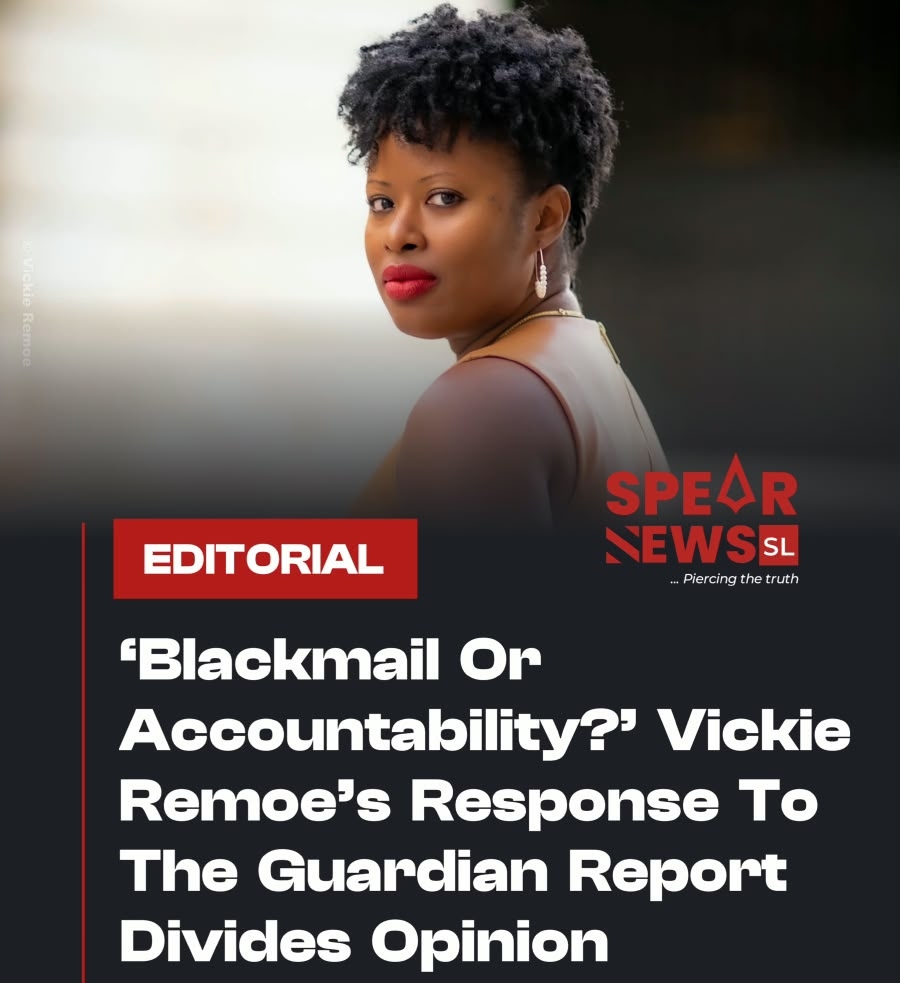
A heated debate has emerged on social media following investigative reporting by British newspaper The Guardian on alleged links between international cocaine trafficking networks and influential figures in Sierra Leone, with media personality Vickie Remoe and several commentators offering sharply contrasting interpretations of the controversy.
Remoe, in a series of posts on X, described the newspaper’s investigation as “blackmail”, arguing that the Netherlands was attempting to pressure Sierra Leone’s government into capitulating to foreign demands.
She also challenged the description of Sierra Leone as the “world’s first true narco-state”, arguing that the country does not produce cocaine and questioning why it should be defined by drug trafficking allegations.
While acknowledging that Sierra Leone’s use as a transshipment hub presents a serious problem, Remoe argued that the investigation’s framing was unfair and accused foreign interests of attempting to control the narrative about the country.
Her comments have drawn support from some Sierra Leoneans who view the investigation as an attack on the country’s international reputation. Others, however, have questioned whether defending national sovereignty should come at the expense of demanding answers about allegations involving powerful individuals and state institutions.

One of the more detailed responses came from diaspora commentator LeoBoi, whose posts challenged Remoe’s characterisation of the investigation and the implications of describing Sierra Leoneans who demand answers as traitors.
LeoBoi argued that patriotism should not be equated with unquestioning support for the government, maintaining that scrutiny of those in public office is not an act of betrayal.
He also questioned the evidence behind Remoe’s assertion that the investigation amounted to blackmail or that the journalists involved were acting as agents of the Dutch government.
Addressing the allegations concerning Jos Leijdekkers, also known as Bolle Jos, LeoBoi referred to photographs that he said showed the fugitive in the company of politically influential individuals. He acknowledged that such associations do not, by themselves, establish criminal complicity, but argued that they warrant credible explanations.
His central argument was that the absence of domestic cocaine production does not settle the question of whether an international trafficking network could operate through Sierra Leone or benefit from protection and influence within its institutions.
LeoBoi further argued that challenging the newspaper’s language and evidence is legitimate, but should not replace scrutiny of the allegations themselves.
Another response came from FactCheck Sierra Leone, which similarly cautioned against describing the investigation as blackmail without evidence of collusion. The organisation argued that a country does not need to produce cocaine for criminal networks to compromise its institutions.
The exchange highlights an important distinction in the ongoing debate: whether the investigation’s characterisation of Sierra Leone is justified is a separate question from whether its underlying allegations deserve investigation.
Other reactions have been more confrontational. Commentator Alpha Bah accused Remoe of remaining silent over the disappearance of Alan Jalloh and others while defending what he described as a cartel. That statement remains an accusation made in the online exchange and should not be treated as proof of wrongdoing by Remoe.
The debate has also raised concerns about the language used to describe critics and the possible consequences of portraying demands for accountability as disloyalty. LeoBoi warned that such rhetoric risks providing a pretext for the persecution of people who speak out, although the posts alone do not establish that such persecution has occurred as a result of Remoe’s comments.
The Guardian’s investigation, published on 14 October 2026, alleges that Leijdekkers built a cocaine-trafficking network with connections to influential individuals and institutions in Sierra Leone. The newspaper says its reporting draws on interviews with intelligence and police sources across two continents.
These are serious allegations with potentially far-reaching implications. They require careful examination, responses from those implicated and scrutiny of the evidence. The publication of an investigation does not, by itself, establish the truth of every allegation, and any claim of criminal involvement by a named individual must be assessed on its own merits.
Equally, allegations that the investigation constitutes blackmail or forms part of a foreign campaign against Sierra Leone require evidence. Disagreement with a headline or suspicion about a foreign government’s motives cannot, on its own, establish that journalists acted improperly.
The controversy therefore presents Sierra Leone with two questions that should not be treated as mutually exclusive. How should the country respond to reporting it considers inaccurate or damaging to its reputation? And how should its institutions respond to allegations that international criminal networks may have gained influence or protection within the state?
A credible response requires more than competing declarations of patriotism. It requires transparent communication from the relevant authorities, evidence-based examination of the allegations, and a willingness to correct inaccuracies wherever they are established.
Sierra Leoneans have every right to challenge foreign reporting they consider misleading. They also have the right to demand answers from their own institutions when allegations of serious wrongdoing arise.
National sovereignty should protect a country’s right to due process and independent decision-making. It should not make legitimate scrutiny of public institutions unacceptable. Similarly, international investigative reporting should be open to challenge when its evidence or conclusions are disputed.
Ultimately, defending Sierra Leone’s reputation and demanding accountability are not opposing causes. If the investigation contains inaccuracies, those inaccuracies should be demonstrated and corrected. If credible evidence supports its allegations, the appropriate authorities should address them through lawful and transparent processes.
The most constructive outcome of this debate would be neither the automatic acceptance of every allegation nor its dismissal as a foreign plot, but a public demand for evidence, answers and accountability.