



An online opinion poll tracking the race for the opposition All People’s Congress (APC) presidential nomination has entered its final phase with Dr. Ibrahim Bangura establishing a commanding lead, while a tightly contested battle for the positions immediately behind him has injected fresh intrigue into the party’s emerging 2028 succession race.

The poll, circulated through an APC-linked WhatsApp channel and followed closely by Spear News from its opening, has recorded thousands of votes since voting commenced. The latest screenshots reviewed by this newspaper show Bangura with approximately 4,700 votes, well ahead of his closest listed challengers.
Chief Alhaji Samuel Sam-Sumana follows with about 1,500 votes, while Ady Macauley Esq. has approximately 1,600. Bai Mahmoud Bangura is shown with about 1,300 votes, while Sheikh Alhaji Mohamed O. Kamara has about 1,400.
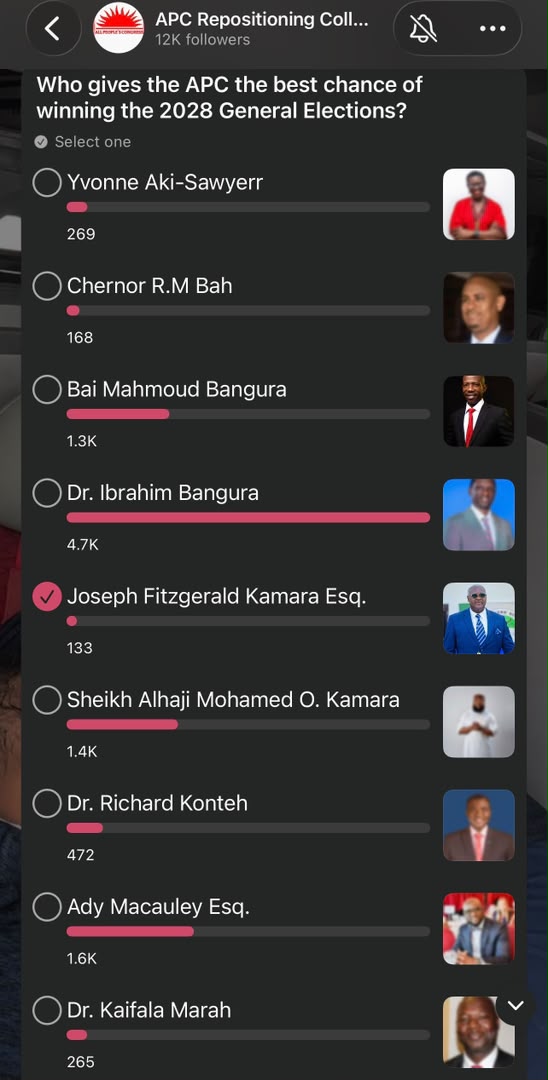
The figures place the leading candidate substantially ahead of the rest of the field, but the more closely fought contest is taking place among the candidates occupying the next four positions.
That pattern is significant because the poll has not produced a static leaderboard.

From the opening days of the exercise, the ranking shifted repeatedly as different geographical constituencies appeared to generate fresh waves of participation. An early update, after more than 1,000 votes had been recorded, suggested that Kambia was emerging strongly in the contest. Within the following 24 hours, however, the organisers reported that the top positions had changed hands twice, with the frontrunners separated by fewer than a dozen votes at one point.
By August 4, the contest had begun to take a different shape. One candidate had crossed 2,000 votes, while almost 3,500 votes had been accumulated by the top two contenders. At the same time, the candidate in third position was approaching the 1,000-vote threshold, prompting speculation that the race could develop into a three-way contest.
The following day, the gap at the top had expanded to more than 1,000 votes, signalling the first major indication that one candidate was beginning to separate himself from the field. But even then, the leaderboard remained fluid.
Kono District subsequently produced one of the poll’s most notable surges, pushing its candidate into fourth place and reshuffling the upper end of the table. The development underscored the extent to which the online exercise was being influenced by waves of participation rather than a fixed hierarchy.
By August 7, Kambia, Kono and Kenema had become central to the narrative surrounding the poll. The organisers described the three districts as producing significant movements in the rankings, with Kambia continuing to lead the momentum, Kono making a dramatic late surge and Kenema generating attention of its own.
Then came Port Loko.
An August 11 update reported that Port Loko had surged into second place, marking another major change in the leaderboard. At the same time, the poll crossed 11,000 votes and, for the first time, all five candidates occupying the top five positions had surpassed 1,000 votes each.
The latest screenshots now present a markedly different picture from the uncertainty of the opening days.
Bangura stands at approximately 4,700 votes, followed by Ady Macauley with about 1,600 and Sam-Sumana with approximately 1,500. Sheikh Alhaji Mohamed O. Kamara is shown at about 1,400, while Bai Mahmoud Bangura has approximately 1,300.
Further down the table, Dr. Richard Konteh has about 472 votes, Yvonne Aki-Sawyerr approximately 269, Dr. Kaifala Marah 265, Chernor R.M. Bah 168, Joseph Fitzgerald Kamara 133 and Osman Abdal Timbo 92.
Taken together, the figures displayed in the latest screenshots amount to approximately 11,899 votes across the 11 listed aspirants.
The numbers, however, should be read as an indication of online sentiment within the poll rather than as a scientific measurement of the APC’s national support base.
The organisers themselves stated at the beginning of the exercise that the poll was anonymous and intended to gauge public sentiment and encourage democratic engagement. They also expressly stated that it was not an official APC poll and would not determine who ultimately becomes the party’s flagbearer.
That caveat is particularly important as the APC’s 2028 presidential conversation continues to attract increasing attention.
The poll nevertheless provides an interesting snapshot of how different aspirants have performed in an open digital environment where supporters can mobilise, vote and potentially alter the leaderboard within a matter of hours.
For Bangura, the latest figures represent a significant moment in an exercise that initially appeared far less predictable.
His lead has not merely survived the successive movements recorded during the poll; it has expanded considerably. The latest result places him more than three times ahead of the candidate currently closest to him by vote count.
Yet the contest beneath the frontrunner remains difficult to ignore.
The difference between the candidates clustered around second to fifth is comparatively narrow, meaning that the final figures could still alter their order depending on participation before voting closes.
That is consistent with the central theme that has run through the poll since its launch: momentum has repeatedly moved from one part of the country to another, and candidates who appeared settled in one position have subsequently been overtaken.
The poll therefore tells two stories at once.
The first is the emergence of a clear frontrunner in the online contest. The second is the continuing uncertainty over who could command the strongest position among the challengers.
Whether those digital patterns will translate into actual support within the APC’s formal delegate and selection structures is a separate question.
The party’s eventual flagbearer will be determined through its established internal processes, not by the WhatsApp exercise documented in the poll.
But as the APC looks toward the 2028 presidential election, the intensity of participation offers a glimpse into the growing appetite among party supporters and political observers to debate who can return the party to State House.
For now, the latest online numbers put Ibrahim Bangura firmly at the centre of that conversation.
The poll may not decide the APC’s flagbearer.
But before voting closes, it has already revealed something difficult to ignore: the race for the APC’s 2028 nomination is attracting a level of digital mobilisation capable of changing the political conversation long before the party formally chooses its candidate.