

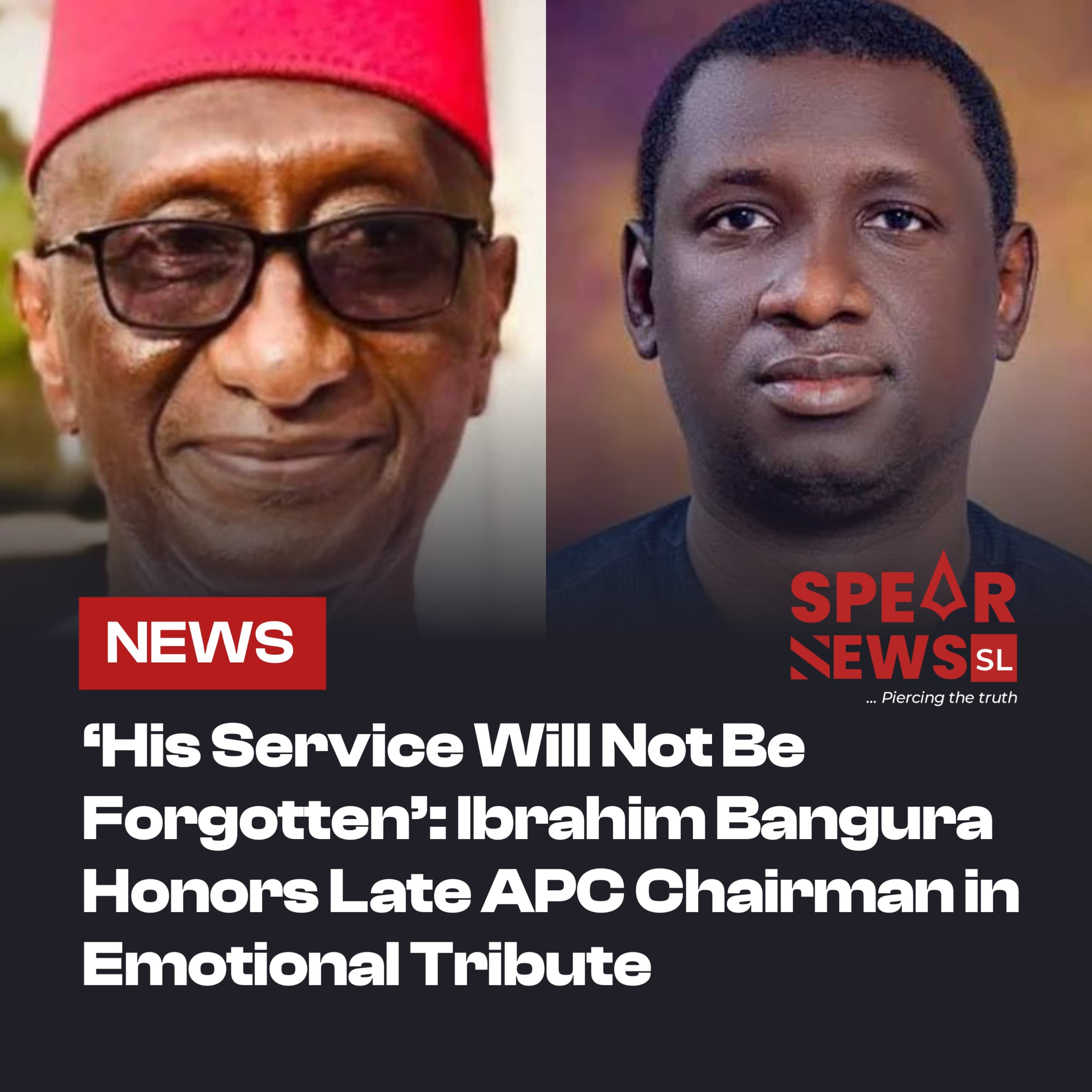

As Sierra Leone continues to mourn the death of All People’s Congress (APC) National Chairman Alhaji Minkailu Mansaray, one tribute has resonated deeply within the country’s political landscape.
Dr. Ibrahim Bangura, the academic, peacebuilding expert, and APC flagbearer aspirant whose profile has risen significantly within the opposition party in recent years, described the late chairman as a “distinguished statesman, committed party stalwart, and loyal servant of the people of Sierra Leone,” offering one of the most comprehensive reflections yet on the life and legacy of a man many considered the institutional backbone of the APC.
The statement, released on behalf of the DIB Movement, comes at a moment when the APC is grappling not only with the loss of one of its most senior leaders but also with questions about the future direction of the party ahead of the 2028 elections.
For many party supporters, Bangura’s message was more than a condolence note. It was a reminder of the extraordinary political journey of a man whose career stretched from the grassroots structures of the APC to the highest levels of government and party leadership.
Remembering a Political Institution

Few figures in modern APC history embodied continuity quite like Alhaji Minkailu Mansaray.
Long before he became National Chairman, he had already established himself as one of the party’s most trusted operatives and strategists.
According to Bangura, Mansaray’s commitment to the APC began in his youth when he served as President of the party’s then National Youth League, laying the foundation for a political career that would span decades.
His rise through the ranks mirrored the evolution of the APC itself.
From youth activism to Parliament, from Cabinet minister to Deputy Leader and ultimately National Chairman, Mansaray remained one of the few politicians whose influence transcended generations of party leadership.
His death in Dakar, Senegal, after a prolonged illness has left a void that many within the APC believe will be difficult to fill.
“His contributions to governance and national development will remain an enduring part of his legacy,” Bangura said in his tribute, reflecting a sentiment increasingly shared across Sierra Leone’s political divide.
The Making of a Statesman
Born in Tonkolili District and raised in Freetown, Mansaray’s path to national prominence began far from the intense spotlight of politics.
A graduate of Fourah Bay College, he first built a successful career in the insurance industry, working for the Sierra Leone National Insurance Company before entering public life. His professional background and administrative experience later became valuable assets in government and party leadership.
His political career accelerated following his election to Parliament in 2002, during a period when Sierra Leone was rebuilding after the civil war and democratic institutions were regaining strength.
When the APC returned to power under President Ernest Bai Koroma in 2007, Mansaray emerged as one of the administration’s trusted figures, serving first as Minister of Labour and Employment before later taking charge of the strategic Ministry of Mines and Mineral Resources.
His years in government cemented his reputation as a steady hand within the APC hierarchy and strengthened his standing among the party’s senior leadership.
Throughout his political life, he remained a close ally of former President Koroma and a key member of the APC National Advisory Council, one of the party’s most influential decision-making bodies.
Why Bangura’s Tribute Matters
The significance of Dr. Ibrahim Bangura’s tribute lies not only in what he said but in who he is becoming within the APC.
A respected academic and peacebuilding specialist, Bangura has emerged as one of the most prominent figures in the race to shape the future of the opposition party. He is a senior lecturer in Peace and Conflict Studies at Fourah Bay College and has worked extensively in governance, conflict resolution, and development initiatives across Africa. He has also become one of the leading aspirants seeking to lead the APC into the next electoral cycle. (IDDRTG)
Born into a family with deep APC roots, Bangura is the son of the late Senior Comrade M.L. Bangura, a founding figure of the APC National Youth League and former National Organising Secretary of the party. His political heritage and growing grassroots appeal have positioned him as one of the emerging voices within the APC’s next generation of leadership. (Independent Observer)
Over the past year, Bangura has intensified nationwide engagements under his “Heal, Unite, Build” platform while advocating party unity and reconciliation ahead of the 2028 elections. (nationalistsl.com)
It is perhaps unsurprising, therefore, that his tribute focused heavily on Mansaray’s role as a unifier.
“For many within our party, Alhaji Minkailu Mansaray was more than a leader; he was a source of counsel, stability, and institutional memory,” Bangura wrote.
That observation captures what many APC members fear losing most.
A Party Elder During Difficult Times
Mansaray’s final years as chairman coincided with one of the most challenging periods in the APC’s recent history.
The party navigated internal disputes, constitutional debates, legal challenges, and the aftermath of contentious elections.
Amid those challenges, many members viewed Mansaray as a stabilizing force whose experience helped preserve cohesion within the party.
Unlike younger politicians seeking visibility through public confrontation, Mansaray often exercised influence quietly through consultation, mediation, and consensus-building.
That approach earned him respect from both allies and rivals.
Political observers frequently described him as one of the APC’s last remaining elder statesmen whose authority stemmed not merely from position but from decades of service and sacrifice.
The Legacy He Leaves Behind
As arrangements continue for the return of his remains to Sierra Leone, tributes have continued to flow from across the political spectrum.
Yet Bangura’s message may prove among the most significant because it connects two generations of APC leadership.
One represents the party’s institutional memory and historical foundation.
The other represents a generation seeking to define its future.
In mourning Mansaray, Bangura was also acknowledging a legacy that helped shape the APC he now hopes to lead.
For Sierra Leone, the passing of Alhaji Minkailu Mansaray marks the end of a distinguished chapter in national politics.
For the APC, it is the loss of a trusted counselor, strategist, and loyal servant whose journey from youth activist to national chairman embodied a lifetime of dedication to party and country.
And as the nation reflects on that legacy, Bangura’s closing words continue to echo among supporters and political observers alike:
“His service and sacrifices will not be forgotten.”