

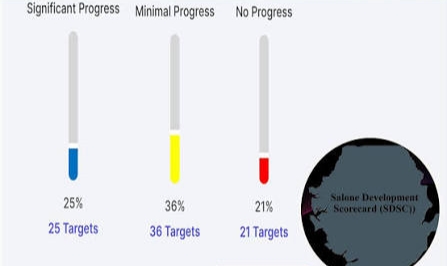
The Institute for Governance Reform (IGR) has called on the Government of Sierra Leone to intensify efforts toward fulfilling key national development commitments, warning that more than one-fifth of the targets outlined in the country’s development blueprint remain stagnant or have shown little to no progress.
The appeal follows the recent launch of the Salone Development Scorecard, an accountability tool designed to monitor the government’s performance under the Medium-Term National Development Plan (MTNDP) 2024–2030. While acknowledging progress in several sectors, IGR expressed concern that 21 out of 100 priority targets remain stalled despite the administration being more than three years into its current term and over two years into implementation of the development plan.
According to the governance watchdog, the delayed targets cut across critical sectors that directly affect economic growth, social welfare, governance, security, and national development.
One of the areas highlighted is youth development, where efforts to reduce substance abuse among young people have yet to record significant progress. The organization noted that drug abuse continues to pose a major challenge for communities across the country, with little evidence of advancement toward the government’s stated objectives.
The mining sector also came under scrutiny. IGR observed that plans to rehabilitate five mined-out sites by 2028 have not commenced, while commitments to increase domestic mining revenue from six percent in 2022 to ten percent by 2030 remain far from realization. The institution warned that delays in these areas could undermine environmental sustainability and limit the sector’s contribution to national revenue generation.

Public sector modernization was identified as another area facing setbacks. Targets aimed at transitioning government workers from paper-based systems to digital platforms, centralizing job advertisements through a single recruitment portal, and digitizing reporting mechanisms were expected to be completed by 2026. However, IGR stated that these reforms remain largely unfinished.
The organization further raised concerns over gender and social development indicators. Commitments to significantly reduce adolescent pregnancy and lower cases of physical and sexual violence have shown little measurable progress. Advocates continue to warn that the persistence of these challenges threatens the well-being and future prospects of thousands of women and girls nationwide.
In the area of trade and industrialization, IGR reported that ambitions to increase manufacturing’s contribution to the national economy and boost export output have yet to gain meaningful traction. Similar concerns were raised regarding social protection measures intended to improve the welfare of persons with disabilities and reduce incidents of child abuse and neglect.
Security and governance reforms also feature prominently among the delayed priorities. The institute noted that plans to modernize the Republic of Sierra Leone Armed Forces and achieve a substantial reduction in national crime rates remain off track. These commitments were originally intended to strengthen national security and enhance public confidence in state institutions.
The information and communications technology sector has also experienced setbacks. IGR pointed specifically to the proposed establishment of a Smart City in Bo District, a flagship initiative expected to drive technological innovation and digital transformation, which has yet to make notable progress.
Economic governance reforms have similarly lagged behind expectations. Among the most significant outstanding commitments is the establishment of a sovereign wealth fund to manage revenues generated from the country’s natural resources. Analysts have long argued that such a fund would help safeguard future generations and promote sustainable economic management.
Environmental and climate-related goals remain another source of concern. Efforts aimed at improving Sierra Leone’s resilience to climate change and reducing the country’s vulnerability to environmental shocks have not achieved the desired progress. At the same time, planned reforms within the Ministry of Foreign Affairs, including the digitization of a majority of its operations, remain incomplete.
Education sector reforms have also been affected, particularly efforts to integrate technical and vocational education more deeply into the national curriculum. The initiative is viewed as a key strategy for equipping young people with practical skills needed to compete in the modern labor market.
Additionally, IGR highlighted delays in peacebuilding and national cohesion programs intended to strengthen democratic culture, promote political tolerance, and encourage constructive engagement among political actors.
The organization stressed that these commitments are not merely policy statements but measurable development targets that citizens can use to assess government performance. It warned that continued delays could undermine public confidence in the Medium-Term National Development Plan and slow the country’s broader development agenda.
IGR therefore urged the government to accelerate implementation efforts, strengthen monitoring mechanisms, and ensure that resources are directed toward priority areas requiring urgent attention. The institution maintained that timely delivery of the outstanding commitments is essential for achieving sustainable economic growth, social inclusion, improved governance, and long-term national stability.
As implementation of the MTNDP enters another critical phase, the institute emphasized that progress on these targets will serve as an important test of the government’s ability to translate policy promises into tangible outcomes for the people of Sierra Leone.