

Spear News Sierra Leone | Special Investigative Report | October 15, 2026
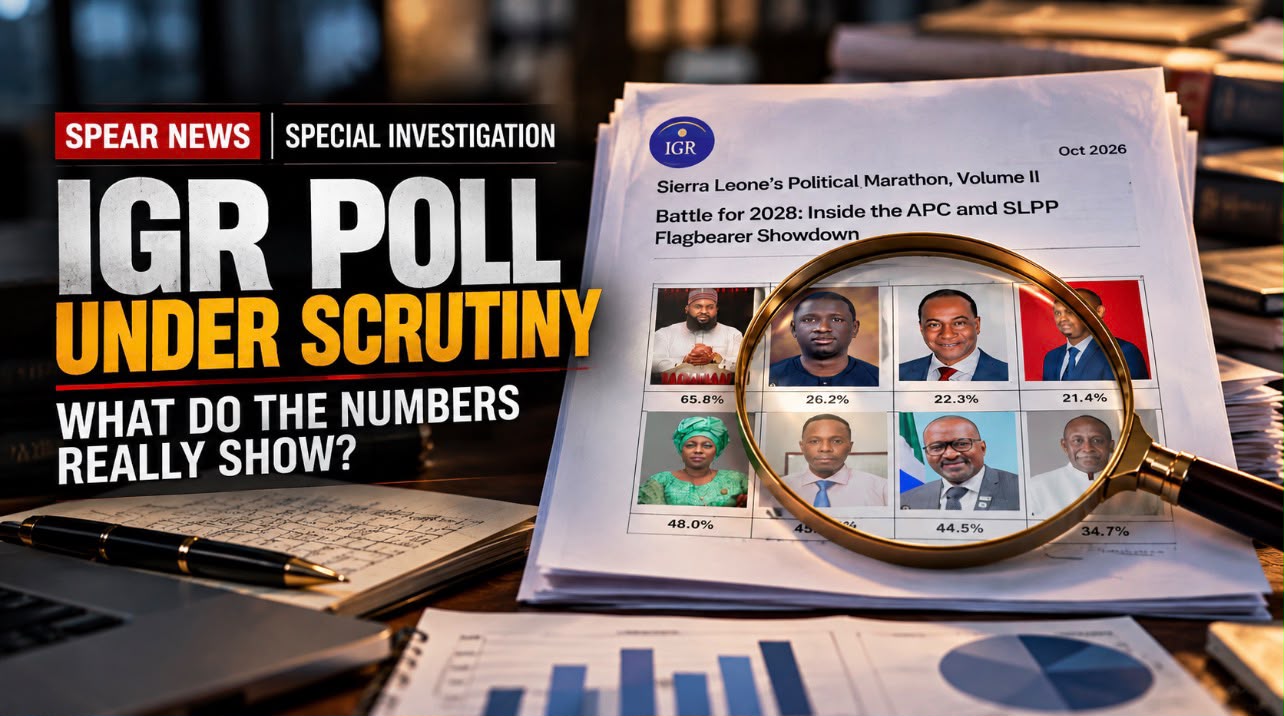
The Institute for Governance Reform’s (IGR) latest report on the anticipated 2028 presidential flagbearer contests of the All People’s Congress (APC) and the Sierra Leone People’s Party (SLPP) has generated renewed attention around the political fortunes of businessman Mohamed Omodu Kamara, popularly known as Jagaban, and First Lady Fatima Bio.
But a closer examination of the published findings raises important questions about how the figures are presented, how different respondent groups are combined, and whether the available evidence supports the political conclusions readers may draw from them.
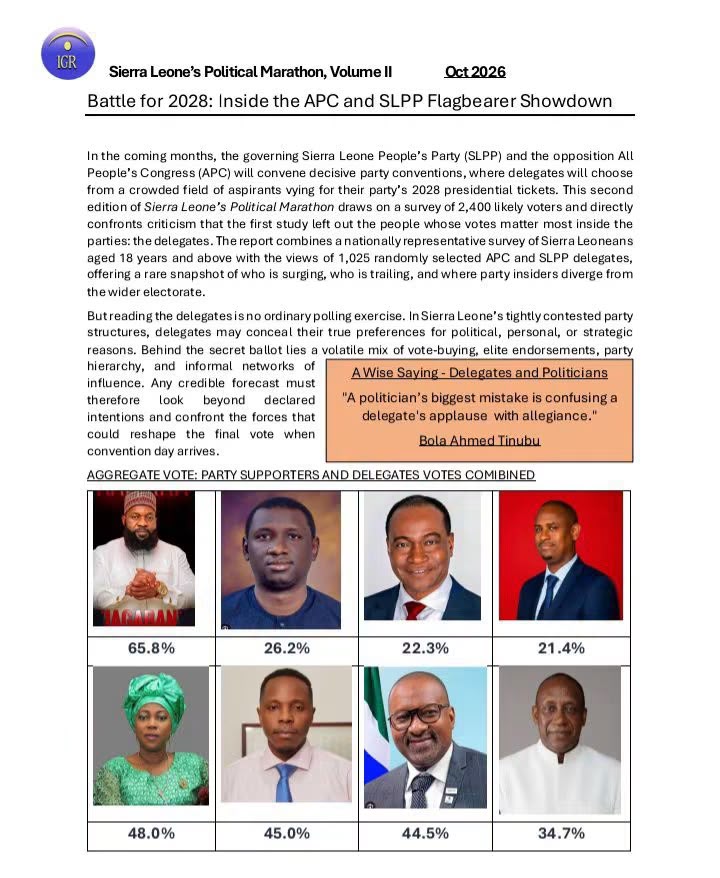
The report, titled Sierra Leone’s Political Marathon, Volume II: Battle for 2028 — Inside the APC and SLPP Flagbearer Showdown, was reported by Sierra Leone Monitor and Sierraloaded on October 14, 2026. Both publications attribute to IGR a survey involving 2,400 likely voters and 1,025 randomly selected APC and SLPP delegates. The coverage identifies Jagaban at 65.8 per cent and Fatima Bio at 48 per cent when ordinary party supporters’ preferences are combined with those of delegates.
These figures are attributable to IGR’s reported findings. However, the question facing the public is whether the published information provides enough evidence to independently assess how the figures were obtained and what they actually mean.

THE FIRST PROBLEM: THE PUBLICATION DOES NOT, ON THE AVAILABLE PAGE, SHOW THE COMPLETE METHODOLOGY
The page examined by Spear News states that 2,400 likely voters were surveyed alongside 1,025 delegates aged 18 and above. It also describes the delegates as randomly selected.
Random selection can be an important safeguard against selection bias. However, a statement that respondents were randomly selected does not, by itself, establish that the sample represents the wider population of eligible party delegates.
To assess that claim, readers need to know how the researchers identified eligible delegates, which party records or sampling frames they used, how respondents were selected, and whether the final sample adequately represented the different regions and organisational structures of both parties.
The available page does not provide the fieldwork dates, the breakdown of delegates by party, the response rate, the weighting procedures or the statistical uncertainty associated with the estimates.
This is a limitation of the material available for examination, not proof that IGR did not conduct the procedures in question. The full report and its supporting methodological documentation are needed before a definitive conclusion can be reached.
THE SECOND PROBLEM: HOW WERE ORDINARY SUPPORTERS’ PREFERENCES COMBINED WITH DELEGATE PREFERENCES?
This is one of the most consequential questions raised by the findings.
The published coverage attributes the 65.8 per cent figure to a combination of ordinary APC supporters and delegates, while the 48 per cent figure for Fatima Bio is presented in the same general context of combined preferences.
Yet ordinary party supporters and convention delegates are different populations. A survey of the wider party-supporting public can measure political popularity, but a delegate survey seeks to measure preferences among those who may actually cast votes at a party convention.
Those measures answer different questions.
A candidate could enjoy substantial popularity among party supporters without commanding the same level of support among delegates. Equally, a candidate with a smaller grassroots following might have significant backing within the party structures that determine the eventual nomination.
Combining these populations is not necessarily invalid. However, it requires a transparent and defensible methodology.
IGR should explain whether the figures were calculated by pooling responses, weighting each respondent group, constructing an index or applying another statistical model. It should also explain why the chosen method is appropriate for assessing a convention in which eligible delegates, rather than the wider party-supporting population, determine the outcome.
Without that explanation, readers cannot independently reproduce the calculation or determine how much influence each respondent group has on the final percentage.
THE THIRD PROBLEM: THE PUBLISHED CHART REQUIRES CLEARER EXPLANATION
The graphic examined by Spear News displays four percentages in its first row: 65.8 per cent, 26.2 per cent, 22.3 per cent and 21.4 per cent. Its second row displays 48 per cent, 45 per cent, 44.5 per cent and 34.7 per cent.
The first row totals 135.7 per cent, while the second totals 172.2 per cent.
These totals do not, on their own, prove that the survey is mathematically wrong. Multiple-response questions, overlapping measures, separate denominators and independently calculated candidate percentages can legitimately produce totals above 100 per cent.
The problem is that the supplied graphic does not adequately explain the statistical meaning of the figures. Its heading, “Aggregate Vote: Party Supporters and Delegates Votes Combined,” does not establish whether each percentage represents an individual candidate’s preference, a measure of combined support, a multi-response result or a modelled projection.
Sierra Leone Monitor’s October 14 report offers one clarification: it says the delegate figures of 70.9 per cent for the APC and 62.4 per cent for the SLPP represent combined preferences for groups of three aspirants, rather than individual support for Jagaban or Fatima Bio alone.
That distinction matters. A group-level figure must not be presented as though it represents the personal support enjoyed by one candidate.
IGR should publish a clearly labelled table identifying every candidate, the question asked, the relevant denominator, the number of respondents, and whether respondents could select more than one aspirant. Until those details are available, the graphic is open to misinterpretation.
THE FOURTH PROBLEM: THE RESULTS DO NOT ESTABLISH WHO WILL WIN THE 2028 FLAGBEARER CONTESTS
The report is concerned with party conventions expected in 2027, ahead of Sierra Leone’s 2028 general elections.
The reported percentages may offer an indication of preferences among the people surveyed at the time. They do not constitute actual convention results.
The eventual outcome will depend on the eligible delegates, the candidates who formally contest, the parties’ applicable rules, developments within the parties and the voting process itself.
A survey can contribute to an informed discussion about political prospects. It cannot replace the convention vote, and a combined supporter-and-delegate percentage should not be treated as a direct forecast of the outcome unless a credible predictive model has been developed and validated.
Indeed, the contemporary coverage of IGR’s report acknowledges that the figures reflect current preferences that may change as the contests develop.
The appropriate conclusion, therefore, is that the reported results are a snapshot of stated preferences, not proof that either aspirant has secured a future party nomination.
THE FIFTH PROBLEM: COMPARISONS WITH IGR’S EARLIER RESEARCH MUST BE HANDLED CAREFULLY
IGR’s official website confirms that the first volume of Sierra Leone’s Political Marathon, published in December 2025, examined internal party democracy and reported that Jagaban was the only one among 26 rumoured aspirants from the APC and SLPP to receive more than 50 per cent endorsement from party members.
Contemporary reporting on that earlier study described a survey of 1,200 Sierra Leoneans conducted in December 2025. It reported Jagaban at 63 per cent for likability and 51 per cent for electability, while Kandeh K. Yumkella led the SLPP field on the reported measures of likability and electability.
Those results cannot automatically be treated as inconsistent with the new findings. The studies may have examined different respondent groups, asked different questions or used different calculations.
However, those differences must be clearly documented before readers can determine whether the new figures reflect changing political preferences, a change in the people surveyed or a change in the measurement method.
A meaningful comparison requires the full questionnaires, fieldwork dates, sampling methods, definitions of support and calculation procedures from both studies.
WHAT THE AVAILABLE EVIDENCE DOES NOT PROVE
The investigation has not established that IGR fabricated its data, that the survey was deliberately manipulated, or that the reported percentages are necessarily false.
It has also not independently verified the underlying dataset or reproduced the reported calculations.
The distinction is essential. A lack of publicly available methodological information is a legitimate reason to question the strength of a research conclusion. It is not sufficient evidence to accuse a research organisation of fraud or deliberate misinformation.
Similarly, the presence of IGR’s first volume on its official website and the publication of the second volume’s findings by news outlets provide evidence that the research series exists. They do not independently validate every statistical result attributed to the latest study.
The responsible conclusion is that important methodological questions remain unanswered by the material available for this examination.
QUESTIONS IGR SHOULD ANSWER
To strengthen public confidence in the findings, Spear News calls on IGR to clarify the following:
- When was the Volume II survey conducted, and can the full report and questionnaire be made publicly available?
- How were the 1,025 delegates selected, and how many respondents came from each party?
- What sampling frame was used, and how was the eligibility of each delegate established?
- How were the preferences of 2,400 likely voters combined with those of 1,025 delegates?
- What precisely do the percentages in the published graphic measure, and what explains their denominators?
- What are the margin of error, confidence level, response rate and principal limitations of the survey?
- What evidence supports the use of the combined figures as an indicator of the likely direction of the future conventions?
These questions are not an attempt to dismiss political research. They are the basic questions that readers should be able to ask of research being used to shape a national political conversation.
CONCLUSION: POLITICAL RESEARCH MUST BE TRANSPARENT ENOUGH TO BE TESTED
Sierra Leone’s 2028 political transition deserves serious research, open debate and responsible journalism. Surveys can help citizens understand party dynamics, but their value depends on transparent methods, clear definitions and conclusions proportionate to the evidence.
IGR’s reported figures have attracted attention because they concern two major parties and individuals associated with the emerging flagbearer debate. That makes independent scrutiny more important, not less.
At this stage, Spear News cannot responsibly declare the survey false. What the available evidence does establish is that the published page and the accompanying media coverage do not provide enough information to independently reproduce the headline calculations or fully assess the method used to combine ordinary supporters’ preferences with those of delegates.
Until the underlying methodology is made available and the questions are answered, the percentages should be treated as reported survey findings rather than independently verified forecasts of the APC and SLPP conventions.
Spear News invites the Institute for Governance Reform to respond to the questions raised in this investigation and will fairly reflect any substantive clarification or supporting evidence it provides.
Spear News Sierra Leone. Uncovering The Facts, Upholding Accountability.