

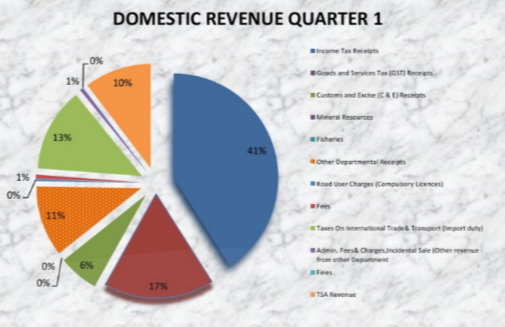

Income tax was the single largest contributor to Sierra Leone’s domestic revenue during the first three months of 2026, generating NLe 1.86 billion and accounting for 41 percent of total collections, according to official government figures.
The Domestic Revenue Analysis for the first quarter indicates that the government mobilized a total of NLe 4.52 billion in domestic revenue between January and March, with income tax serving as the primary driver of collections.
The Goods and Services Tax (GST) followed as the second-largest revenue stream, contributing NLe 779 million, equivalent to 17 percent of total revenue generated during the period.
Import duties and other taxes on international trade and transport brought in NLe 565 million, representing 13 percent of total receipts, while revenues collected through the Treasury Single Account (TSA) amounted to NLe 470 million, accounting for 10 percent.
Customs and excise taxes generated NLe 281 million, contributing six percent to the overall revenue performance for the quarter.

In addition, non-tax revenue sources—including administrative fees, fines, road user charges, and other government service payments—yielded NLe 563 million, representing 13 percent of total collections. Much of this was driven by a strong increase in departmental receipts, which reached NLe 497 million following improved collections in March.
Despite the encouraging performance of major tax categories, the report revealed notable weaknesses in revenue generation from key sectors expected to contribute significantly to government finances.
Both the mineral resources and fisheries sectors failed to record any revenue inflows during the first quarter, despite annual projections of NLe 1.29 billion and NLe 671 million respectively. The absence of contributions from these sectors has intensified concerns about revenue collection efficiency, regulatory compliance, and enforcement mechanisms.
With total domestic revenue reaching only 19 percent of the annual target of NLe 23.67 billion, the government faces a considerable challenge in meeting its fiscal objectives before the end of the year.
The latest figures suggest that while traditional tax streams continue to provide a dependable source of revenue, the country’s fiscal stability remains vulnerable to underperformance in strategic sectors such as mining and fisheries.
Financial observers caution that failure to strengthen resource-based revenue collection could increase pressure on government finances and potentially lead to greater dependence on borrowing to fund public expenditure and development priorities.