


The outcome of the All People’s Congress (APC) district executive elections in Kono has brought renewed attention to the political influence of Hon. Diana Konomanyi, following celebrations by supporters of Dr Ibrahim Bangura, popularly known as DIB, who have described the results as a major victory for grassroots mobilisation and local political organisation.
Commentaries emerging after the elections have portrayed the outcome as a setback for rival political networks and a demonstration that financial resources and campaign promises do not necessarily guarantee electoral success. At the centre of that narrative is Konomanyi, whom DIB supporters have credited with helping to consolidate political support behind Bangura’s camp.
While the claims about her precise role have not been independently established, the discussion surrounding the results highlights the importance of local alliances, established party structures and influential political figures in the APC’s evolving internal contest ahead of the 2028 presidential election.
In a commentary titled “DIB Sweeps The Unpredictable Kono District Yesterday,” political commentator Sahr Moigua argued that Bangura’s reported gains reflected groundwork and coordination rather than the influence of money or promises of development projects.
“Kono has spoken, and it has spoken loudly,” Moigua wrote, describing the outcome as a decisive moment in the district’s internal party politics.

Moigua characterised Kono as one of the most unpredictable districts in the APC’s internal elections and claimed that DIB had achieved a “100% sweep”. The phrase has featured prominently in the celebratory narrative surrounding the outcome, although the six district executive results supplied to Spear News do not, on their own, establish a sweep across every party position or demonstrate how delegates would vote in a separate presidential flagbearer contest.
The commentary also raised questions about the performance of the political network associated with Mohammed Omodu Kamara, popularly known as Jagaban. Moigua alleged that the camp had relied on money, bags of rice, donations and promises of projects but failed to secure an executive position in Kono.
The allegations concerning financial inducements and campaign spending have not been independently verified by Spear News. No response from Kamara or his representatives was included in the material reviewed.
Nevertheless, Moigua’s central argument was that delegates could not necessarily be persuaded to abandon longstanding political relationships simply because a rival camp had greater financial resources.
“The help you gave me yesterday is because you are my brother, not because you want me to deny my conscience,” he wrote, presenting the statement as an illustration of the attitude he believed had shaped delegates’ decisions.
He further argued that political organisations built around relationships in local communities could have an advantage over campaigns driven primarily by activities organised from Freetown.
“Kono wanted those who were there yesterday, not those who promise tomorrow,” Moigua wrote.
The observation reflects a wider debate within political parties about the relationship between campaign spending and grassroots credibility. Financial resources can help candidates organise meetings, communicate their programmes and maintain political networks, but they do not necessarily translate into votes when delegates have competing loyalties, personal relationships and expectations of leadership.
In Kono, the narrative advanced by DIB supporters is that sustained engagement and local coordination proved more persuasive than the campaign approaches they attributed to rival camps. Establishing whether that interpretation fully explains the outcome, however, would require more evidence about the candidates’ alliances, campaign activities and the considerations that influenced delegates.
Diana Konomanyi’s Place In The Kono Political Equation
Perhaps the most striking aspect of the post-election commentary has been the attention given to Hon. Diana Konomanyi, a prominent APC figure whose name has emerged repeatedly in supporters’ explanations of DIB’s reported gains.
Moigua described Konomanyi as the person behind the coordination of the successful political effort, arguing that her influence was exercised through strategy, advice, relationships and the ability to bring competing interests together rather than through public appearances alone.
“Where is Diana? She is in the victory. She is in the 100% sweep,” he wrote.
The commentary went further, describing her as “the strategist, the advisor, the pillar who held the umbrella over DIB’s camp.”
Those descriptions are political assessments from a supporter’s perspective, rather than independently confirmed accounts of Konomanyi’s formal role in the campaign. Nonetheless, they point to the importance her supporters believe she continues to hold in Kono’s political calculations.
According to Moigua, Konomanyi helped bring together interests across Gbane, Tankoro, Nimikoro, Kamara, Soa and Fiama, contributing to a broader coalition around Bangura’s camp. The account suggests that the reported outcome may have involved more than the mobilisation of individual candidates, reflecting efforts to align different local networks around a common political objective.
If substantiated, such coordination would underline the value of political experience and relationships in district-level contests, where candidates often depend on local organisers and community connections to build support.
It would also illustrate a distinction between visibility and influence. A political figure does not necessarily need to dominate public rallies or appear at the centre of every campaign activity to shape political outcomes. Influence may also be exercised through consultations, negotiations and the ability to encourage cooperation among groups that might otherwise compete with one another.
However, the extent of Konomanyi’s contribution remains a matter requiring further confirmation. The available commentary does not independently establish the details of her involvement or demonstrate that the results would have been different without her intervention.
For now, her prominence in the post-election discussion is itself politically significant: supporters are presenting her as a figure whose relationships and experience remain relevant to the APC’s grassroots politics.
What The Results Show
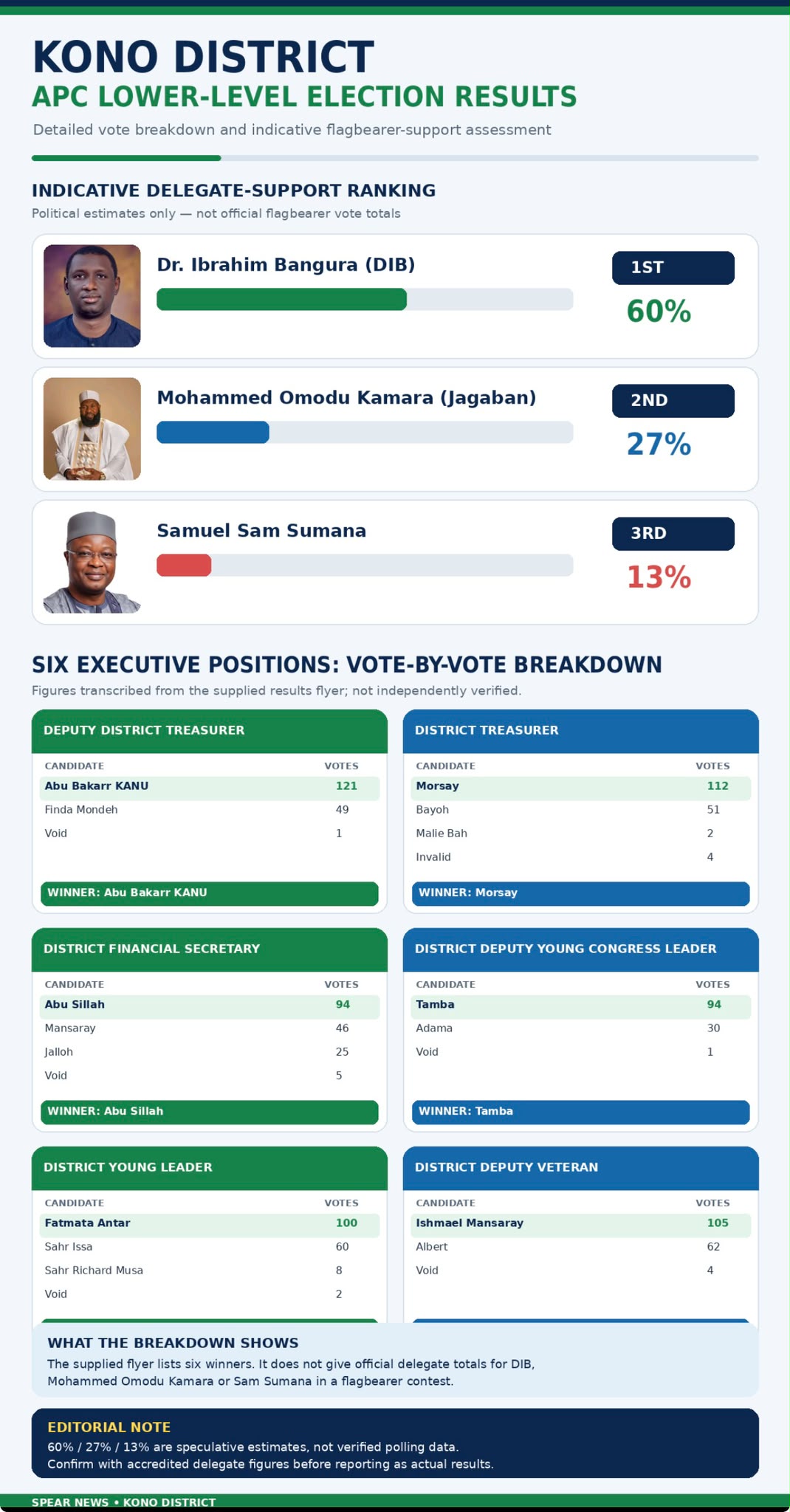
The district executive results supplied to Spear News recorded victories in six positions. Abu Bakarr Kanu won Deputy District Treasurer with 121 votes; Morsay secured District Treasurer with 112 votes; and Abu Sillah won District Financial Secretary with 94 votes.
Tamba won Deputy Young Congress Leader with 94 votes, while Fatmata Antar secured the Young Leader position with 100 votes. Ishmael Mansaray won Deputy Veteran Leader with 105 votes.
The figures provide a more concrete basis for assessing the individual contests than broad declarations of political victory. However, the results alone do not identify the political alignment of every successful candidate. The claim that the outcome represents a comprehensive victory for DIB’s camp therefore depends on confirming the relationships between the winners and the different aspirant groups.
The results also need to be understood within the scope of the elections themselves. District executive contests determine who occupies positions in the party’s local structure; they are not the same as a direct vote for the APC’s presidential flagbearer.
That distinction matters as political camps interpret the results in the context of the 2028 race. Success in local party elections may strengthen an aspirant’s network, improve access to organisers and demonstrate the capacity to mobilise supporters. It does not, by itself, establish the eventual distribution of support in a national nomination contest.
For DIB, the political value of the reported gains may therefore lie in the organisational relationships that helped produce them and whether those relationships can be maintained beyond the immediate elections.
“Integrity Over Money”: A Message Beyond Kono
A separate statement dated October 19, attributed to Dr Conteh, identified as the newly elected APC Kono District Deputy Public Relations Officer, presented the outcome as a reminder that delegates retain the responsibility to make independent choices.
The statement argued that the elections had generated discussion about the power of delegates to vote according to their convictions, leadership expectations and assessment of the party’s future. It also alleged that substantial sums had been spent by some aspirants seeking to influence the contests, although it did not provide independently verifiable evidence for those claims.
The statement’s central message was expressed in the phrase “INTEGRITY OVER MONEY”, which supporters have adopted as a summary of their interpretation of the results.
“Money may play a role in political contests, but the final decision rests with those entrusted with the responsibility to vote,” the statement said.
The message carries political weight because internal party elections can test whether delegates prioritise financial considerations, personal relationships, promises of development, loyalty to established leaders or confidence in a candidate’s capacity to represent their interests.
Yet the broader question is not simply whether money matters. It is whether candidates can build durable political relationships, communicate credible plans and maintain the confidence of delegates after the immediate campaign has ended.
The language of integrity also places an obligation on the victorious camps. If supporters argue that the results reflect independent decision-making and a rejection of financial influence, the same principles should guide how the new district executives exercise their responsibilities and engage members who supported opposing candidates.
A victory framed around integrity and unity would be weakened if it led to exclusion, retaliation or deeper divisions within the party.
Unity After The Contest
The post-election discussion has also placed renewed emphasis on the challenge of maintaining unity within the APC after competitive internal elections.
Bangura has previously urged party supporters to embrace reconciliation, discipline and mutual respect following internal contests. During an engagement in Port Loko on October 5, he called on members to avoid allowing electoral disagreements to create lasting divisions, including among those whose preferred candidates did not win.
That message is relevant to Kono, where the celebration of political gains now needs to be balanced with the responsibility of bringing party members together.
District elections can strengthen a political organisation when they produce leaders capable of working across factions. They can also deepen existing rivalries when the result is interpreted as a permanent victory for one camp over another.
For the APC, the more consequential test will be whether the newly elected executives can serve the wider party membership, regardless of the alliances that brought individual candidates to office.
For DIB, the reported outcome offers an opportunity to demonstrate that grassroots mobilisation can be translated into broader political engagement. For Konomanyi, the attention surrounding her alleged role underscores the continuing interest in the influence of established party figures and their ability to connect local structures with wider political ambitions.
The claims of a comprehensive sweep and the allegations surrounding campaign spending remain subject to verification. But the reaction to the Kono elections has already made one issue clear: the struggle for influence within the APC is not being fought only through public declarations by presidential aspirants. It is also being shaped by local alliances, party structures, trusted organisers and the relationships that candidates cultivate among delegates.
As the APC looks towards its 2028 flagbearer contest, Kono’s internal elections will be examined not merely for the names of the winners, but for what they may reveal about organisation, political trust and the evolving balance of influence within the party.
The message celebrated by DIB supporters is “integrity over money” and “unity over division”. Whether those ideals become lasting features of the party’s internal politics will depend on how its leaders respond to the results and whether today’s victories can be converted into cooperation rather than further factional competition.