

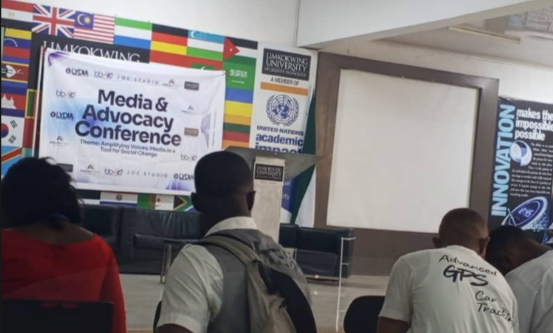

The Lydia Network has hosted its first Media and Advocacy Conference in Freetown as part of efforts aimed at empowering young people with media literacy, advocacy skills, and leadership knowledge to drive social change within their communities.
The conference, held on Monday, May 19, 2026, at Limkokwing University in Freetown, was organized under the theme: “Amplifying Voices: Media as a Tool for Social Change.”
The event attracted media owners, journalists, communication professionals, students from various universities, and youth advocates from across the country.
Speaking during the conference, the Executive Director of Lydia Network, Lydia Kadie Tucker, emphasized the importance of creating platforms that equip young people with the tools and opportunities needed to contribute meaningfully to national development.
She described young people as changemakers capable of transforming communities when empowered with knowledge, leadership, and opportunities.

“A community becomes stronger when young people are informed, included and empowered to turn their ideas into meaningful social impact,” she said.
According to her, youth participation should go beyond mere representation and must instead focus on giving young people the opportunity to speak, lead, create, and influence society positively.
“Youth participation is not just about being present; it is about giving young people the platform to speak, lead, create, and shape the future,” Tucker stated.
She further noted that when young people are equipped with the right knowledge and leadership skills, they become catalysts for long-term community development and social transformation.
Delivering the keynote address, the Chief Executive Officer of BBN, Ransford Wright, encouraged participants to use media platforms responsibly to influence positive social change and amplify unheard voices.
“Social change begins when someone chooses to speak with courage, share with purpose, and use their platform to demand better,” Wright said.
He urged young people to become intentional about using their voices to address societal issues and advocate for vulnerable and underrepresented communities.
“We need to be responsible as young people and be ready to amplify unheard voices, whether yours or those of other people, so we can create change. Young people, it’s on us to amplify the voices that aren’t being heard,” he added.
Wright also stressed that meaningful impact through media is not limited to owners of television stations, newspapers, or radio platforms.
“Media is powerful when you use your voice. You do not need to own a television station, a newspaper, or a radio platform to create change. Sometimes, all you need is your voice, your phone, and a clear purpose,” he stated.
Also speaking at the event, the Strategic Communications Adviser at the Ministry of Information and Civic Education, Mohamed Jaward Nyallay, commended the initiative, describing it as an important platform for rebuilding civic consciousness among young people.
“Programs like this help build civic consciousness among young people. They remind us that media, communication, and digital platforms can be used for more than visibility. They can educate citizens, promote social good, amplify positive stories, and inspire responsible action within our communities,” Nyallay said.
He encouraged young people to take advantage of modern communication tools and social media platforms to promote unity, education, and positive social values.
“As a generation, we already have a voice. We have platforms, networks, mobile devices, and influence. The question is no longer whether we can speak, but whether our voices will promote unity, educate communities, amplify good work, and help build the society we truly want to see,” he said.
Nyallay added that the rise of digital communication has placed significant influence in the hands of young people, making it necessary for them to use that influence responsibly.
“The microphone is no longer in the hands of journalists alone; it is now in the hands of millions of young people. The real challenge before us is not whether we have a voice, but what kind of society we want to build with the power of that voice,” he noted.
Head of the Communications Department at Limkokwing University, Hassan Kamara, also highlighted the importance of using media to amplify marginalized voices and drive social progress.
“When marginalized voices are amplified with clarity, truth, and courage, they become instruments of reflection, progress, and positive transformation in society,” Kamara stated.
The conference formed part of broader efforts by the Lydia Network to promote youth engagement, responsible communication, civic participation, and advocacy through media and digital platforms.