

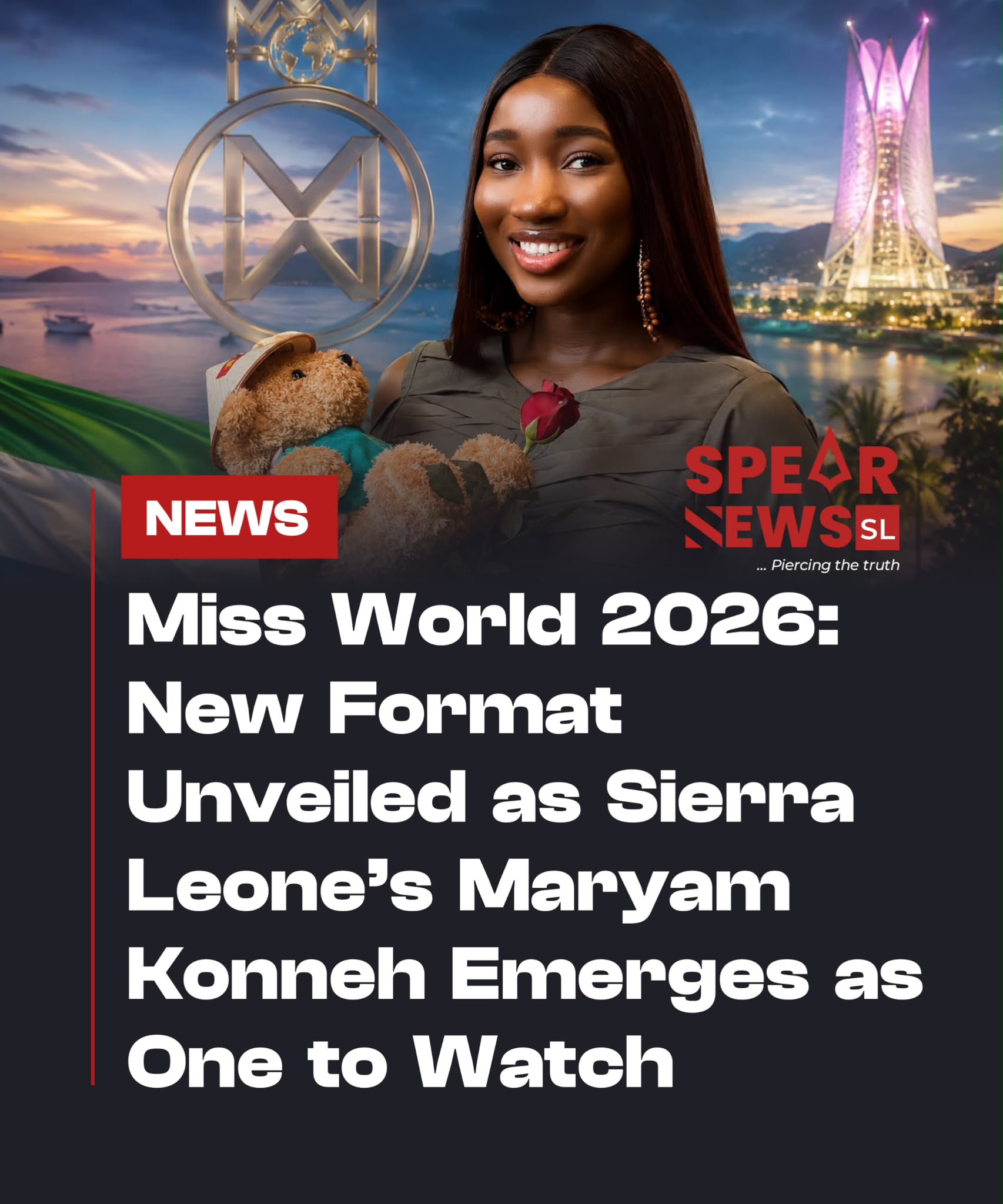
The road to the Miss World 2026 crown has entered a new phase following the unveiling of the official competition format for the 75th Anniversary edition, with Sierra Leone’s Maryam Lorba Konneh emerging among the African contestants attracting growing attention ahead of the global final in Vietnam.
The Miss World Organisation has announced a revamped qualification structure that will determine how the 111 national representatives competing this year progress from the opening stages to the final six contestants who will ultimately compete for the crown.
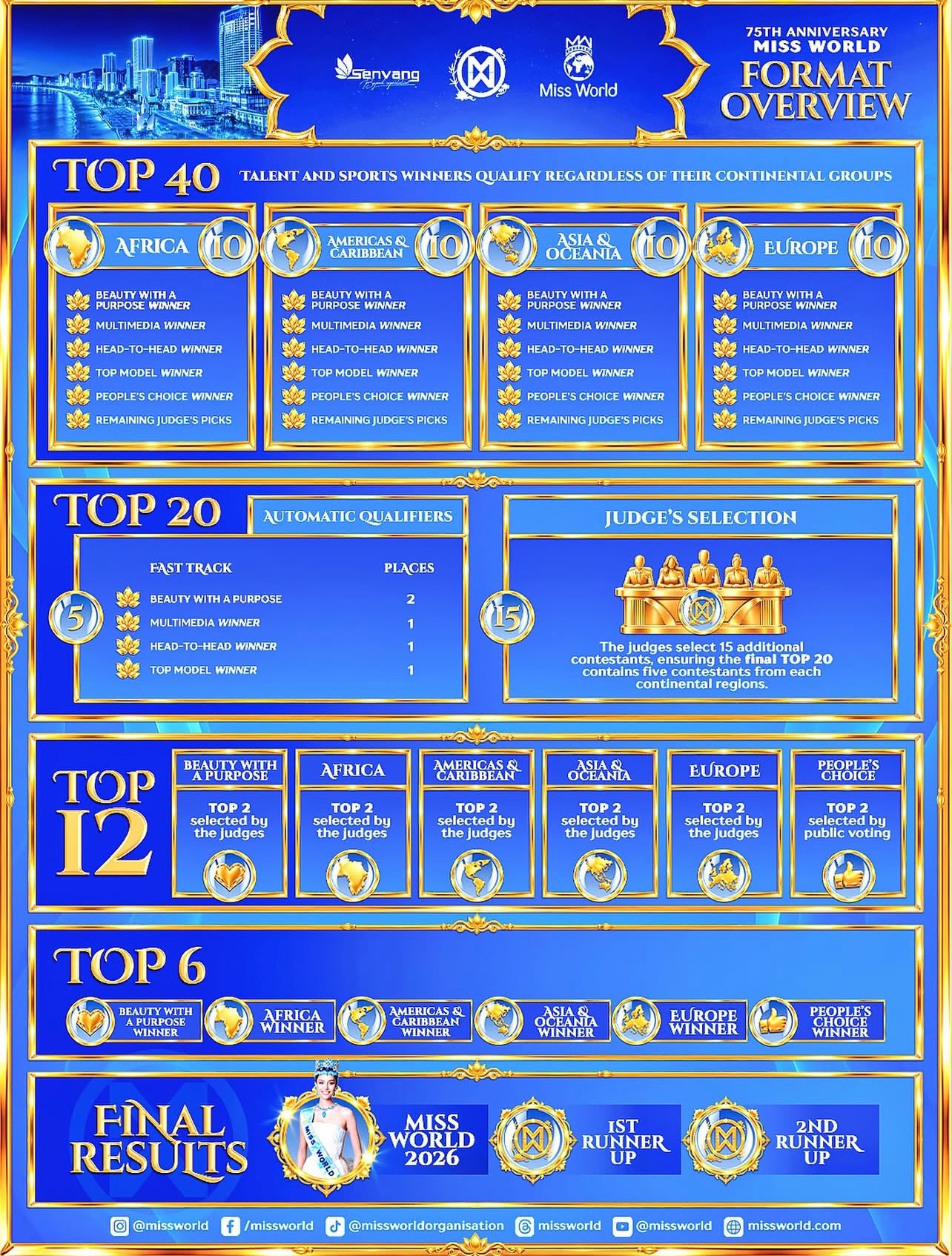
The new format places a greater emphasis on fast-track competitions, regional representation, public participation and the judges’ selections, creating several routes through which contestants can advance.
The competition will begin with the selection of a Top 40, with the contestants divided across four continental regions, Africa, the Americas and Caribbean, Asia and Oceania, and Europe. Each region will produce 10 contestants.
According to the format released by the Miss World Organisation, winners of the major challenge events will qualify for the Top 40 regardless of their continental grouping. These include Beauty With a Purpose, Multimedia, Head-to-Head, Top Model and People’s Choice, while the remaining positions will be determined through the judges’ selections.

The structure means that the journey towards the crown will not depend exclusively on a single final-stage assessment. Contestants will have multiple opportunities to secure their places by demonstrating strength in areas ranging from advocacy and communication to modelling, digital engagement and public popularity.
From the Top 40, the competition will narrow to a Top 20.
The Top 20 will comprise automatic qualifiers emerging from the fast-track competitions, alongside 15 additional contestants selected by the judges. The organisation says the judges’ selections will ensure that each of the four continental regions is represented in the next stage.
The competition will then move to the Top 12, where the continental structure becomes even more significant.
Two contestants will be selected from Africa, two from the Americas and Caribbean, two from Asia and Oceania and two from Europe. The remaining places will go to two contestants selected through Beauty With a Purpose and two through the People’s Choice route.
The final six contestants will then be determined through another distinct structure, comprising the Beauty With a Purpose winner, the four continental winners and the People’s Choice winner.
It is within this increasingly competitive pathway that Sierra Leone’s Maryam Lorba Konneh will seek to make history for the country.
Konneh’s participation has generated considerable interest in Sierra Leone, particularly because of her advocacy work and the broader social-development message she has brought to her Miss World campaign.
Her association with Maryam’s Ways Foundation, which has focused on initiatives including menstrual hygiene, girls’ dignity, education and community empowerment, gives her a platform that aligns closely with the Beauty With a Purpose philosophy at the centre of the Miss World competition.
That component could prove important under the newly announced format.
Rather than viewing the competition solely through the traditional lens of beauty and runway performance, the structure gives contestants an opportunity to build a case for themselves through advocacy, social impact, communication, multimedia engagement and public support.
For Konneh, that potentially creates more than one route towards the later stages of the competition.
There is also growing attention from outside Sierra Leone.
A prediction published by The Crown Jewels – Pageants, a third-party pageant platform, has included Konneh among its predicted leading African contenders for Miss World 2026.
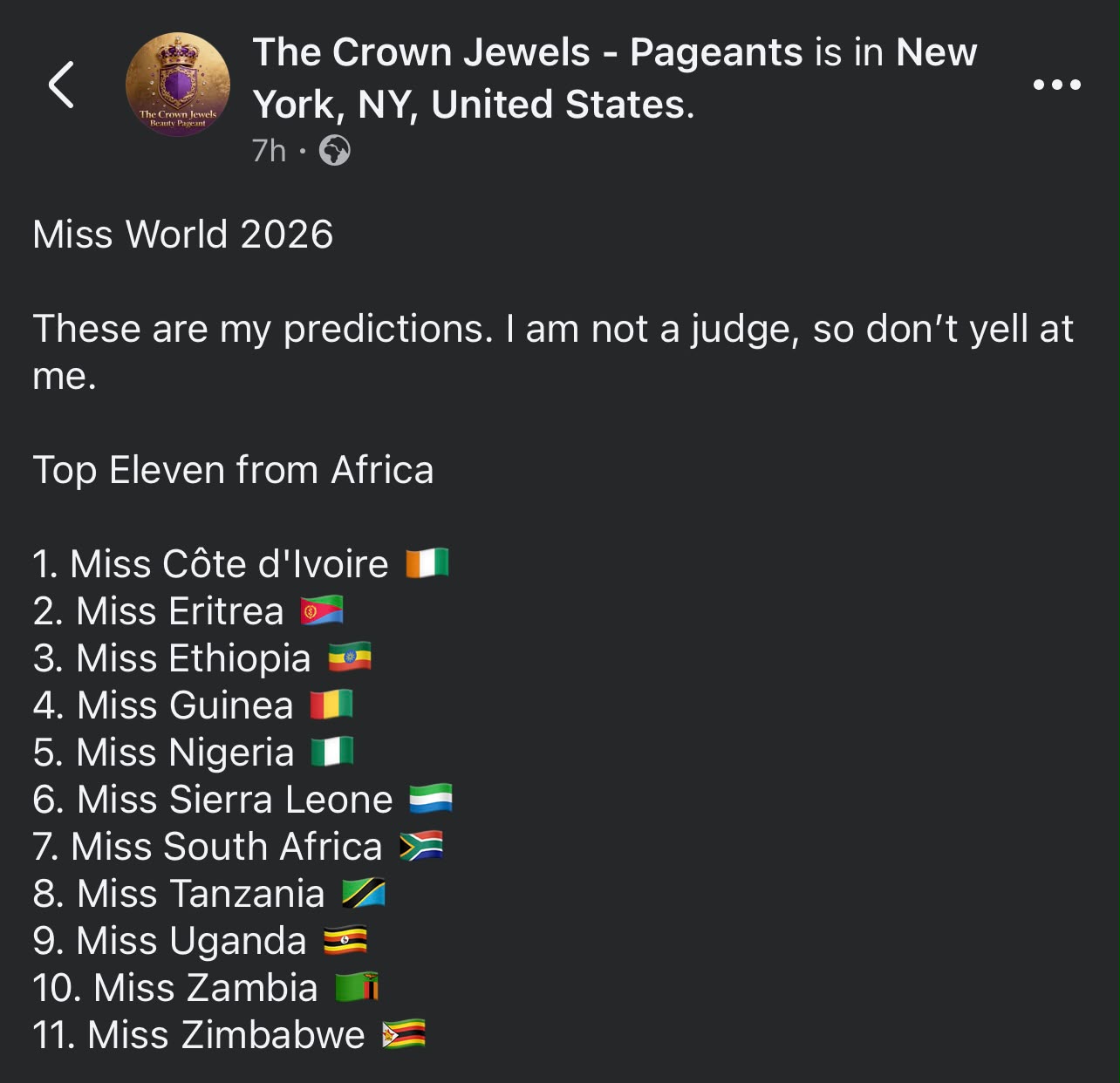
The prediction places Miss Sierra Leone sixth among its projected Top 11 African contestants, behind Côte d’Ivoire, Eritrea, Ethiopia, Guinea and Nigeria, while ranking her ahead of representatives from South Africa, Tanzania, Uganda, Zambia and Zimbabwe.
The ranking is not an official Miss World assessment and does not determine qualification. However, its inclusion of Sierra Leone among the African contestants considered capable of making an impact provides an indication of the attention beginning to surround Konneh ahead of the competition.
The same prediction names Jamaica, Nigeria, the Philippines, Italy and Venezuela among its projected global Top Five, with Côte d’Ivoire, Croatia, India, Trinidad and Tobago and Brazil completing its predicted Top 10.
For Sierra Leone, however, the significance lies less in the prediction itself than in the fact that Konneh is beginning to appear in conversations about potential African contenders.
The official Miss World format makes the African competition particularly important.
With only two African contestants guaranteed a place in the Top 12 through the continental selection, the race among delegates from the continent is expected to be intense. A strong performance in the fast-track events could therefore provide a crucial advantage to contestants seeking to avoid relying solely on the judges’ final selections.
Konneh’s challenge will be to translate her advocacy and public profile into performances capable of carrying her through each successive stage.
The People’s Choice route also introduces another dimension to the competition. Powered by public participation, the pathway gives supporters the opportunity to influence a contestant’s progress, potentially allowing a nationally supported candidate to advance further than conventional judging alone might suggest.
For Sierra Leone, this makes public mobilisation around its representative potentially significant.
But the road to the crown remains demanding.
The new format creates a series of increasingly narrow gates, beginning with 111 contestants and eventually leaving only six women standing. At every stage, contestants will have to demonstrate that they possess more than the qualities expected of a conventional pageant participant.
They will need to communicate, advocate, engage audiences, perform under pressure and demonstrate the ability to represent their countries on one of the world’s most prominent international beauty and purpose platforms.
For Konneh, the opportunity is particularly significant.
Sierra Leone has produced contestants who have commanded attention on international pageant stages, but the Miss World crown remains an elusive prize. A deep run by Konneh would therefore carry significance beyond her individual campaign and could become one of the country’s most notable moments in the history of the competition.
The 75th Anniversary edition also gives the contest an added sense of occasion.
The Miss World 2026 journey will culminate on September 5 in Nha Trang, Vietnam, where the new Miss World will be crowned.
Until then, the focus will remain on the preliminary competitions and the contestants capable of turning early attention into sustained momentum.
For Sierra Leone, Maryam Konneh enters that race with both expectation and opportunity.
The third-party prediction may be only a forecast, and the official Miss World organisation has made no guarantee about who will advance. But being identified as one of Africa’s contestants to watch adds another layer to a campaign that is increasingly drawing attention.
The new Miss World format has effectively opened several doors to the crown.
For Konneh, the task now is to find the right one and walk through it.