

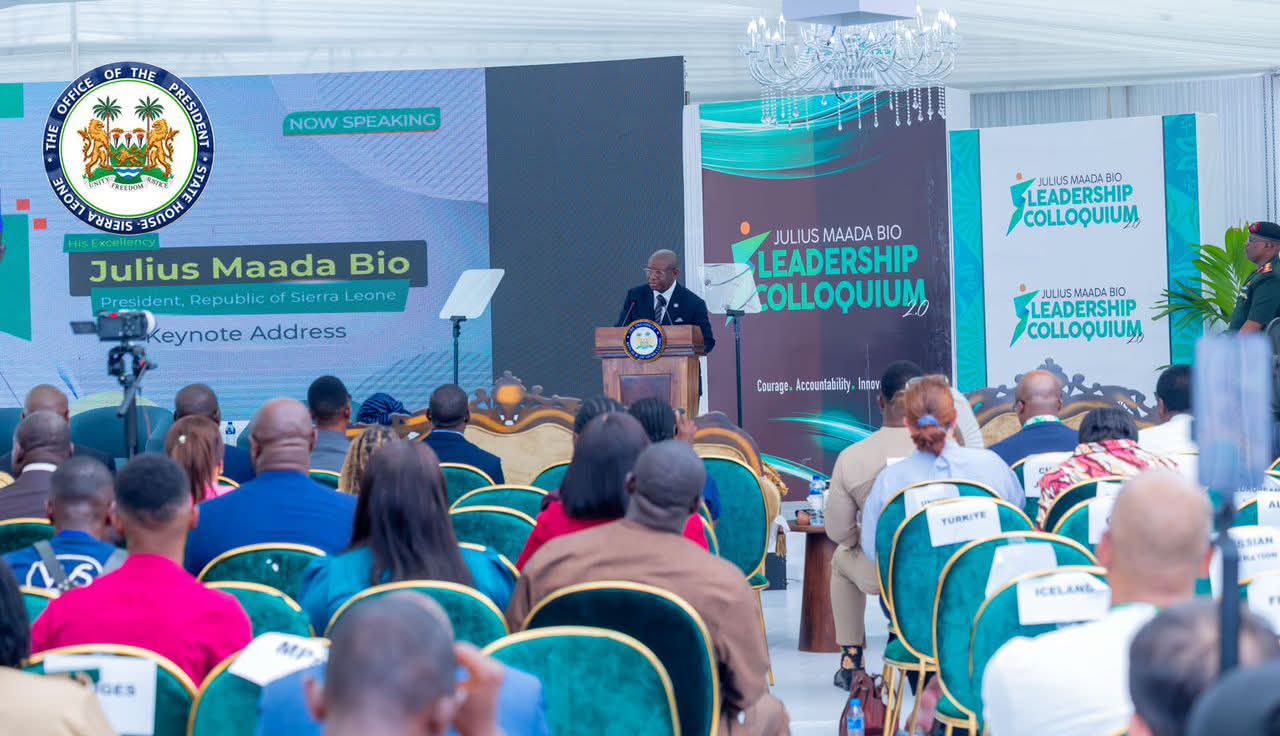

President Julius Maada Bio on Wednesday hosted a high-level Africa Leadership Colloquium at the Freetown International Conference Center, bringing together African leaders, diplomats, youth representatives, policymakers, traditional rulers, and women leaders to discuss the future of governance and leadership across the continent.
The colloquium, organized by the African Young Leadership Convergence as part of activities marking President Bio’s birthday, was held under the theme: “Reimagining African Leadership: Courage, Accountability, Innovation and Leadership in an Era of Global Uncertainty.
”The gathering focused on promoting democratic accountability, innovation, inclusive governance, and transformative leadership at a time of increasing political and economic uncertainty across Africa and the wider global community.
Delivering welcome remarks, Sierra Leone’s Vice President, Mohamed Juldeh Jalloh, described President Bio as a courageous and visionary leader whose commitment to human capital development and inclusive governance continues to strengthen Sierra Leone’s reputation on the African continent.
Former Commonwealth Secretary-General, Patricia Scotland, commended President Bio for prioritizing education, women’s empowerment, and democratic inclusion. She urged African governments to expand opportunities for women in leadership and decision-making roles.

Also speaking at the event, former Malawian President Joyce Banda praised Africa’s progress in advancing women into leadership positions, noting that the continent has produced more female presidents than several regions globally.
She further encouraged African governments to create sustainable opportunities for young people in order to tackle unemployment and reduce unsafe migration.
The colloquium featured panel discussions centered on governance, youth participation, innovation, accountability, and women’s inclusion, with participants highlighting practical solutions to Africa’s socio-political and economic challenges through people-centered leadership.
In his keynote address, President Bio said the gathering represented more than a ceremonial event, describing it as “a reckoning, both reflection and responsibility.
”“We are here to confront a defining and unavoidable question: What kind of leadership will shape Africa’s future in this century?” the President stated.
President Bio stressed that Africa must embrace decisive leadership, accountability, and innovation capable of driving structural transformation across the continent.
“The era of managing decline while speaking the language of transformation must end,” he declared, adding that leadership should be measured not by how long leaders remain in power, but by the impact they make on institutions and citizens’ lives.
Reflecting on his transition from military ruler to democratic statesman, the President recalled his decision in 1996 to hand over power to a democratically elected civilian government, describing the move as an act of democratic conviction rather than political convenience.
He maintained that true leadership demands sacrifice, responsibility, and the courage to make difficult decisions in the interest of national development and democratic stability.