

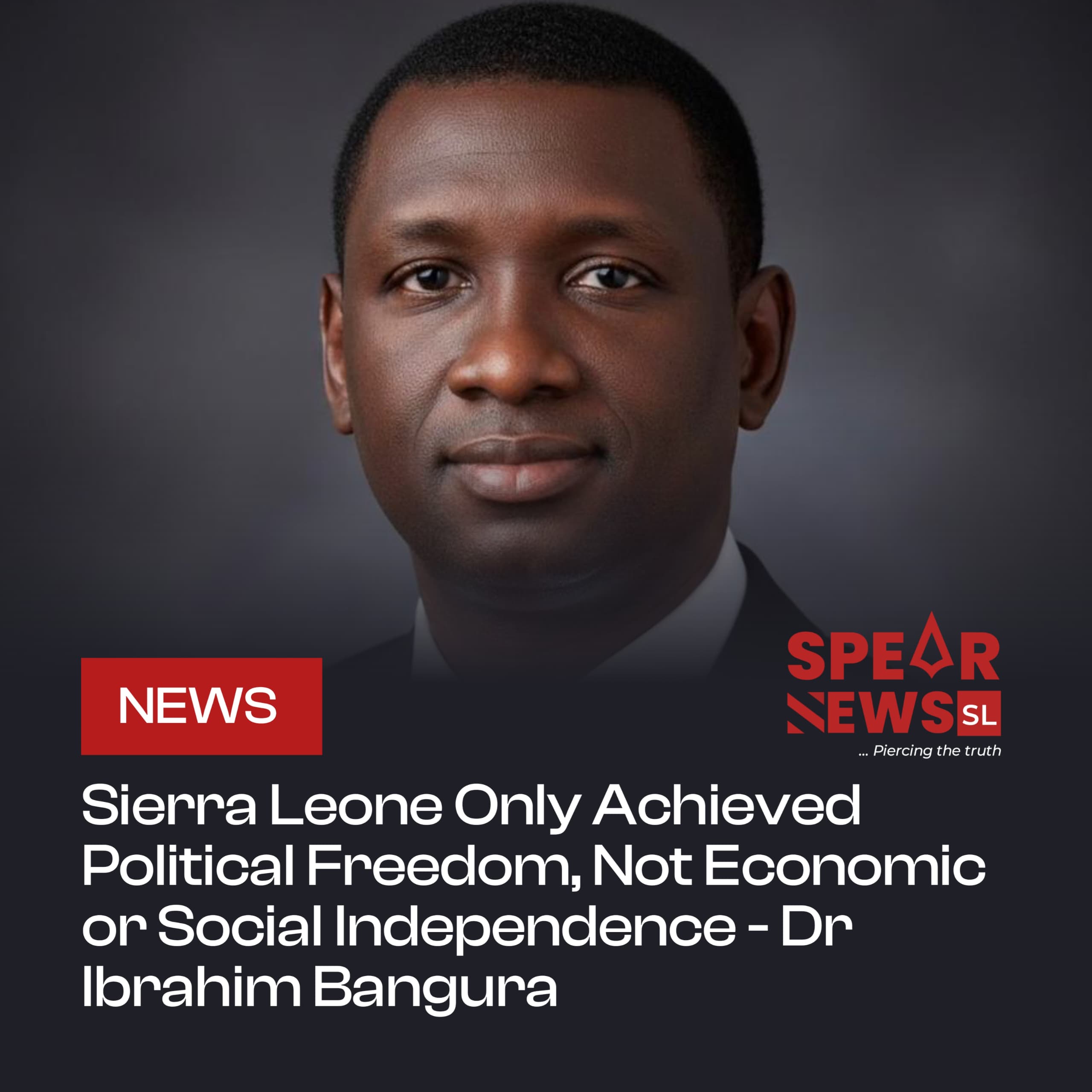
Sierra Leone’s Independence Day has sparked renewed national reflection after Dr. Ibrahim Bangura used his April 27 address to argue that the country’s 1961 liberation marked only the beginning of true independence, insisting that decades later, the nation is still struggling to complete what he described as its economic, social, and institutional freedom.
In a wide-ranging message that has already triggered public debate, Dr. Bangura drew a clear distinction between political independence and what he called “real independence,” stressing that while Sierra Leone gained sovereignty from colonial rule in 1961, it has yet to fully translate that milestone into everyday progress for its citizens.
“My fellow citizens of Sierra Leone, and all who call this land home, today, we gather not merely to celebrate a date, but to honor a journey, a journey that reached a defining moment on April 27, 1961, when our nation stepped into self governance and the promise of shaping its own destiny,” he said, grounding his remarks in the historical significance of independence.
However, he quickly shifted to a more critical assessment of what that independence has produced over time. “That moment was not an accident of history. It was built on courage, sacrifice, and the enduring belief that a people, united in purpose, can define their own future,” he added, before questioning the depth of progress since then.
Dr. Bangura emphasized that the original vision of independence extended beyond governance, stating, “We remember the struggles of our forebears, men and women who imagined a nation grounded in dignity, justice, and opportunity. Their vision was not only about political freedom, but about building a society where every individual could belong, contribute, and thrive.”

It was at this point that he introduced the central argument of his speech, asserting that Sierra Leone’s independence story remains incomplete. “So as we celebrate independence, we must ask ourselves a deeper question: What does independence mean today?” he asked, before offering a direct answer that has since become the focal point of national discussion.
“Political independence was achieved in 1961. But true independence, economic resilience, social justice, inclusive governance, and shared prosperity, remains a journey we are still shaping,” he said, drawing a sharp line between sovereignty and lived reality.
He further argued that the country’s current challenges reflect that unfinished journey. “We are a nation rich in natural resources, yet too many still struggle. We are a nation blessed with vibrant youth, yet too many feel unheard. We are a nation of immense potential, yet we continue to face challenges of trust, equity, and institutional strength,” he said.
Throughout the address, Dr. Bangura repeatedly warned against treating Independence Day as symbolic celebration alone, insisting that it must be a moment of honest national assessment. “This is not a message of division. It is a call to collective responsibility. Because the story of Sierra Leone is not finished and it is not written by one group alone. It is written by all of us,” he said.
He urged a shift in national priorities, stating that independence must now be measured by tangible outcomes in people’s lives. “The independence we celebrate today must evolve beyond symbolism into substance. It must mean that every child, regardless of background, has access to opportunity. It must mean that every young person can dream and be supported to achieve. It must mean that leadership listens, includes, and serves with integrity,” he said.
Addressing governance directly, he added, “To our leaders and institutions, the future demands trust. Leadership must be transparent, accountable, and deeply connected to the people it serves.”
He also placed strong emphasis on youth participation and national inclusion, saying, “To the young people, your voice matters. Your energy, your innovation, your courage to question and to create, these are the forces that will shape the next chapter of Sierra Leone.”
In one of the most defining sections of his address, Dr. Bangura reframed independence itself, stating, “Because independence, in its truest form, is not isolation, it is the confidence to stand, to grow, and to engage with the world from a place of strength and dignity.”
He concluded his message with a structured roadmap for national renewal, stating, “So the path forward is clear. First, we must heal, heal from past divisions, rebuild trust, and create space for every voice to be heard. Then, we must unite, not by erasing our differences, but by aligning our purpose… And only then can we truly build a nation that reflects the promise of its independence.”
He ended with a final warning and call to action, saying, “The future is not waiting. It is calling. Let us answer, together,” a statement that has since circulated widely across political and civic discussions as Sierra Leone reflects once again on what independence truly means more than six decades later.