

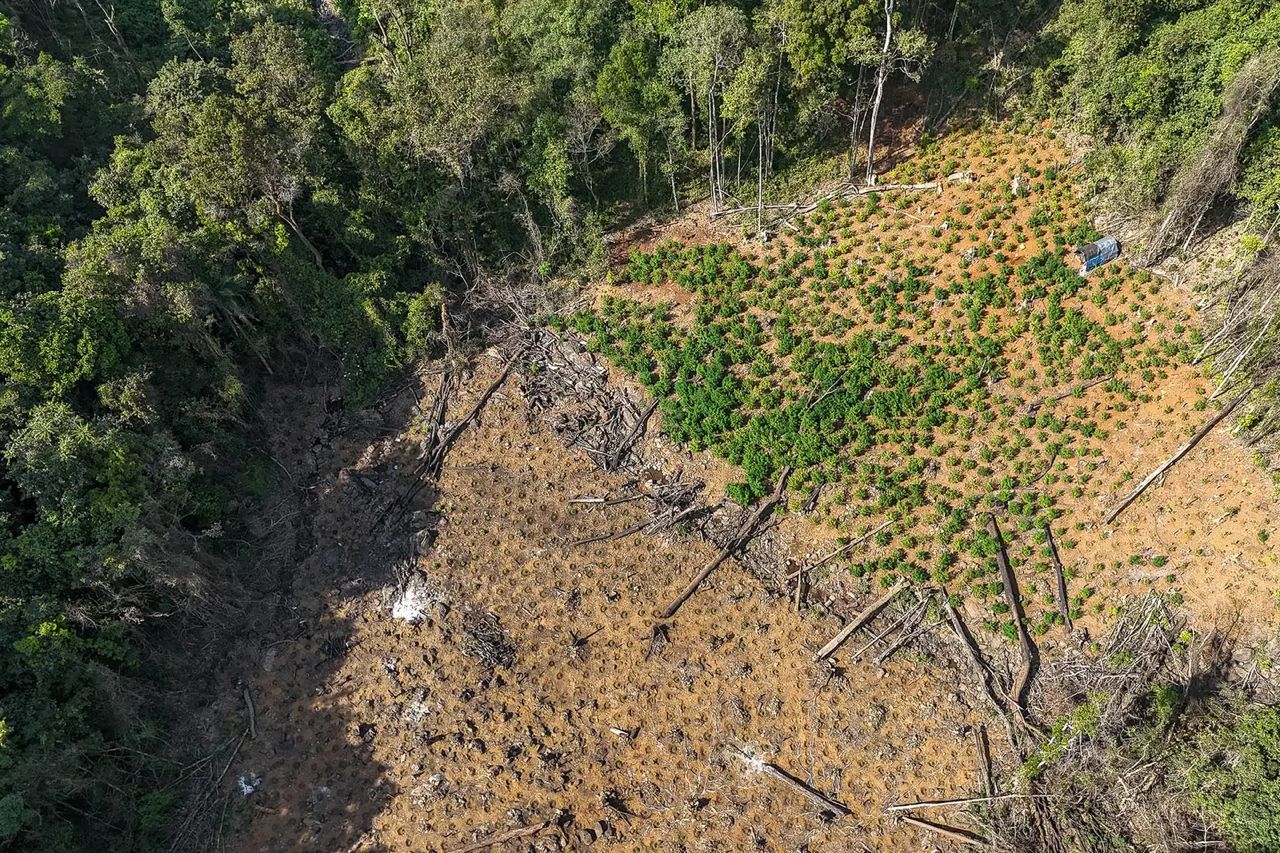
For decades, Sierra Leone has been quietly branded Africa’s “best-kept secret,” a country whose pristine white-sand beaches, lush rainforests and wildlife sanctuaries attracted ecotourists from across the world. But that dream is now under serious threat as illegal land grabbing, uncontrolled logging and foreign-backed extraction tear through protected areas and destroy the very natural assets the country depends on.
At River Number 2 Beach along the Western Peninsula, local bartender Jacob “Jalex Sweet Mouth” Koroma describes his beach as “the most beautiful in the world.” Behind him lies the Western Peninsula National Park — an 18,000-hectare stretch of hills and rainforest that runs along the coast. But smoke now rises from the once emerald slopes as trees are felled daily to make way for illegal villas, charcoal burning and quarrying.
Despite the tourism ministry’s campaign to sell Sierra Leone abroad as a sustainable ecotourism destination including appearances at major travel fairs in London and Madrid, deforestation is accelerating at home. In 2024 alone, Sierra Leone lost 3,705 hectares of primary forest, equivalent to more than 5,000 football pitches. Satellite data shows the Western Peninsula National Park has already lost nearly a quarter of its tree cover since 2020.
Environmentalists say foreign companies are also driving the destruction. Chinese contractors have been implicated in the felling of rosewood and mahogany, and even quarrying inside protected forests. Park rangers complain they are under-resourced, often ordered to stand down when powerful interests are involved, and left to patrol vast forest areas armed only with pepper spray.
The environmental collapse is already affecting established ecotourism hubs. Tacugama Chimpanzee Sanctuary, one of Africa’s most famous conservation centres temporarily shut its gates after wildfires encroached dangerously close to its facilities. Founder Bala Amarasekaran warned that over 120 rescued chimps could escape if the fires damaged electric fences, leading to a major crisis.
In another blow, the once-popular Tito’s Paradise ecolodge at Black Johnson Beach was demolished to make way for a Chinese-funded £44 million deep-sea fishing port under the Belt and Road Initiative, a project that will replace beaches and mangroves with concrete for processing plants and docking facilities.

The government says reforms are coming. Sierra Leone plans to unveil “Protect Salone” a national forest recovery initiative at COP30 in Brazil, targeting reforestation, stricter protection zones, and a shift to cleaner, alternative cooking fuels to reduce charcoal dependence. But the plan carries a projected £650 million price tag and depends heavily on international financing.
Environment advocates argue that political will remains the missing link.
“Sierra Leone is very beautiful. But nature is under attack,” says conservationist Tommy Garnett.
Back at his beach bar, Koroma insists the nation’s beauty is still alive pointing to the symbolic colours of Sierra Leone’s flag: green for the forests, white for the beaches, blue for the ocean.
But environmentalists warn that unless urgent action is taken, the green band on that flag may fade into history.