

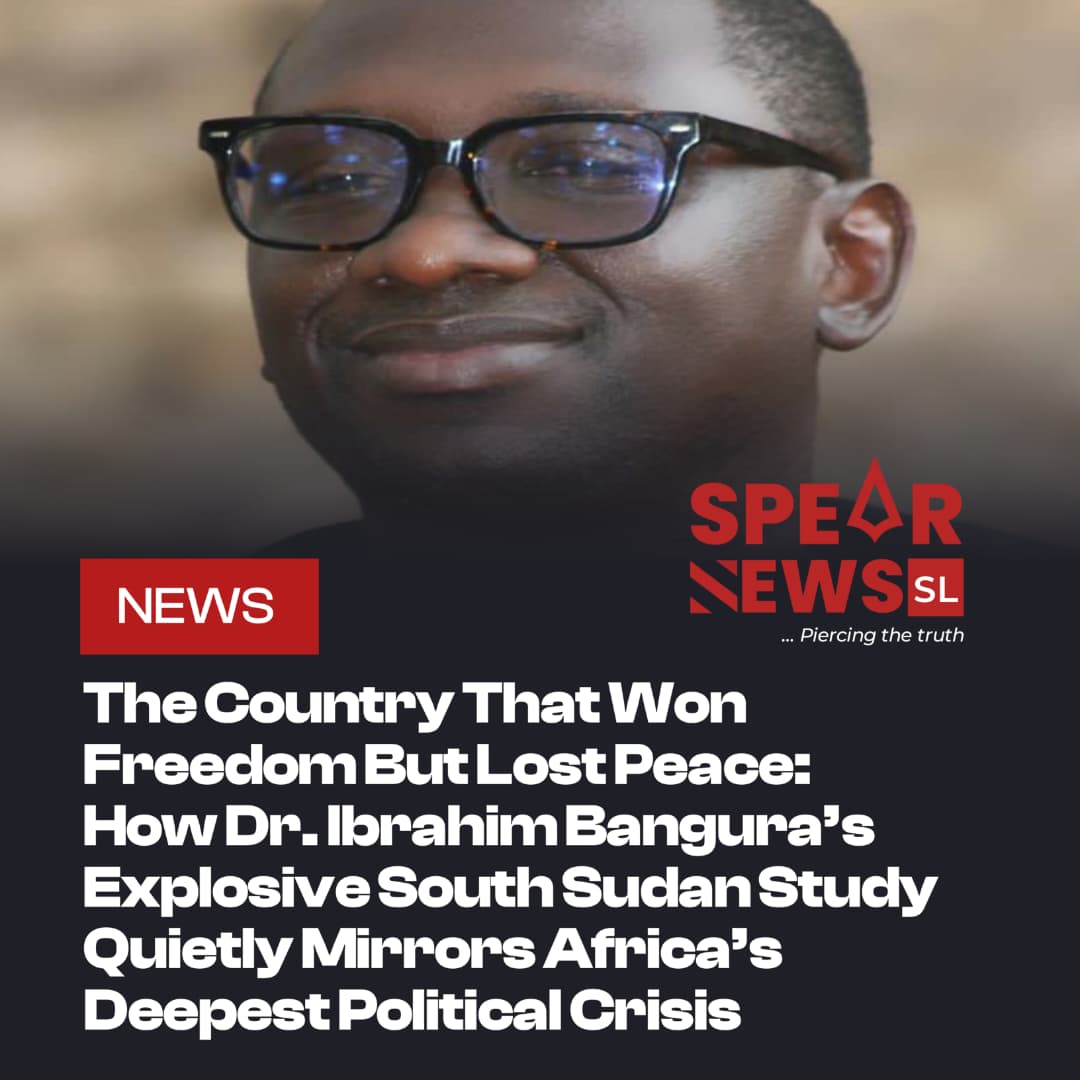

In a continent where peace agreements are often celebrated with handshakes before collapsing into gunfire, one Sierra Leonean scholar is beginning to force an uncomfortable conversation many leaders would rather avoid. Ibrahim Bangura, a lecturer in the Department of Peace and Conflict Studies at the University of Sierra Leone and one of the emerging presidential aspirants of the opposition All People’s Congress, has released what many observers are already describing as one of the most piercing African analyses of post-independence failure in recent years, using the tragedy of South Sudan to expose how liberation without healing can destroy a nation from within.
Published in the Brazilian Journal of African Studies under the striking title “Peace in Pieces: The Politics and Pitfalls of Peacemaking in South Sudan,” the paper goes far beyond academic reflection. It reads like an autopsy of broken nationhood. It asks why a country born out of decades of sacrifice and celebrated globally as Africa’s newest state descended so quickly into ethnic violence, elite rivalry, distrust, and humanitarian collapse. But beneath the statistics, interviews, and political analysis lies something deeper — a warning to fragile democracies across Africa that independence alone does not guarantee peace, and that nations cannot build sustainably on unhealed trauma, exclusion, and elite domination.
The paper argues that peace in South Sudan repeatedly failed because political elites treated agreements as transactions for power-sharing rather than opportunities for national transformation. According to Bangura, violence in the country was never truly resolved; it was merely postponed, recycled, and repackaged through what he describes as a “revolving-door syndrome,” where conflicts pause temporarily only to return because the root causes were never addressed. While much of the world focused on ceasefires and political negotiations, Bangura focused on something more haunting — trauma. Entire generations, he notes, grew up in war, became socialized into violence, and inherited fear, anger, and mistrust as part of national culture.
In one of the most emotionally powerful sections of the study, Bangura recounts testimonies from citizens and professionals who described South Sudan as a country that never had time to heal before being handed independence. The result, he argues, was a wounded state trying to govern wounded people through militarized politics. His paper challenges the traditional approach to peacebuilding dominated by international organizations and political elites, insisting instead that sustainable peace must be rooted in reconciliation, justice, inclusion, and grassroots ownership.
What has made the paper resonate beyond academic circles is the growing perception that Bangura is not merely writing about South Sudan. He is speaking to Africa itself. From the Democratic Republic of Congo to Sudan, from Libya to parts of the Sahel, many post-conflict societies continue to battle the same demons: elite capture of the state, ethnic exclusion, corruption, militarized governance, youth frustration, and political systems that reward violence more than dialogue. Bangura’s argument that peace agreements often protect powerful interests while ordinary citizens continue suffering has triggered discussions among political observers, scholars, and youth activists who see his analysis as part of a larger African reckoning.

That growing attention is also impossible to separate from Bangura’s own rising political relevance in Sierra Leone. Over the past year, the academic and peacebuilding expert has increasingly emerged as one of the notable voices within the APC’s future leadership conversation, repeatedly emphasizing themes of national healing, unity, inclusion, and rebuilding. Recent public statements from Bangura have consistently urged Sierra Leoneans to move beyond division and pursue what he described as “true independence rooted in economic resilience, social justice, and inclusive governance.” In multiple appearances linked to his political engagements, Bangura has framed national transformation around three interconnected ideas: healing divisions, uniting citizens, and building institutions that serve all people.
It is perhaps this overlap between scholarship and political philosophy that is now drawing unusual attention to the South Sudan paper. Observers note that while the study never directly references Sierra Leonean politics, its conclusions align remarkably with Bangura’s broader public messaging about reconciliation, inclusive governance, and rebuilding fractured societies. His insistence that nations cannot achieve stability without confronting historical grievances, creating trust, empowering youth, strengthening institutions, and promoting justice mirrors themes he has increasingly associated with his own national vision.
Bangura is not new to the field of conflict and peace studies. Years before entering frontline political conversations, he had already built a body of work around youth marginalization, violence, reintegration, and post-war recovery in Sierra Leone and other African contexts. In one earlier study titled “We Can’t Eat Peace,” he warned that neglected and frustrated youth populations could become fertile ground for instability if governments fail to create economic opportunities and meaningful inclusion. Those ideas now appear to echo through his South Sudan analysis, where he again warns that poverty, exclusion, and hopelessness make violence easier to reproduce across generations.
Yet perhaps the most striking part of Bangura’s South Sudan study is not its criticism of elites or international actors, but its belief that peace can still emerge from below. The paper highlights women’s groups, youth-led movements, churches, traditional leaders, and local peace initiatives attempting to rebuild trust in communities abandoned by formal politics. In Bangura’s view, peace cannot survive as an elite ceremony negotiated in hotels and protected by political calculations. It must become part of everyday life, owned by ordinary citizens themselves.
That message may explain why the paper is increasingly being discussed not only as an academic contribution but as a political and philosophical statement from one of Sierra Leone’s emerging intellectual-political figures. In a continent where many politicians speak the language of power while scholars remain distant from public life, Bangura appears to be attempting something more unusual — merging peace scholarship with political imagination. Whether that ultimately translates into electoral success remains uncertain. But what is becoming harder to ignore is that his South Sudan paper has elevated him beyond the confines of a university lecturer into a voice participating in a wider African debate about leadership, reconciliation, governance, and the unfinished meaning of independence itself.
And perhaps that is the real power of “The Country That Won Freedom But Lost Peace.” It is not merely the story of South Sudan. It is the story of what happens when nations celebrate liberation without confronting trauma, when elites inherit states without building trust, and when politics becomes stronger than humanity. Through South Sudan, Ibrahim Bangura may have written one of the clearest warnings yet about the fragile distance between freedom and collapse in modern Africa.