

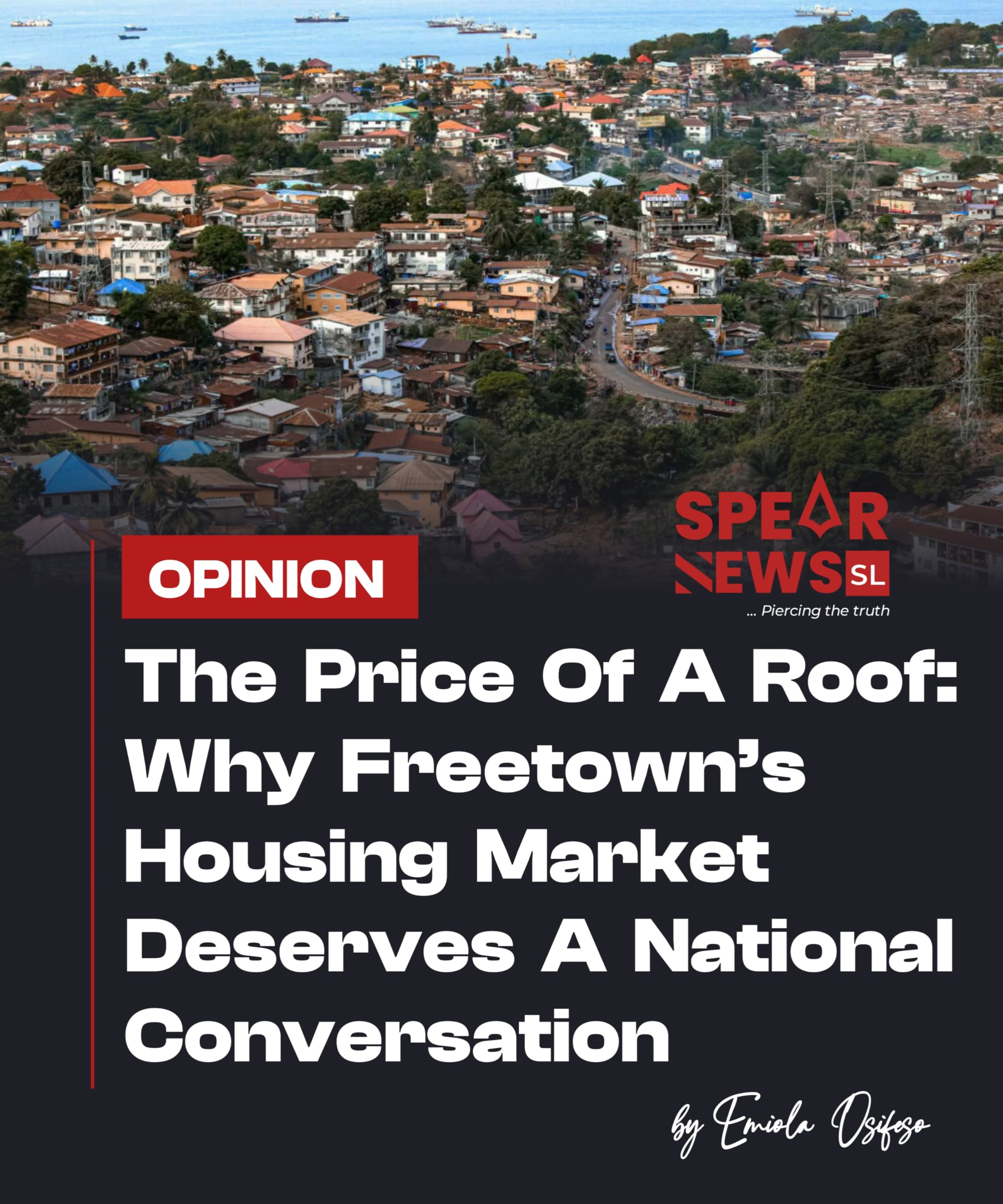

By Emiola Osifeso
There are moments in life when comparison becomes unavoidable, not because one country is better than another, but because comparison is the only honest way to measure reality.
As someone who travels frequently between Nigeria and Sierra Leone, I arrived in Freetown with a simple assumption. Sierra Leone is a smaller economy, with a smaller population, a less congested capital city and lower levels of urbanisation than Lagos or Abuja. Naturally, I expected the cost of housing to be more affordable.
I was wrong.
The longer I stayed in Freetown, the more one question refused to leave my mind: Why is housing in Freetown so expensive?

This is not an attempt to glorify Nigeria. Far from it. Every Nigerian knows that housing has become painfully expensive. Whether in Lagos, Abuja or Port Harcourt, millions of ordinary citizens have watched rents rise faster than their incomes. Home ownership has become increasingly difficult, while quality accommodation is steadily moving beyond the reach of young professionals and middle income families. Nigeria has a housing affordability crisis.
But after carefully comparing the two countries, I arrived at a conclusion that surprised even me. Nigeria is expensive. Freetown is disproportionately expensive. There is an important difference.
Nigeria’s Expensive Houses Usually Deliver Value
In Lagos, a modern two bedroom apartment in Ajah with all rooms ensuite commonly rents for approximately $1,900 to $2,500 per year. A four bedroom duplex around Orchid Road rents for roughly $6,300 to $9,500 annually. Airbnb accommodation in Ikate, Lekki generally ranges between $38 and $76 per night, depending on the quality of the finishing, furnishings and available amenities.
These are not Nigeria’s most elite neighbourhoods. They are largely middle class communities occupied by professionals, entrepreneurs and young families.
Move into Old Ikoyi or Banana Island and the story changes. There, a two bedroom apartment commonly rents between $16,000 and over $31,000 annually, while premium Airbnbs often range from $190 to more than $440 per night.
Abuja presents a similar pattern. Maitama, Asokoro and Guzape command premium prices because of their diplomatic significance, superior infrastructure and proximity to government institutions. Modern apartments generally rent between $5,000 and $9,500 annually, while serviced luxury apartments often command $9,500 to almost $19,000, with exceptional developments exceeding those figures. Luxury Airbnbs typically range from $95 to over $400 per night.
These numbers are undoubtedly high. Many Nigerians complain about them daily, and sometimes rightly. Yet there is another side of the conversation. Most modern Nigerian apartments genuinely attempt to justify those prices. They typically feature imported security doors, porcelain flooring, POP ceilings with recessed lighting, granite or quartz kitchen worktops, fitted wardrobes, quality sanitary fittings, glass shower cubicles, backup electricity, treated water systems, professional estate management and relatively good road access.
Luxury apartments move into an entirely different category. Marble or imported Italian porcelain flooring, bespoke hardwood doors, floor to ceiling windows, designer kitchens, integrated appliances, hotel style bathrooms, central air conditioning, smart home technology, concierge services, gyms, swimming pools, landscaped gardens, CCTV surveillance, professional facility management and uninterrupted electricity through industrial generators have increasingly become standard features.
Does that mean Nigerian real estate is cheap? Absolutely not. But there is usually an identifiable relationship between price, quality, location and infrastructure. The apartment is expensive, the environment is expensive and the services are expensive. The market, at least in many premium locations, attempts to reflect those realities.
Then I Arrived In Freetown
My experience in Freetown challenged many assumptions. Unlike many modern Nigerian developments, a significant proportion of residential buildings in Freetown are considerably older. Many properties still use PVC ceilings rather than decorative POP finishes. Interior doors are often basic. Floor finishes frequently reflect older construction styles. Road access to many residential areas remains poor. Electricity supply is unreliable. Water supply is inconsistent in some neighbourhoods. None of these observations are intended as criticism of Sierra Leone itself. Every developing country faces infrastructure challenges.
The surprise comes elsewhere. The prices.
Older two bedroom apartments frequently rent between $2,000 and $3,500 annually. Modern two and three bedroom apartments commonly range between $5,000 and $10,000. Luxury and serviced properties frequently command between $20,000 and $35,000 annually, with larger homes attracting even higher rents.
Detached houses tell an even more surprising story. Older duplexes can command annual rents between $15,000 and $30,000. Modern detached homes often range from $30,000 to $50,000. Some luxury properties are advertised for as much as $60,000 to $120,000 annually.
When I recently came across a property advertised for $120,000 per year, I paused. Not because expensive houses should not exist. Every country has luxury property. The concern is whether the value being delivered matches the asking price. That is where serious questions begin.
The Airbnb Puzzle
The short let market raises even more questions. In many parts of Africa, and indeed around the world, the longer a guest stays, the lower the effective daily rate becomes. That is standard hospitality economics. Long term occupancy reduces vacancy risk, lowers marketing costs and provides predictable income for property owners.
Yet in Freetown, many Airbnb operators continue calculating prices on a simple daily multiplication basis. A guest staying for one hundred days may still be charged one hundred daily rates, perhaps with only a token reduction. That approach ignores how hospitality markets typically reward longer stays.
Even more concerning is the quality proposition. Some two bedroom apartments with relatively modest finishes, older designs and limited amenities command $100 to $200 per night. Others with only moderate improvements are advertised between $400 and $600 per night. At those prices, travellers naturally begin comparing them with international hospitality standards, and that comparison becomes difficult.
Hotels Tell The Same Story
This is perhaps the comparison that surprised me the most. Nigeria’s leading hotels, including The Delborough, Lagos Continental, Transcorp Hilton Abuja, Fraser Suites and The Wheatbaker, represent some of West Africa’s finest hospitality offerings. Their premium suites range from several hundred dollars per night to around $2,000 for their most exclusive accommodations. These establishments offer world class restaurants, concierge services, conference facilities, wellness centres, uninterrupted electricity, sophisticated security systems and internationally recognised service standards.
In Freetown, however, hotels that many Nigerians would regard as equivalent to middle range or upper middle range accommodations frequently command around $400 per night. Price alone is never the issue. Value is. Consumers generally accept premium pricing when premium value accompanies it. Problems begin when prices rise much faster than quality.
This Is Bigger Than Real Estate
Housing is never just about housing. It is about the economy. It is about opportunity. It is about national competitiveness. It is about dignity.
When housing becomes disproportionately expensive relative to average incomes, society begins paying hidden costs. Young professionals postpone marriage because they cannot afford decent accommodation. Teachers, nurses, journalists, police officers and civil servants spend an unsustainable share of their income on rent. Entrepreneurs divert capital from business expansion into housing costs. Families reduce spending on education, healthcare and nutrition simply to keep a roof over their heads.
Businesses also suffer. High residential rents eventually translate into higher commercial rents. Higher commercial rents increase operating costs. Those costs are passed to consumers through more expensive goods and services. Inflation becomes harder to control. Economic productivity weakens. Investment becomes less attractive. A city cannot become globally competitive if the cost of simply living there steadily outpaces the value being delivered.
The Dollar Question
Another issue deserves urgent national discussion. The increasing dependence on the United States dollar in housing transactions.
The Leone is Sierra Leone’s national currency. It represents more than money. It represents national monetary sovereignty. When domestic rents increasingly become denominated in foreign currency, several consequences follow. Landlords become insulated from exchange rate risk while tenants inherit all of it. Every depreciation of the Leone immediately makes housing more expensive for ordinary citizens whose incomes remain denominated in local currency.
More importantly, widespread reliance on the dollar gradually weakens confidence in the national currency itself. When people begin thinking in dollars, saving in dollars, pricing property in dollars and negotiating contracts in dollars, the domestic currency loses part of its practical role within the economy. That trend can make monetary policy less effective, complicate inflation management and deepen economic inequality.
This is not an argument against foreign investment. Foreign capital is important. But domestic housing markets should primarily serve domestic citizens. The measure of a healthy housing market is not how attractive it appears to foreign investors. It is whether ordinary citizens can realistically participate in it.
Why Regulation Matters
Markets work best when competition is fair, information is transparent and speculation does not overwhelm social needs. Calling for smarter housing policies is therefore not hostility toward investors. It is recognition that housing is unlike most other commodities. People can postpone buying a luxury car. They cannot postpone needing shelter.
Government does not necessarily need to fix prices. But it can strengthen transparency in rental markets, improve land administration, encourage affordable housing development, support long term mortgage financing, invest in roads and public infrastructure, and promote fairer market practices. Clear standards for tenancy agreements, improved data on market rents and incentives for quality affordable housing would help create a healthier market for both landlords and tenants.
Investors deserve fair returns. Citizens deserve fair opportunities. Those two objectives are not mutually exclusive.
A Final Reflection
This article is not an argument that Nigeria has solved its housing challenges. It has not. Millions of Nigerians still struggle with unaffordable rents. Housing remains one of Nigeria’s greatest socioeconomic challenges. But comparison is valuable because it forces us to ask difficult questions.
If Nigeria, despite its own affordability crisis, generally delivers stronger infrastructure, newer developments, higher construction standards and broader amenities at comparable or sometimes lower prices, then Freetown must honestly ask whether its current market trajectory is sustainable.
A nation’s success cannot be measured solely by rising property values. It must also be measured by whether ordinary people can build ordinary lives. The greatness of a city is not reflected in how expensive its houses become. It is reflected in how many teachers can live with dignity, how many nurses can raise families, how many young entrepreneurs can rent an office without sacrificing their dreams, and how many civil servants can live close enough to work without spending most of their income on shelter.
Housing should create stability, not anxiety. Real estate should build wealth, not exclusion. Progress should make life easier, not merely more expensive.
As someone who deeply admires Sierra Leone, I offer these reflections not as criticism from the outside, but as concern from someone who believes that the country’s future deserves a housing market that rewards investment while remaining accessible to the people whose labour, enterprise and aspirations will ultimately build the nation. Because the true wealth of any country is not measured by the price of its buildings. It is measured by the quality of life they make possible.