

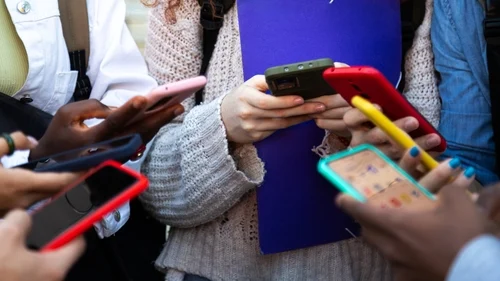
UK Prime Minister Keir Starmer has promised to “call time on a system that’s failing our kids” ahead of his expected announcement of an under-16s social media ban.
Mr Starmer will announce sweeping reforms to protect children online at a Downing Street press conference today.
He promised “bold action” in response to calls for change from parents, after the vast majority responding to a government consultation backed a minimum age of 16 before children can access social media platforms.
The UK is expected to follow Australia’s example in raising the minimum age to 16 for sites including TikTok, Instagram, Threads, Facebook, X, YouTube, Snapchat and Reddit.
But the ban will go further than Australia’s by including romantic or sexual AI chatbots, and children could also be blocked from chatting to strangers on gaming platforms, according to The Sunday Times.

The newspaper reported that daily social media use will be limited for under-18s in a bid to stop late-night scrolling.
Kier Starmer said children’s online safety is ‘one of the biggest debates of our time’
The public consultation on the issue, which closed on 26 May, received about 116,000 responses, making it the second-largest in history.
Over 83% of parents who responded said social media risks outweigh the benefits for children – with 91% backing a minimum age of 16 before platforms can offer their services to children.
Almost two thirds (62%) of children who responded said restricting the high-risk features would make them safer online.
But 72% also said they were worried about feeling left out if restrictions came in.
Mr Starmer said: “How we keep kids safe online is one of the biggest debates of our time. As a dad, I know every parent wants their child to grow up safe and happy.
“This is a choice about whose side we’re on: families across the country, or a status quo that isn’t working.
“People rightly expect action, and this government will always stand up for parents and put children first.
“That’s why we will call time on a system that’s failing our kids and take bold action to give every child the best possible start in life.”
It comes after Mr Starmer last week issued a three-month ultimatum to Apple and Google to make it technologically impossible for children to take, share or view nude images on their smartphones.
US backlash
The latest move risks prompting a backlash from US President Donald Trump’s pro-tech US administration, which warned against a blanket ban for under-16s.
In a response to the consultation, the US embassy in London said the country preferred “narrowly targeted requirements”, that “most content should be accessible by default”, and that age verification requirements could “impose disproportionate compliance burdens on American companies”.
Some groups have argued that a ban may not be the appropriate instrument to tackle a wide spread of social media harms.
The Molly Rose Foundation, set up in memory of 14-year-old Molly Russell, who took her own life in 2017 after viewing harmful content online, said a social media ban “will fail to tackle fundamental product safety risks issues and leaves parents with a false sense of safety”.
Chief executive Andy Burrows said: “A majority of children will continue to use high-risk sites that will have no incentive to implement robust protections.
“This is not what online safety experts believe will work and is necessary. Keir Starmer has chosen to abdicate responsibility for tackling harmful algorithms and his legacy will be setting back children’s safety by years.”
The co-chairwoman of the All-Party Parliamentary Group for digital creators, Labour’s Feryal Clark, argued young people should not lose access to good-quality content that helps young people learn and find communities.
She said: “High-quality, creator-led educational video content is a critical public resource and is not the same thing as social media.
“For example, many young people use it to revise for GCSEs, to learn a language or a musical instrument.
“Any legislative intervention must capably address this distinction.
“Failing to do so would be dangerously short-sighted and cut off opportunities from young people at exactly the moment they need these things most.”
Leanda Barrington-Leach, executive director of the 5Rights Foundation, a non-governmental organisation that campaigns for online safety, said “a ban or curfew may change who comes through the front door, but it does not change what is waiting for children inside” and that firms must be driven “to make their products safe for kids”.