

The National Public Health Agency (NPHA) has assured Sierra Leoneans that the country currently has no confirmed, suspected, or probable cases of Ebola, despite growing concerns over the ongoing Ebola Virus Disease outbreak in parts of Central and East Africa.
The assurance was given during a press briefing on Tuesday, May 19, 2026, following the World Health Organization’s declaration of a Public Health Emergency of International Concern (PHEIC) in response to the Ebola outbreak in the Democratic Republic of Congo (DRC) and Uganda.
Speaking to journalists, the Executive Director of the NPHA, Prof. Foday Sahr, emphasized that Sierra Leone remains Ebola-free and fully alert to prevent any possible spread into the country.“Sierra Leone is currently Ebola-free,” Prof. Sahr stated.
He stressed that the country’s preparedness measures are not reactive but based on the painful lessons learned during the devastating 2014–2016 Ebola outbreak that claimed thousands of lives across West Africa.
“Sierra Leone is not unprepared. Our preparedness posture is not reactive; it is grounded in the hard lessons of 2014 to 2016. So, we are not waiting for risk to escalate before we act,” he said.

According to Prof. Sahr, the current outbreak in the Democratic Republic of Congo involves the Bundibugyo strain of the Ebola virus, which he described as a rare strain for which there are currently no licensed vaccines or approved treatments.
As of May 16, 2026, the DRC had reportedly recorded 246 suspected cases and 80 suspected deaths in Ituri Province.Uganda, he added, has so far confirmed two laboratory-confirmed cases, including one death, in Kampala involving infections imported from the DRC, with no evidence of further transmission.
Prof. Sahr clarified that the WHO’s declaration of a public health emergency was intended to mobilize coordinated international support rather than suggest a widespread global threat.
“When WHO declared a PHEIC, it did so because the outbreak requires coordinated international support, not because it poses a high risk to the global public,” he explained.
He further described the current outbreak as the largest documented outbreak of the Bundibugyo strain in history.The NPHA Executive Director disclosed that the National Emergency Health Committee has already been activated to oversee Sierra Leone’s preparedness and response strategy.
He also revealed that the Public Health Emergency Operations Centre (PHEOC) has been activated at Alert Level 2 as part of precautionary measures.Prof. Sahr stated that health screening operations have been strengthened at all major entry points into the country, including Lungi International Airport, Freetown Harbour, and land border crossings such as Kambia, Gbalamuya, and Kailahun.
“Lungi International Airport, Freetown Harbour, and all major land border crossings, including Kambia, Gbalamuya, and Kailahun, are fully operational with trained personnel,” he said.
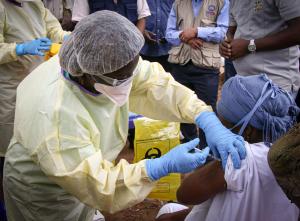
He disclosed that emergency medical supplies, including personal protective equipment, rapid diagnostic materials, and isolation resources, have already been pre-positioned in high-risk districts.
According to him, these supplies have been distributed to the Western Area and border districts including Kambia, Koinadugu, and Kailahun.
Prof. Sahr also announced that Rapid Response Teams are currently on standby in all 16 districts across Sierra Leone to respond swiftly to any suspected outbreak.“Isolation protocols are being reviewed and reinforced at key referral facilities,” he stated.
He added that Sierra Leone remains in active communication with regional and international health bodies including the Africa Centres for Disease Control and Prevention (Africa CDC), the ECOWAS Health Authority, the WHO, and neighbouring countries such as Guinea and Liberia.
“Real-time outbreak intelligence is being monitored around the clock,” he noted.While reassuring the public that Sierra Leone remains a low-risk country, the NPHA boss urged citizens to remain vigilant and report any suspected symptoms immediately.
“Early detection and reporting are our most powerful tools,” he warned.He urged members of the public to immediately call the emergency health line 117 if they experience symptoms such as sudden fever, severe headache, vomiting, diarrhoea, unexplained bleeding, or skin rashes, especially following recent travel from the DRC.“Do not wait.
Do not visit a crowded facility. Call 117 first,” he advised.Prof. Sahr also directed health workers in both public and private facilities nationwide to maintain heightened surveillance and immediately report any suspected Ebola-related symptoms, particularly among persons with recent travel history from the DRC or Uganda.
“Report suspected cases immediately to your District Health Management Team or directly to the NPHA Emergency Operations Centre at 117,” he stated.He cautioned healthcare workers against attempting to manage suspected Ebola patients in facilities lacking proper preparedness.
“Activate isolation protocols and call for Rapid Response Team support without delay,” he added.The NPHA further disclosed that a nationwide Risk Communication and Community Engagement (RCCE) campaign is being rolled out across all districts to raise public awareness and strengthen preventive measures.
The agency also advised citizens to rely only on official government communication platforms, including the NPHA, the Ministry of Health, and the Sierra Leone Broadcasting Corporation (SLBC), for verified information regarding the Ebola situation.
Prof. Sahr concluded by reassuring the public that the government remains fully prepared while calling on citizens to remain calm, cooperative, and alert.“The government is prepared. We ask that every Sierra Leonean be equally prepared, vigilant, calm, and cooperative,” he said.