

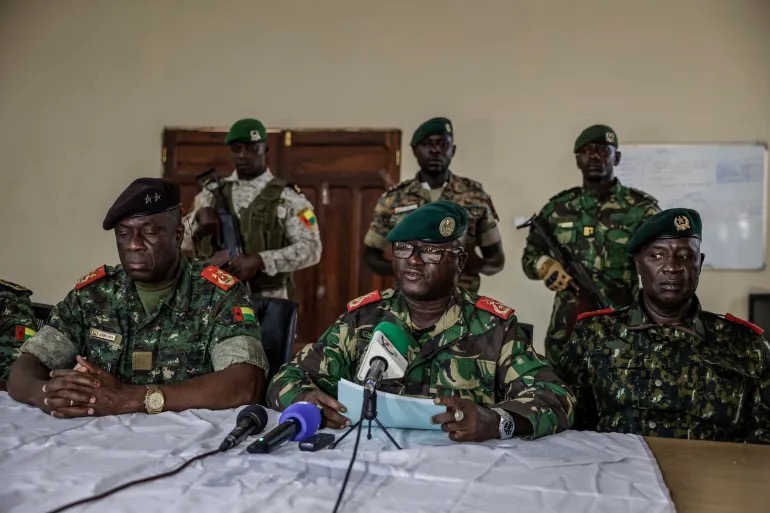
Guinea-Bissau has been thrown into its most serious political crisis in years after a group of senior military officers announced they had assumed “total control” of the country, suspending the electoral process and detaining key political figures, including President Umaro Sissoco Embaló.

The announcement was made on national television on Wednesday by Brigadier General Denis N’Canha, head of the military office of the presidency and commander of the presidential guard. Identifying themselves as the “High Military Command for the Restoration of Order,” the officers declared that all state institutions were under their authority until “stability and constitutional sanity” were restored.
The intervention comes just days after a fiercely contested presidential election in which both Embaló and his main challenger, popular businessman Fernando Dias, prematurely declared victory without official tallies from the National Election Commission (CNE).
Borders Closed, Curfew Imposed
In their televised statement, the military announced sweeping measures, including:
• Immediate suspension of the electoral process

• Closure of all land, air, and sea borders
• Imposition of a nationwide dusk-to-dawn curfew
• Temporary shutdown of internet and telecommunications services
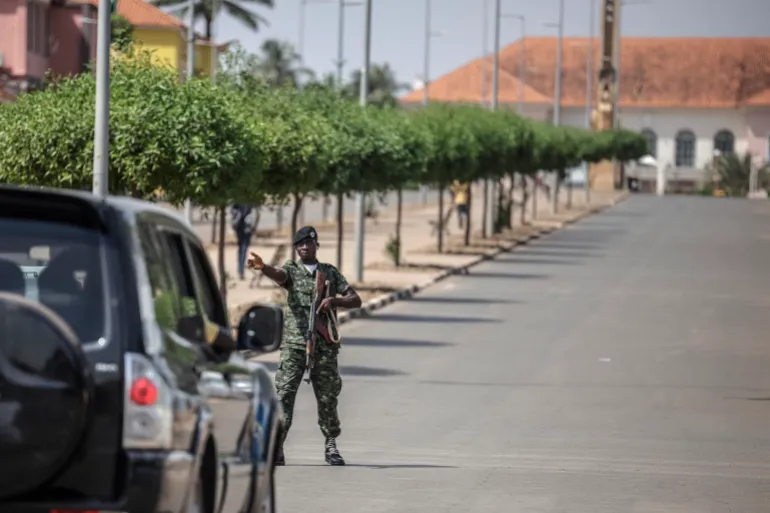
The declaration followed hours of sustained gunfire reported around key government installations in the capital, Bissau, including near the CNE headquarters, the presidential palace, and the Interior Ministry. Witnesses described scenes of soldiers taking positions around strategic sites as residents fled indoors.
In a brief phone interview with France24, President Embaló said, “I have been deposed. I am currently at the general staff headquarters.”
Regional outlets later reported that Embaló is being held under arrest.
Opposition leader Domingos Simões Pereira, head of the PAIGC and former prime minister, has also reportedly been detained.
According to Al Jazeera’s Nicolas Haque, the coup is being led directly by Brig. Gen. Denis N’Canha — a striking twist, given his position as protector of the presidency.
“The man supposed to protect the president himself has put the president under arrest,” Haque reported.
The military insists its intervention was necessary to prevent an escalation of post-election instability. Civil society groups had criticized the electoral process even before voting day, particularly after the influential PAIGC was controversially barred from fielding a presidential candidate.
Analysts say the exclusion of the PAIGC — the nation’s oldest political party — created an atmosphere of distrust around the polls.
Both major candidates declared victory with little evidence:
• Embaló’s spokesman Oscar Barbosa insisted: “There won’t be a second round. The president will have a second mandate.”
• Fernando Dias, in a viral video, declared: “This election has been won in the first round.”
The CNE had been scheduled to announce preliminary results on Thursday.
The West African nation, with a population of just two million, has endured chronic political instability since gaining independence from Portugal in 1974. It has experienced at least 10 coups or attempted coups, ranking among the most unstable countries globally.
The most recent major attempt occurred in 2022 when heavily armed men tried to overthrow Embaló’s administration. He later blamed drug traffickers for the incident — a claim that international observers found unconvincing.
Spear News has gathered additional updates emerging throughout Wednesday:
• Internet services in Bissau have largely shut down, with residents relying on foreign SIM cards to access messaging platforms.
• Eyewitnesses report military checkpoints across the capital, especially near the port and the airport.
• Staff at several foreign embassies have been instructed to remain indoors, with at least two diplomatic missions initiating emergency evacuation protocols for non-essential personnel.
• A senior officer in the air force, speaking anonymously, told Spear News that the military leadership is divided, with some commanders opposing the takeover.
• Rumors suggest the military may form a Transitional Council, though no formal announcement has been made.
• The Economic Community of West African States (ECOWAS) is expected to issue a communiqué tonight, with sources in Abuja indicating that the bloc is considering sending a high-level mediation team to Bissau within 48 hours.
The Portuguese government quickly issued a statement urging calm, warning all actors to avoid “any act of institutional or civic violence.” Lisbon emphasized that the country’s institutions must be allowed to complete the electoral process “without interference.”
The African Union is reportedly monitoring the situation “with grave concern,” while the United Nations has called for restraint and dialogue.
With both the president and key opposition figures in custody, Guinea-Bissau enters uncharted political territory. Analysts warn that the uncertain situation may embolden rival military factions or armed groups in the country’s volatile interior.
The population remains tense, with residents staying indoors while awaiting word on the country’s immediate future.
Spear News will continue to monitor the fast-evolving situation and provide updates as more information becomes available.