


A document attributed to the Sierra Leone Government, specifically from the Ministry of Local Government and Community Affairs, has surfaced and is now drawing attention due to its reference to administrative measures tied to local council operations.
The letter, dated April 2, 2026, and addressed to all Chief Administrators of Local Councils, appears to be an internal communication from the Permanent Secretary of the ministry, with references copied to senior offices including the Attorney General and Minister of Justice, the Vice President, the Minister of Finance, and the Office of the President.
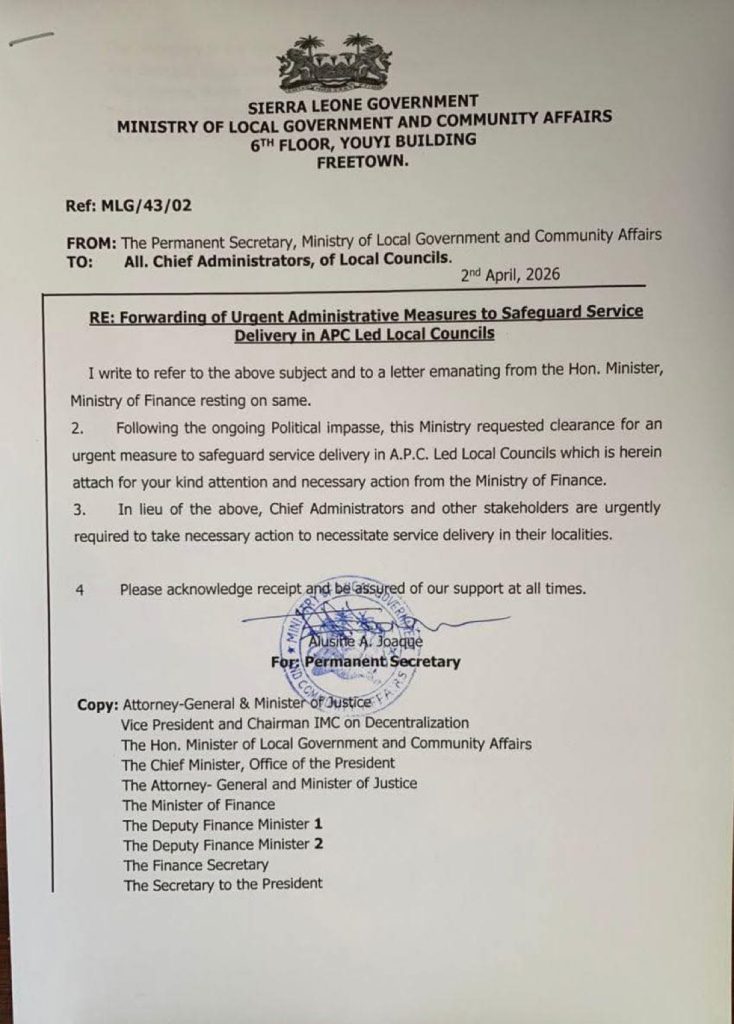
The subject of the communication is stated as the “forwarding of urgent administrative measures to safeguard service delivery in APC led local councils.” This suggests that the directive is linked to ongoing political or administrative tensions affecting local governance structures in Sierra Leone.
In the body of the letter, the ministry references an ongoing political impasse and indicates that it had sought clearance for urgent measures to ensure continuity of service delivery in councils. The communication also implies that approval or input was requested from the Ministry of Finance, signalling that financial or administrative adjustments may be involved in implementing these measures.
The document further instructs Chief Administrators and stakeholders to take necessary actions to ensure continued service delivery in their respective localities. It concludes with a call for acknowledgment and assurance of support, which is typical of official government correspondence aimed at reinforcing compliance with administrative directives.
While the letter carries official formatting, including government insignia, reference numbers, and formal language consistent with public service communication, its wider context remains a subject of discussion. The mention of “APC led local councils” points to a politically sensitive environment, as local governance in Sierra Leone often intersects with party control, administrative authority, and national oversight.

However, there has been no independent confirmation of the document’s full authenticity, nor has there been an official public statement from the Sierra Leone Ministry of Local Government and Community Affairs or other referenced offices to clarify the intent, scope, or implementation of the directive.
In situations like this, official documents typically follow established administrative channels, with clear protocols for dissemination, especially when they involve multiple high level offices. The presence of multiple copies sent to senior officials suggests that the document may be part of a broader inter ministerial process, though this cannot be confirmed without official validation.
At present, what is clear is that the document has triggered public interest due to its content and the political undertones suggested by its references. As with all sensitive administrative communications, verification through official government channels remains essential before drawing conclusions about its implications or legitimacy.