

By Osman Tolo Sesay
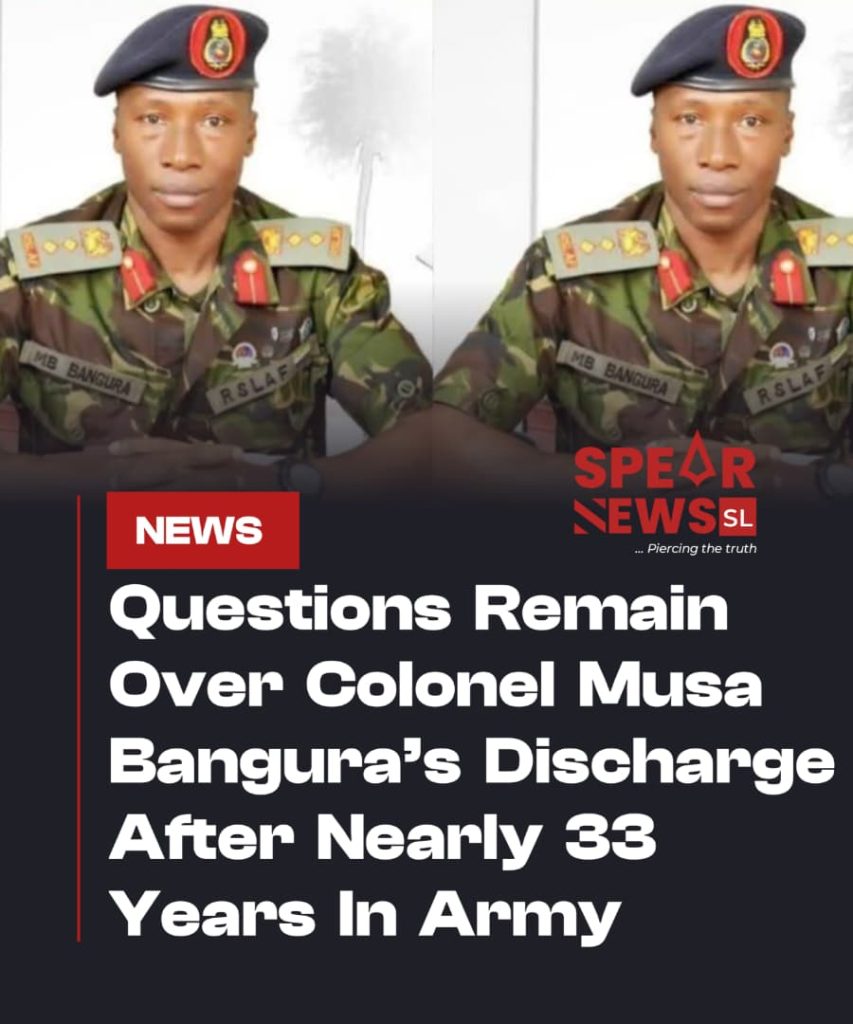
Questions are being raised over the circumstances surrounding the compulsory discharge of Colonel Musa Bangura from the Republic of Sierra Leone Armed Forces (RSLAF), following the publication of his name in the Sierra Leone Gazette in February 2024.
Bangura, who enlisted in the military on May 4, 1991, had served for approximately 32 years and nine months when his compulsory discharge took effect on January 31, 2024.
His name appears in Government Notice No. 74 of the Sierra Leone Gazette, published on February 29, 2024, under the Ministry of Defence’s list of discharged officers.
However, while the official record confirms his rank, enlistment date and compulsory discharge, it does not explain the specific circumstances or grounds behind the decision.

The development attracted public attention following a report published on January 29, 2024, which alleged that Bangura’s departure was connected to issues involving a WhatsApp group.
The publication, citing unnamed military sources, reported that he had been dismissed over alleged misconduct but did not provide details of the specific offence.
Bangura’s departure came amid a broader restructuring exercise within the Republic of Sierra Leone Armed Forces.
On January 29, 2024, the Ministry of Defence and RSLAF announced that the Defence Council had endorsed the discharge of 37 officers following a meeting held on January 18, 2024.
According to the announcement, the discharges covered different categories, including eight officers for absence without leave, 18 for alleged subversion and five for alleged misconduct. Six other officers opted for voluntary discharge.
The announcement indicated that the decision was taken pursuant to Section 169(1) of the Constitution of Sierra Leone Act No. 6 of 1991 and relevant provisions of the Army Orders Act No. 1 of 1965.
The Gazette subsequently published a list headed “List of 38 Discharged Officers”, which included Bangura.
However, his individual entry records his departure as a compulsory discharge without specifying whether it fell under the categories of absence without leave, subversion or misconduct announced by the Ministry.
Consequently, the available official records do not establish that Bangura was discharged for misconduct or involvement in a WhatsApp group.
Beyond the circumstances surrounding his departure, Bangura’s military history has attracted attention because of his reported experience during Sierra Leone’s civil war.
A 2019 publication by the Australian Army Research Centre documents the ordeal of a Sierra Leone Army liaison officer identified as Lieutenant Musa Bangura during the West Side Boys hostage crisis in August 2000.
According to the publication, Bangura was part of a patrol accompanying British soldiers when they were captured by the West Side Boys near Magbeni and taken to their headquarters at Gberi Bana.
The hostages were subjected to violence and mock executions during their captivity, with Bangura receiving particularly severe treatment after being recognised by former members of the Sierra Leone Army who had joined the armed group.
The publication noted that he was close to death by the time the rescue operation took place on September 10, 2000.
The rescue was conducted during Operation Barras, a British military operation involving special forces to free the captured soldiers and their Sierra Leonean liaison officer. The National Army Museum’s historical account confirms that the hostages were successfully rescued, although one British soldier was killed during the operation.
The circumstances surrounding Bangura’s departure have continued to generate public interest, particularly because the official discharge notice does not provide a detailed explanation of the decision.
Among the questions being raised are what specific grounds led to his compulsory discharge, whether he was subjected to formal disciplinary proceedings and whether he was given an opportunity to respond to any allegations against him.
The Ministry of Defence and RSLAF’s general announcement explained the categories under which officers were discharged but did not provide a detailed account of Bangura’s individual case.
The distinction is important because compulsory discharge does not, by itself, establish that an officer was found guilty of a disciplinary offence.
For an officer who joined the armed forces in 1991 and whose military history includes the West Side Boys hostage crisis, the unanswered questions surrounding his departure remain significant.
The central issue is what specific decision and procedure led to Colonel Musa Bangura’s compulsory discharge after nearly 33 years in uniform.
A clear explanation from the Ministry of Defence would help establish the facts surrounding his departure and address the questions that continue to circulate about the end of his military career.