

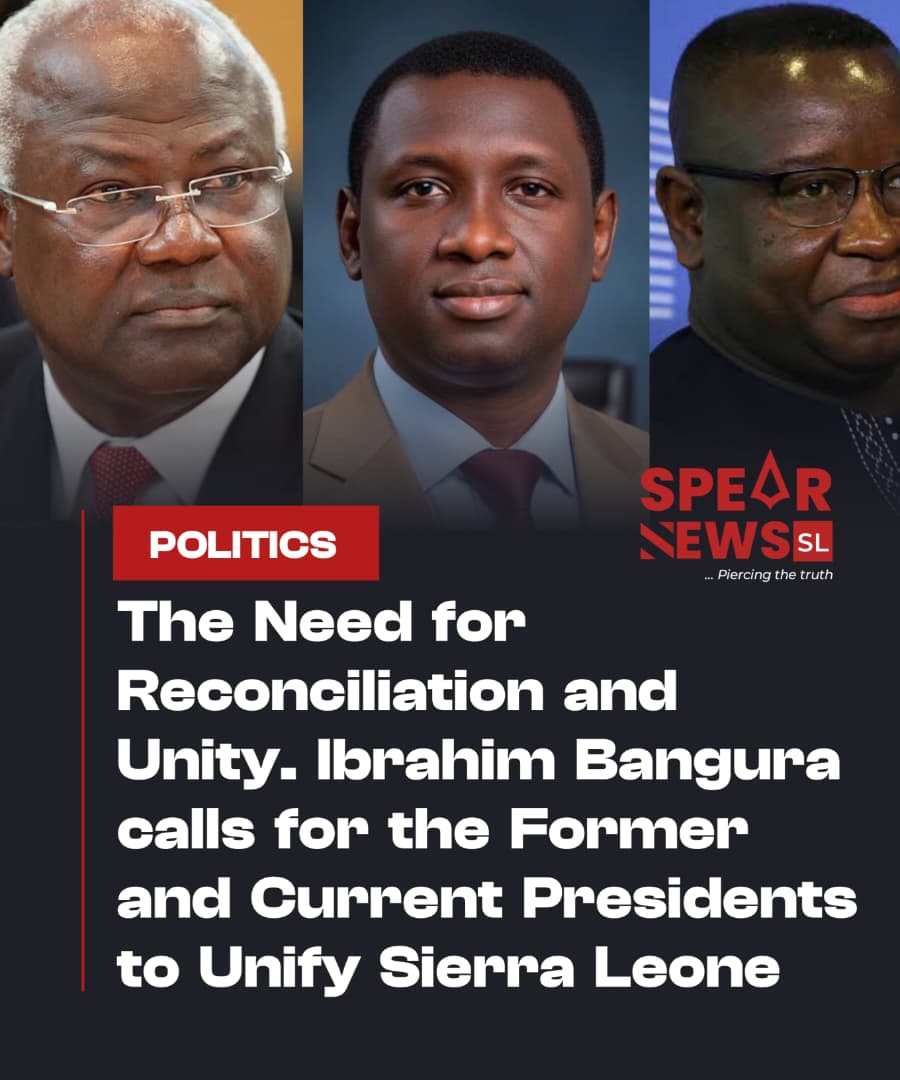

Opposition party, All People’s Congress flagbearer aspirant Dr. Ibrahim Bangura has made an emotional appeal for reconciliation, urging Sierra Leoneans to reject hatred and embrace unity as the foundation for national development. Speaking in a video interview that has rapidly gained traction across social media, Bangura shared painful memories of growing up during Sierra Leone’s civil war, reflected on his work in conflict affected countries across Africa, and outlined what he described as a vision to heal a nation that, in his view, has never fully recovered from the trauma of war.
Introducing himself, Bangura said, “I am Ibrahim Bangura, a flag bearer aspirant of the All People’s Congress Party.”
He explained that many people have repeatedly asked why peace and unity occupy such a central place in his political message.
“A lot of times people ask me why I focus on unity and peace in Sierra Leone. I want to take time to talk about the reason why I made it one of the key areas our campaign will focus on.”
Rather than launching into policy proposals, Bangura chose to begin with a deeply personal story that has shaped his outlook on leadership and national service.

“I grew up during the war in Sierra Leone and I still remember where I stood at 37 Circular Road when our uncle, Uncle Lamin, called us to inform us that there was war in Sierra Leone.”
The memory, he said, remains vivid decades later.
“I saw all that happened, the lives that were lost, the homes that were destroyed. I saw what happened during the NPRC coup, I saw what happened during the AFRC coup d’état and what happened on the 6th of January in Sierra Leone.”
Those events remain among the darkest chapters in Sierra Leone’s history. The civil war, which lasted from 1991 to 2002, left tens of thousands dead, displaced millions of people and devastated the country’s economy and institutions. The NPRC military takeover in 1992, the AFRC coup in 1997 and the January 6, 1999 invasion of Freetown became defining moments that exposed the devastating human cost of conflict.
Reflecting on those years, Bangura said, “Those were dark days, difficult times. The country was in a state of inertia.”
He described the daily struggle that ordinary families endured.
“It was difficult to get food to eat. There was a type of beans we used to eat then that they called folic acid. We had bread that they baked for us to eat.”
The uncertainty of war, he said, meant no one truly felt safe.
“We slept sometimes with our shoes and bags on because you were not sure what could happen the next moment.”
According to Bangura, the consequences of violence extend far beyond the battlefield.
“We also saw what violence can do to a country. There will be no development, no growth. You struggle on a daily basis just to survive.”
Bangura said those experiences were later reinforced through years of professional work across some of Africa’s most fragile states.
“I have travelled around the world. I have worked in conflict affected countries, from Somalia to South Sudan, to the Central African Republic and to the Democratic Republic of Congo. I have seen the damage that was caused in those places.”
Drawing comparisons with Sierra Leone, he argued that although the country succeeded in ending the war, it failed to adequately address its psychological and emotional consequences.
“Sierra Leone was never healed from the war we experienced. We did not focus on massive investments in the psychosocial component of the war.”
He illustrated that point by recalling one of the most memorable conversations he had with a former combatant.
“In one of the interviews I did with an ex combatant, he told me that the war did not end.”
According to Bangura, the former fighter explained, “They took our guns but the things that made us start the war still did not change. In fact, our lives became very hard. We are unable to take care of our families.”
The man, Bangura said, went even further.
“He said, ‘They lied to us. They told us our lives would change, but they did not.’”
For Bangura, those remarks reflect unresolved issues that continue to affect the country more than two decades after the guns fell silent.
He said his travels around Sierra Leone continue to expose the same struggles facing ordinary citizens.
“I have gone around schools and universities and seen the kind of things people contend with. Food to eat is a problem. Good water to drink is a problem. Electricity and internet are problems. Shelter is a problem.”
He argued that while citizens continue to face these basic challenges, politics has become increasingly divisive.
“If we do not come together and keep allowing politics to divide us, this country will not progress.”
Bangura also expressed concern over the growing number of young Sierra Leoneans risking their lives in search of better opportunities abroad.
“We have young people who are fighting to leave this country on a daily basis.”
He referred to the dangerous migration route across the Sahara Desert, popularly known among many young West Africans as Temple Run.
“Some are doing what they call Temple Run, going through the Sahara trying to enter Europe and many of them died on the way.”
Despite those realities, Bangura insisted Sierra Leone possesses enormous potential.
“We have a beautiful country. A country with the potential for growth, but the kind of politics we have been practising over time is undermining the growth and development we want to see.”
He maintained that no nation can build lasting prosperity without first securing peace.
“If we do not have peace, if we do not have unity, it will be difficult to move forward as a nation.”
Bangura said it was this conviction that inspired the launch of his campaign mantra, “Heal, Unite and Build,” which forms the foundation of his broader Love Over Hate campaign.
“This is why we launched a campaign with a mantra called Heal, Unite and Build.”
He said the campaign seeks to encourage Sierra Leoneans to confront the country’s painful history honestly rather than ignore it.
“We said all the bad experiences we have had, let us have a conversation on them.”
While acknowledging previous reconciliation efforts, Bangura argued that they have not produced the lasting transformation many citizens hoped for.
“We have experienced Bintumani, Bintumani Two and Three, but things did not change.”
The Bintumani dialogues were convened at different periods to ease political tensions and strengthen national cohesion, but Bangura believes Sierra Leone now requires a more sincere and inclusive process.
“We need a deeper, proper, honest and genuine conversation on the side we want to see Sierra Leone head to.”
He stressed that his campaign is not interested in reopening old political battles.
“We are saying our own campaign will not focus on fighting the past. We want to draw a line. We want to focus on shaping the future.”
Central to that future, he said, is a country where opportunities are determined by merit rather than identity.
“We want a country where your surname will not matter, your ethnic group will not matter, your region will not matter if you apply for a job or scholarship.”
Instead, Bangura said, “What will matter will be your qualification. Not who you know, not your ethnic group and not the political party you have affiliation with.”
Perhaps the most striking moment of the interview came when Bangura described the political culture he hopes Sierra Leone can one day embrace.
“We want a country where the former president and the current president will be able to sit together and talk, look at each other and walk around the country, embrace each other, embrace the people and make all of us know that it is not about the party, it is about the country.”
He said political leaders must rise above partisan interests if Sierra Leone is to unlock its full potential.
“We cannot compromise on our national interest. We must shape and ensure that everyone has a place and a voice and is respected, and let people grow and do the things they love to do and how they love to do them without being inhibited because of their affiliation.”
Bangura’s remarks arrive at a time when political discourse in Sierra Leone remains sharply polarised and public concern continues to grow over economic hardship, unemployment, youth migration and national cohesion. Rather than framing his message around political rivalry, the APC flag bearer aspirant has placed reconciliation at the centre of his campaign, arguing that healing the nation’s divisions is not simply a moral obligation but a prerequisite for development. His call for a Sierra Leone where former and current presidents can stand together, where merit outweighs ethnicity and political loyalty, and where citizens choose love over hate has resonated with many viewers, transforming what began as a campaign interview into a wider national conversation about the future direction of the country.