


The All People’s Congress (APC) has announced fresh rerun ward elections across affected areas following the cancellation of earlier polls marred by controversy, irregularities, and growing internal tensions within the party.

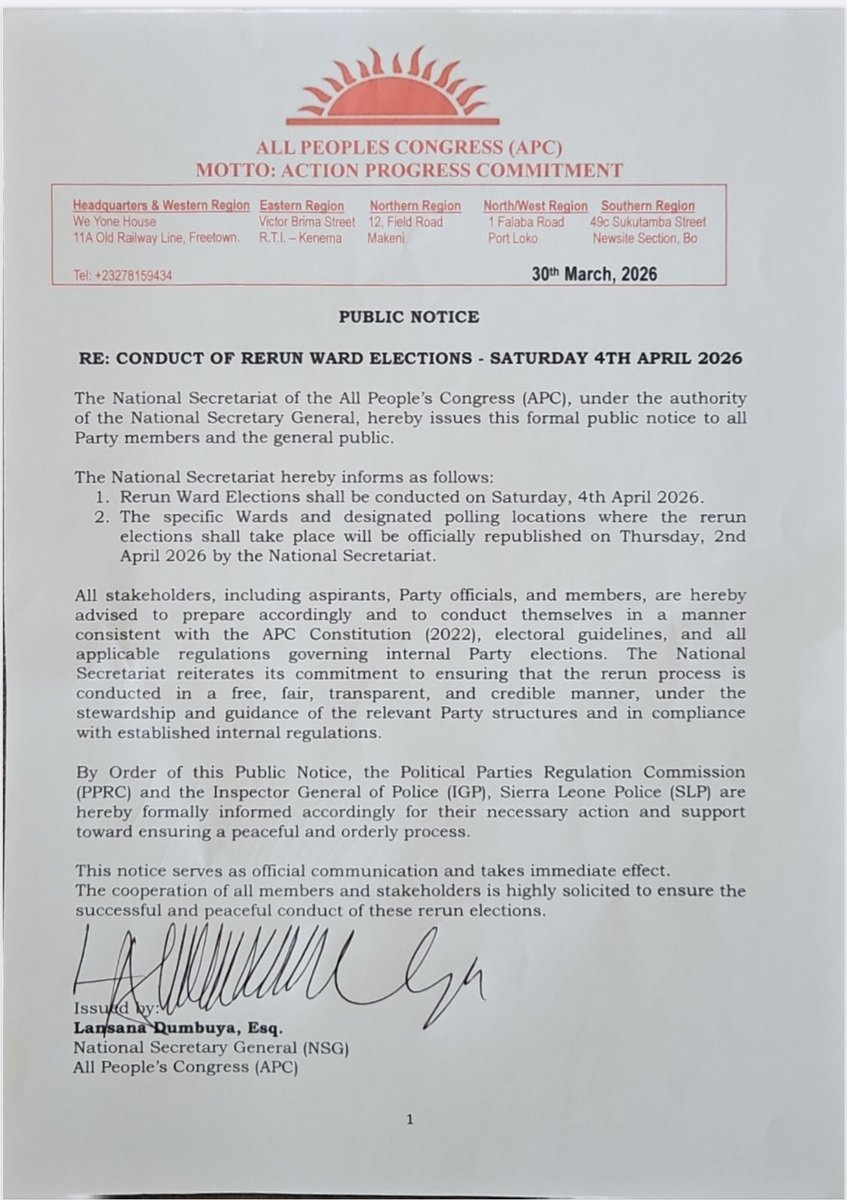
In a public notice issued by its National Secretariat on March 30, the party fixed Saturday, April 4, 2026, for the conduct of the rerun elections, describing the exercise as a necessary step to safeguard internal democracy and restore confidence among its members.
Signed by the National Secretary General, Lansana Dumbuya, the notice stated that the elections would hold in designated wards, with detailed polling locations to be republished ahead of the exercise. The directive, which takes immediate effect, also called on all stakeholders to adhere strictly to party guidelines and conduct themselves in line with established regulations.
However, beneath the routine language of electoral procedure lies a deeper story of internal strain, contested legitimacy, and the APC’s ongoing struggle to maintain cohesion ahead of critical political milestones.
The rerun elections are a direct consequence of the collapse of earlier ward-level polls conducted in March 2026, which were subsequently nullified in several locations after reports of widespread irregularities. The party’s Internal Elections Management Committee moved to cancel results in multiple wards following a post-election assessment that revealed procedural lapses and operational failures that undermined the credibility of the process.
Across key districts, including strongholds in the northern region and parts of the Western Area, the elections were reportedly characterised by logistical breakdowns, disputes among party members, and heightened tensions at polling centres. In some instances, the process was disrupted entirely, while in others, results were rejected amid accusations that the integrity of the exercise had been compromised.

Although the party stopped short of officially declaring the elections fraudulent, accounts from participants and observers pointed to allegations of manipulation, interference, and attempts to influence outcomes in favour of certain interests. These claims, whether substantiated or not, were enough to trigger internal backlash and deepen mistrust among aspirants and grassroots members.
The decision to cancel the affected elections was widely interpreted as an effort by the party leadership to prevent a legitimacy crisis that could spiral into wider factional conflict. By voiding the disputed results, the APC signaled its unwillingness to endorse outcomes that could weaken its internal structure or undermine confidence in its democratic processes.
The April 4 rerun is therefore more than a routine electoral exercise. It represents a test of the party’s ability to correct itself, rebuild trust, and demonstrate a commitment to transparency at a time when internal unity is increasingly critical.
In its notice, the APC emphasised that the rerun elections would be conducted in a free, fair, transparent, and credible manner, under the supervision of relevant party organs. It also urged aspirants, officials, and members to prepare adequately and avoid actions capable of disrupting the process.
The party further called on key national institutions, including the Political Parties Regulation Commission and the Sierra Leone Police, to provide the necessary support to ensure a peaceful and orderly exercise.
Observers note that ward-level elections, though often overlooked, play a crucial role in shaping the party’s grassroots structure and determining the balance of power within its ranks. As such, disputes at this level often reflect deeper political alignments and competing interests that can influence the party’s broader direction.
For many within the APC, the rerun elections present an opportunity to reset the process and address grievances that emerged from the earlier exercise. For others, it is a moment of reckoning that will test whether the party can rise above internal pressures and deliver a process that commands legitimacy across all levels.
As the countdown to April 4 begins, attention will be firmly fixed on how the APC navigates this delicate moment. The success or failure of the rerun elections may not only determine the composition of its grassroots leadership but also shape perceptions of its readiness to manage internal democracy in the face of mounting expectations.
In the end, the exercise is not just about filling positions at the ward level. It is about credibility, control, and the party’s capacity to hold itself accountable in a political environment where trust remains one of its most valuable — and most fragile — assets.