

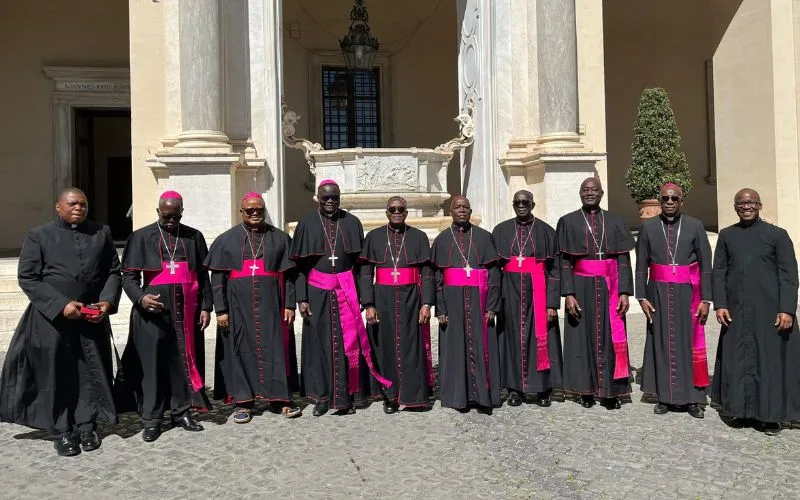
Catholic bishops from The Gambia, Liberia, and Sierra Leone have reaffirmed their commitment to the ongoing process of synodal renewal, describing it as a transformative journey shaping the future of the Church in their respective countries.

The bishops, drawn from the Inter-Territorial Catholic Bishops’ Conference of The Gambia and Sierra Leone and the Catholic Bishops’ Conference of Liberia, made this known during their Ad Limina visit to Rome, which began on March 23 and concluded on March 28 with a closing Mass.
The Ad Limina visit, a longstanding tradition in the Catholic Church, provides an opportunity for diocesan bishops to meet with the Pope, pray at the tombs of Apostles Peter and Paul, and present reports on the pastoral and administrative life of their dioceses.
According to a report published by the Vatican’s Synod office, the bishops confirmed that local churches across the three West African nations are actively implementing guidelines from the final document of the 16th Ordinary General Assembly of the Synod of Bishops held in October 2024.
They described the process of “synodal conversion” as both complex and rewarding, noting that it has deepened participation, dialogue, and shared responsibility within the Church.
Speaking on behalf of the regional bodies, Bishop Charles Allieu Matthew Campbell of the Catholic Diocese of Bo highlighted the impact of synodality across the three countries, emphasising its role in fostering unity, healing, and renewal.

In The Gambia, he noted that synodality has served as a bridge across diversity, helping communities embrace differences while strengthening mutual understanding.
“In our diversity, we find strength; in our listening, we gain understanding; and in our journey together, we encounter Christ,” he said.
Reflecting on Liberia’s experience, the bishop described synodality as a powerful instrument of reconciliation in a nation shaped by a history of conflict and gradual healing.
He explained that the process has reinforced the idea of the Church as a community rooted in mercy and inclusion, where every voice is valued and no one is excluded.
In Sierra Leone, he said, synodality has emerged as a source of spiritual renewal, particularly in the face of social and historical challenges, reaffirming the vitality of the Church through the faith and commitment of its people.
Bishop Campbell further stressed that the synodal process has underscored the importance of listening within the Church, describing it not merely as a method but as a sacred duty that strengthens its mission and identity.
The weeklong visit also featured expanded engagements with various Vatican offices, reflecting a more inclusive approach encouraged in recent years to deepen collaboration between local churches and the central administration of the Catholic Church.
Archbishop Edward Tamba Charles of the Catholic Archdiocese of Freetown noted that the bishops engaged with a wider range of Vatican dicasteries than in previous visits, allowing for more comprehensive discussions on pastoral and administrative issues.
Throughout the visit, the bishops celebrated Mass at key basilicas in Rome, including the Basilica of St John Lateran, regarded as the cathedral of the Pope as Bishop of Rome, and later at Saint Mary Major.
Beyond reflections on progress, the bishops also acknowledged several challenges facing the Church in the region. These include the need for improved formation of priests, religious, and lay faithful, as well as strengthening safeguarding mechanisms for minors and vulnerable individuals.
They also pointed to limited resources affecting pastoral outreach, particularly in remote communities, alongside broader socioeconomic pressures impacting families and young people.
Concerns around transparency, accountability, and trust in Church governance were also raised as areas requiring continued attention.
Despite these challenges, the bishops expressed optimism, affirming their commitment to deeper renewal and transformation.
They emphasised the need for the Church to remain close to the people, listening to their concerns, accompanying them in their daily struggles, and responding to their needs with compassion and purpose.
“Our people seek a Church that is near to thema Church that listens, accompanies, and stands firmly alongside them in their daily struggles,” Bishop Campbell said.
He added that the faith, hope, and perseverance of the people continue to inspire the Church’s mission, reinforcing its resolve to grow stronger in charity and service.
The bishops concluded that the journey of synodal conversion remains ongoing, calling for sustained commitment to building a Church that is more inclusive, accountable, and responsive to the realities of its members across West Africa.